Saturday, November 6, 2010

Best Florida Green Roof Plant?

Green roofs in Florida are harsh places – remember the 7 (or more) H’s:
  1. High Humidity
  2. Hot, hot heat
  3. High desiccating winds (killer)
  4. Hurricanes (not the football team)
  5. Hard Freezes
  6. Horrible temperature swings
  7. Hurtful droughts
  8. Harmful floods
And we all are cautious about irrigating a green roof (I speak as a lawyer – not a botanist here) – our litigious society has already bred a number of legal articles on green building and tort.  Imagine – the issues of:
  • Mold
  • Water damage to interiors
  • Collapse from weight (water is heavy)
  • Bacterial breeding
  • and who knows what else…
So if we choose to acknowledge Florida’s water shortage problem and build a green roof with micro-irrigation or no irrigation at all, then we need to look to plants that:
  1. Can survive the many H’s
  2. Are visually acceptable by the community
  3. May be cost-effective
  4. Are preferably native species (or non-invasive species)
  5. Do not present a fire hazard or contribute too much dry leaf litter
  6. Are low maintenance
  7. Can survive long periods of drought
  8. Can survive twenty inch downpours
  9. Resist fungal infestations
  10. and much more
Two of the most outstanding plants that almost begin to come close to the above requirements are:
1. Frog Fruit (Lippia nodiflora), and
2. Wild Garlic (Allium canadense)
I’ll be posting more data on these two species over the next couple days.  In the meantime – what are your experiences with these species on green roofs?

Green Roof Plant Dwarfed 2 Year Old Allium Canadense


Happy green roofing!   Kevin

Thursday, November 4, 2010

Rooftop Agriculture - Lots of room to grow food in the Urban Core.

Rooftop farming doesn't have to be complicated.

Small simple systems are available for growing vegetables and other food on any roof.

Of course, as with any endeavor there are both benefits and there can be problems.

Problems include the harshness of the roof environment.  Using the well worn phrase - 'The 5 Horrible H's of Florida Roofs';
  • Hurricanes
  • Horrible Heat
  • High Desiccating Winds
  • Humidity
  • Hard Freezes
you quickly learn rooftop garden can be cruel of plants.

However, depending on the time of year, rooftop gardening can be rewarding.  Autumn,  early winter, Spring and early summer offer opportunities for growing crops, especially on cooler roofs such as a white TPO.

Asphalt and asphalt shingles can contain toxins, so always make sure you have a liner (typical pond liner - HDPE or other membrane) between your growing box and the shingles.  The membrane will also protect the roof from roots and dampness.

Rooftop Agriculture - Winter Mix and Garlic Chives


November is a great time of year in Florida to grow rooftop veggies.  Many of the plants enjoy the cooler nights and soak up the sun's warmth during the day.

A good potting mix blend should consist of 1 part peat,  1 part sphagnum moss, 1 part perlite or vermiculite,  and 1 part potting soil.  Place the mixture into a seed starting plug tray, Jiffy Cups or create your own small potting containers our of water, flour and shredded newspapers.  Start your vegetables from seeds and when they are a couple inches tall, place them in your roof growing tray.

I'll soon be posting a list of places you can order roof growing trays.

As always, happy green roofing!

Kevin

Tuesday, November 2, 2010

3 Reasons Why Native Plant Species on Green Roofs Promote Biodiversity in the Urban Core

The green roof industry must take the initiative to start using native plant species on Florida Green Roofs.

To ignore the call of local, state and national environmental and ecological groups calling for a stop to using vast amounts of imported landscape material is rapidly becoming an outmoded business principle.

As green roofs become more and more popular, we as an industry must learn to adapt to using indigenous plant species for a number of reasons.

* Native species are more likely to survive local environmental conditions.
* Native plant species on green roofs attract a greater degree of indigenous wildlife, promoting biodiversity.
* We have all seen what exotic invasive plant species can do to Florida's ecosystems.  Even regular landscape plants have had devestating effects with respect to monoculture activity, and
* Ecology conscious businesses are now demanding native plant species to be used in their green roof and living wall projects.

In the rush to flood the potentially lucrative Green Roof Florida market with all the different types of Green Roof systems and their plants, we must be careful we do not create an ecological problem with imported plants.

Some of the Green Roof plants that thrive in other locations, may - if imported from other states - bring with them diseases, pests and fungi.  Others may be so aggressive with respect to reproduction that they may turn into another Brazilian Pepper or Chinese Tallow.

Stick with Florida Natives on your Green Roof.

Talk to your local chapter of the Florida Native Plant Society - see their website here.

I've uploaded a very interesting paper entitled "Impact of Native Plants on Bird and Butterfly Biodiversity in Suburban Landscapes" to Google Docs for your reference.


Click here for the download.

The Note suggests that a broader range of biodiversity will exist with respect to butterflies, moths and birds when native plants are used in the Urban Core for landscaping instead of common landscape plants.

The importance for the Green Roof Industry is - roof horticulture is non-exempt from good environmental stewardship.

We must all move from exotic and potentially invasive landscape plants and back to those native species that promote biodiversity.


As always, email us with your questions.

Happy Green Roofing!

3 Reasons for a Green Roof Alternative - Roof Based Vegetated Air Intake Tunnel

The roof-based vegetated air intake tunnel keeps a building roof vegetated and provides additional benefits, including;

1.  Cools intake air
2.  Shades the roof
3.  Removes airborne toxins, and more!

MetroVerde Intake Tunnel Alternative to Green Roof 


Additional benefits allow for reducing heat island effect, providing shade, cleaning stormwater, wildlife habitat and much more.

The MetroVerde Vegetated Air Intake Tunnel is a Green Roof expanded 3D!

Always exploring opportunities to bring volumetric green to the Urban Core!

As always, email us with your ideas and questions.

Happy Green Roofing,

Kevin

Green Roof Plants in the Urban Core - Nature's Best Air Filter

Newton, the Ask a Scientist, Scientist - available for consultation from the U.S. Government - click here for Newton's Website... -

...says 53 Liters is the amount of pure Oxygen the average adult needs to survive every hour.  53 liters is approximately 14 gallons.

You can see we use alot of oxygen on a regular basis.  Now picture your bedroom and night or your office during the day.  For estimation purposes we will use an office space of about 5,000 SF with a 9' ceiling and containing 24 employees.  The Office contains  336,600 gallons of atmosphere.

Green Roof Plants filter toxins and produce oxygen


According to Newton the air we breathe contains about 21% oxygen so the office will contain 70,686 gallons of oxygen.  Is this enough to last the 24 employees for a day?  Let's find out.

Each employee breathes 14 gallons of pure oxygen per hour - more if they are active but most office workers are sedentary - so each employee breathes in120 gallons per shift and the office as a whole breathes in 2,880 gallons of oxygen per shift.

OK - that's plenty of oxygen to start, but within a month without the doors and windows being opened the employees will rapidly use up all the oxygen.  How old is your office?  How old is your house?  When is the last time you've flushed the air in your office or house?

Just think, without the windows being open, you are breathing stale air - air already breathed in many times over by others in your office or house.  This air contains not only stale exhale of others (and suspended germs) but volatile toxins off-gassing from carpet, furniture, paint and other manufactured goods in the office or house.

And the unfortunate part of the whole equation is - we keep our windows shut most of the time.

However, there is a solution - plants!  Plants produce oxygen as a by-product of photosynthesis.  Your personal oxygen machine is as readily available to you as setting a plant on your desk.

I suspect all employees would be happier if air intakes for HVAC systems (most residential systems are closed loop systems) were covered with vines and pumped full of oxygen.

Moreover, plants are extremely efficient at removing toxins from the off-gassing process.

Green roofs and living walls are a key component to filling our sometimes stale Urban Core with fresh oxygen.  Imagine buildings downtown covered in plants and those plants pumping out oxygen daily.

Restoring volumetric green to the Urban Core.

Green Roofs are the key to healthy cities.

Happy Green Roofing!

Kevin

Monday, November 1, 2010

Green Roof Design Mini-Course - Free from Dave Hillary!

Reminder - Dave Hillary is still offering a free Green Roof Design Course - check it out by clicking here!

Happy Green Roofing!

Kevin....

Florida Green Roof Attachment Design

Many arrangements exist for Green Roof attachment to underlying finished roofing or decking.

Photos below depict mat attachment to asphalt shingles, TPO, built-up asphalt, roll asphalt and PVC roofing material.

Our philosophy about about vertical penetrations through roofing material is straight forward for Florida roofs - 'don't do it unless absolutely necessary'.

Green Roof System Arrangements - Field Trial Panels of Varying Materials


Florida's brutal heat, humidity and environment will continually attack roof attachment mechanisms.  The fewer vertical attachment mechanisms, the less the possibility for leaks.

There are many roofing adhesives on the market.  One significant factor we consider is a low VOC content and low carbon footprint.  On the other hand we expect the adhesive to work.

Our trial panels are made up of different materials and different systems.

Once planted, the panels are placed up on the roof for at least twelve months.  Some adhesives work, others do not.   Some adhesives work with different underlying roofing materials, others preform better with another roofing material.  Varying the combination of roofing material, root barrier, adhesive, mat and other components all for performance data to be collected on the different systems.

Developing a solid understanding of system materials is crucial for a successful Florida Green Roof!

As always - email us with your questions.

Happy Green Roofing - Kevin!

Saturday, October 30, 2010

Photos of What Hurricane Force Winds (120 MPH) Do To a Green Roof Plant

The photos included here are from wind uplift testing yesterday at UF. Notice the moderate damage to the plant leaf epidermis and underlying palisade layer (dessication).

Observations and photos of recovery will be posted over the next couple months to see how quickly the plants heal from the damage and regrow.

Not only do the plants suffer dessication and structural damage from 120 MPH winds, but the leaves and stems are bombarded with high speed grit from dust and the roofs soil itself.

The woven mat provides significant support to the root system and stem and in my opinion is the reason the plants did not fly off the roof immediately.

Green Roof Plant Before Hurricane Testing


Green Roof Plant after 120 MPH winds for 3 minutes


We are analyzing what the test results and observations and will be providing additional comments.

More soon!

Happy green roofing and as always - email me with our questions.

Friday, October 29, 2010

Green Roof Hurricane Uplift Testing 120 MPH for 3 Long Minutes

We started off today referring to the Green Roof Wind Uplift Test duration as "until failure".

At least it looked as though the test would proceed until the mat failed.

After all, the MetroVerde Green Roof had been sitting in the hot Florida sun, non-irrigated, 1" thick layer of engineered soil for 18 months at the University of Florida.

We are going into our fifth week of zero precipitation (no rain).

The plants looked brown.

The panel was fixed at a 3/12 slope just feet away from the large hurricane simulator.

The plants looked vulnerable.  The engineered soil just waiting to be blown off the mat along with plants.

The large diesel engines fired up and the turbines spun.

50 MPH for one minute - a little dust blew off the roof.

70 MPH for a minute plus - not much happened.

90 MPH and the dust around the base of the testing platform flew and the plants bent backwards - almost parallel to the roof slope.  Shingles on a shed 300' away began flapping.

We were all amazed, having seen other green roofs under hurricane tests blow away, soil and plants...

We took a break and looked at the panel.  A small amount of the engineered soil had blown off the mat.

The 120 MPH for over three minutes.

The dead, brown material blew off the plants - like a good pruning.  Even the large, tender Echeveria was still there, albeit leaning a little.

The nodding garlic - Allium canadense was beautiful.

The plant roots were so intertwined in the mat that 80% of the engineered soil remained.

Successful.  The first Florida Designed Green Roof Panel to pass the 120 MPH wind uplift test.


Lots learned -

Will be working with UF more in the future!

Enjoy the video - I'll post the link as soon as YouTube finishes processing it - in the meantime here are a couple pics and happy Green Roofing!

MetroVerde Green Roof Passes 120 MPH Hurricane Testing
120 MPH Winds on Green Roof - Hurricane Testing

Thursday, October 28, 2010

Green Roofs and Hurricanes - Miami Dade Uplift Testing Issues - Sustainable Green Roofs

Welcome Back!  I've been busy putting my thoughts down on Tom Cooper's comments.  We addressed the first couple - about Sustainability and Irrigation in the last post and I thought I could whip out an answer to his Miami-Dade Uplift Requirement comment.  However as I started writing I quickly realized I am a Green Roof Systems Expert and not a Roofing Expert or not even a licensed roofer.

I always work with a licensed roofer on the install.  I've said it before and I'll quickly say it again - as a lawyer by graduate education I am always 'Tort Aware'!  Florida law is very specific about roofing requirements and contractors and who can do what.  Research the law and code requirements and your life will always be easier.


So I called Robert Solomon.  I've known Robert for quite some time now - he is the go to guy if you have a question about sustainable roofs in Florida (the non-vegetated type - white TPO et al).  Robert is all for breaking our dependence on foreign oil - and doing so quickly by eliminating asphalt roof use and design.

Robert writes a blog called Wiki Roof and can I ever say it is enlightening.  He has served multiple times on the Florida Governor's Green and Sustainable School Competition Judging Board and well I could go on but won't.

So feeling a little uncomfortable about commenting on roofing issues that impact green roofing but are actually more of a roofing issue, I emailed Mr. Solomon and asked him to think about Tom Cooper's comments and offer his advice.

Mr. Solomon graciously agreed, even though he is a busy person.  Thanks Robert!

My thoughts in this post article are in black, Tom Cooper's questions and comments are in red, and Mr. Solomon's comments are in dark blue.

Again, Mr. Cooper is CEO of Green Roof Solutions, Inc. in Chicago

Robert's Blog Wiki Roof is a must Read - click here for the blog in a new window - but finish this post first.

OK - Tom's question -

I do have a question for you. How do you propose the State of Florida address codes for the:

1.) Components of green roofing under wind uplift requires such as those for Dade County?

My comment first - then Robert's thoughts.  Two things enter my mind when I think of tropical winds and vegetated roofs.

First a quick background.  I grew up in Hialeah (great black beans, yellow rice and yucca) and we had several direct hits from hurricanes in the 1960's.  I've seen cars turned over, huge trees ripped out of the ground, our above ground kids pool lifted up out of our backyard and dumped in the neighbors and more.  Dad boarded up all the windows with plywood but as a child I still remember the wind sounding like a train roaring across the top of our roof.  

So I am biased.  But if a hurricane can pick up a car and flip it, then a hurricane can pick up anything loose on a roof and send it missile like through the air.  That is why I would never plant a tree on a roof in Florida or put a birdbath on a roof in Florida.

But for those who have never directly experienced the terror of unleashed 120 mph winds, I suggest the State of Florida and Miami Dade uplift codes are there for a purpose.  That purpose is to make sure anything manufactured for a roof - that could become a projectile someday - stay on the roof.

As a tort aware lawyer I also suggest that any product placed on a roof without Miami Dade approval or State of Florida approval would be good reason for a lawsuit if that product ends up damaging the fenestration of something else on or in an adjacent structure.

My thoughts are - I get really aggravated with the process but it is there for a purpose, and should include all green roof materials.

Now for Robert's thoughts... 

The actual "ROOF" , or waterproofing element, is accepted by Miami-Dade in many applications.  The most reasonable, cost effective, and environmentally acceptable material for vegetative roof systems is without question, Thermoplastic Polyolefin (TPO), as it contains no oil, no plasticizers, and would not contribute additional nitrogen or phosphorous into water supplies.

I suggest a major manufacturer (Firestone, GAF, Carlisle, Manville, etc.) that is distributed by local supply houses, and stay away from "boutique" manufacturers.  In this way, material is readily available, and you will not find yourself in a "proprietary" scenario that eliminates competition, and drastically increases cost.

For the sake of illustration, I will choose Firestone as our representative manufacturer, and a few Miami-Dade approvals over various roof deck types.  Structural issues regarding design load will greatly impact your options.  Of course, structural concrete, or post tensioned concrete will be your safest route.

target=new* Miami Dade Building Code General Roof

Miami Dade Concrete Deck NOA Requirements Click Here

Miami Dade Wooden Deck NOA Requirements Click Here

Miami Dade Steel Deck NOA Requirements Click Here

FM-I90 wind uplift, and in some cases FM-120 can be achieved.


2.) DO we design part of the roof to blow off as typical landscaping would?  

My thoughts - No.  Under maximum wind load the plants and soils will probably be blown off.  However all other system components must be designed to stay on the roof per code.  Again - I speak from a tort perspective.  I can't imagine having to defend a negligence lawsuit where loose trays or pavers were laid just on the roof.  Not that it is not being done - I just can't imagine defending a client who has designed or installed a part of the roof to blow off in a negligence case - and I can't imagine an insurance company providing product liability insurance for such a system (although I am sure they are out there).

However, plants and soil will probably come off and there is no cost-effective way to completely prevent this.

Whereas Robert says...

NO.  Assuming we are discussing the actual "roof" or waterproofing element.  In this case, TPO, or even liquid applied coating/mesh systems (this can be very humbling if you are not infinitely knowledgeable regarding coatings and reinforcement).  I would far prefer the actual roofing membrane system (TPO).  There are cases when "fully adhered" will be best, and of course, we would use low VOC approved adhesives supplied by the membrane manufacturer.

3.) Yet fix all retention articles to the structure such as edging. 

Robert suggests -

Sheet metal components are no different with vegetative systems, than they are with standard systems, but they must meet the ANSI/SPRI ES-1 Wind Design Standard.  This would include perimeter edge (drip edge), parapet wall coping, gutters, etc.

 My thoughts are - 

In Florida I don't like vertical penetrations through a roof because sooner or later, in under the harsh conditions here, a leak may develop.

But there is the code issue and I agree with Robert - the roof's retention articles should be secure enough to meet code - it would be grossly negligent to, here in Florida or anywhere a tropical storm could impact a green roof, not secure any component of a green roof per uplift requirements.

Soil and Plants are the exception.  I'd note that all soils must be given design consideration to ensure the particles are not gravel like or large enough to harm or do damage.  Plants the same way.  Though highly unlikely, a thorny blackberry brier grown on a roof as a green roof plant would expose the installer to liability for negligence if ripped off the roof in a storm and injured someone below.

4.) Ballast pavers for patios and perhaps root barriers?

 Robert's insight -  (And I'll take the liberty here to suggest Tom's reference to ballast is different than Robert's idea of ballast (( a roofer considers ballast to be gravel or stones placed over asphalt to hold down the asphalt)).  Ballast can be lifted off a roof like shotgun pellets during a hurricane.

Robert - 

I'm somewhat confused why you would require ballast.  The ballast itself can become airborne with devastating results.  It would seem to me that root barriers, or mats, would always be incorporated, regardless of deck type.

I agree with Robert - all components of a vegetated roofing system in Florida must be secured, including the root barrier, mats, trays, etc...

Lots of issues here - for instance you could glue the components down - but what about VOC's?

Cost shoots up with more attachment requirements - but what about good old American Ingenuity?

Would enjoy this discussion.

More of Robert's insight (I paid him to flatter me...)

Height, width, and length of the structure are (of course) determining factors when designing roof systems.  I can easily illustrate, or design a  proper "roof" system, and keep the structure watertight.  But since Mr. Songer is pioneering the attachment of vegetative systems, cannot say with absolute certainty, how the root barrier or mat (hopefully, retaining the root system) would be fastened.

Keeping in mind, our primary roof deck type to be structural concrete, and the wind uplift characteristics of the mat and root barrier would be our most critical component.  Please keep in mind the roof meets wind uplift requirement, thus creating a foundation for additional components (and water) , which affect live load.  A moment ago, I spoke to Firestone, and they will be more than happy to assist in computations and design, which I feel to be a fine gesture on their part.  Always keeping in mind, Firestone is the "Guarantor", and vegetative assembly must be acceptable to them.

I can make these claims, as I am a state certified roofing contractor, licensed roofing consultant, environmentalist, and spent 37 years in the roofing discipline at the highest level.

I hope my comments have at least been marginally informative, and would be very pleased if I've somehow advanced the topic.  

My final, wrap up comments.

I am genuinely suspicious of regulators.  I think the market should ultimately and can regulate itself. 

However having witnessed the brute strength of hurricane force winds time again, I would probably have to say that Miami Dade's requirements have a good measure of validity.  But that having been said, a regulation should never be accepted carte blanche!

Again, with American Ingenuity we can develop systems that satisfy the intent of regulations.  Take for example parapet walls.  There is considerable recent research showing how certain height parapet walls can reduce wind uplift by magnitudes.

So maybe one answer to avoiding permanent attachment of green roof system components is a parapet wall sufficient to protect.  I'm sure with time this possibility will be researched, tested and utilized.

Another facet to consider is the turbulence green roof plants can cause the over blowing wind, decreasing uplift shear.  I've witnessed this phenomena personally during Tropical Storm Fay.  Wind gusts would grab at shingles but the irregular surface of the plants seemed to break the lift vacuum.  I'm sure more research will tell us if textures can break uplift.

We are an evolving industry nation-wide but especially here in Florida!  I always refer to the 5 H's - High Heat (140 F leaf surface temperature on a regular basis), High Humidity (that afternoon sprinkle turns to steam like a pressure cooker), Hard Freezes and Frosts, Hurricanes, Hard Desiccating Winds and more....  Solutions are being developed daily.

It is interest and comments like those Tom Cooper has set forth that will help us make the green roof industry in Florida profitable and effective.

Tom - we'd love to hear your thoughts and comments.

Happy Green Roofing!  

As always - email us with your questions. kevin@metroverde.com


Tuesday, October 26, 2010

Green Roof Design - Miami Dade Hurricane Uplift and Irrigation Issues

 Tom Cooper, CEO of Green Roof Solutions, Inc. in Chicago left a comment on a recent post, bringing up several important points.
"We are based in Chicago and agree that irrigated green roofing is not the path to true sustainable construction."
 The Green Roof Industry must move to sustainability.  We as a industry many times 'greenwash' our services and products.  There is nothing worse than a hypocrite.

 Fortunately the living wall industry and green roof business has many sustainable benefits - those we talk about daily here - see the post on plants (green roof plants included) removing cancer causing VOCs out of the air.   Moreover Green Roofs and Living Walls may be the key to Urban Core survival of the green Florida Anole by replacing lost habitat - see a very interesting post and video of the Anole here.  Cleaning stormwater, creating beauty, sequestering carbon, producing oxygen and other positive, eco-centered green roof attributes abound.

I was reading a powerful and inspirational article this morning on MSNBC.com, entitled  "Departing Microsoft visionary sees 'post-PC' world." The message made me think about what we are doing today - and are we looking to the future or caught up in justifying the not-to-efficient present day method of doing green roofs.


Reminiscent of the over-inflated housing market of several years back, I see some of the approaches to green roofing as dangerously similar.


We can all pretend there is plenty of water to go around (as we do with petrol and gasoline) or we can Vision the Future of Green Roofs.  Those who Vision the Future of Green Roofs will lead the way.


Water shortages are catching up with us even now.  Here in Jacksonville we are allowed to water twice weekly and across America we are using up to 50% of our residential water usage for landscape irrigation.  Georgia, Alabama and Florida have recently been involved in bitter legal battles over water supplies.


From a prudent, common-sense point of view, negligence responsibility for adding irrigation to a roof could possible be very expensive if leaks were to develop - even under the best of contract language (I thoroughly enjoyed 'Torts' class in law school and am always 'tort aware' when working with Green Roofs).   In fact, if I were an insurance company I'd want a big fee and strong assurances from the roofer, architect, engineer and more - because a good attorney would be all over the green roof company if irrigation were specified and a leak/mold/damage developed.


I'm sure good water-proof designs are possible but at what cost?  Are we building a 56 Chevy when visioning (considering both cost and sustainability) demands otherwise?


Visioning Green Roofs as Sustainable with nature-irrigated native species is the future.  The industry will be there sooner than later.  Those who lead they way will win the economic prize.

 
"The sedum perennial growers have distorted the market for green roofing by selling 100% cover in modular systems. This type of performance is both rare and unattainable in the long term without irrigation."

 Native Plant species must replace monoculture systems.  Relying on one genus of plants for Green Roofs may cause massive diebacks in the event of a species selective blight or infestation.  My grandmother understood this basic gardening concept - never plant too much of one variety or it may all soon die.


We must watch what plants we put on a roof - See the post from this morning about Exotic Invasive Species.

Good Visioning of the Future for Green Roofs dictates caution about using plants capable of causing native habitat damage. Seeds spread easily.   


Sustainability calls for locale-friendly plant species, preferably native plants.


Interesting articles abound on the varieties of available Green Roof plants.  Sedums have there place however it may not be in Florida or other hot humid areas.  Southern Blight is blight is a big problem for sedums in Florida - due to the hot humid climate, the fungus, Sclerotium rolfsii, may take large, beautiful carpets of sedums on a green roof installed during cooler months and turn them to black, ugly mush during the month of July (if not sooner).  See the post of Southern Blight.

Finally, most sedums generally have very little strength in their roots when compared to other possible green roof plants.  This factor does not bode well for tropical storm situations.

Selecting the right Green Roof plant is important.  Flammability (Volatile oil content), leaf litter, invasive characteristics, drought tolerance and disease resilience, habitat value and beauty are but a few of the factors to be considered.

Monocultures of sedums on roofs in Florida are the result of a lack of Visioning and like the 56 Chevy, wouldn't be sustainable.

"I do have a question for you. How do you propose the State of Florida address codes for the components of green roofing under wind uplift requires such as those for Dade County? DO we design part of the roof to blow off as typical landscaping would yet fix all retention articles to the structure such as edging, ballast pavers for patios and perhaps root barriers?"

Tom - We'll add our thoughts to this next all important question in tomorrow's post.

Love to hear your comments too.

The more we discuss, the more we Vision!

Happy Green Roofing!

As always, feel free to email us here.

Kevin

Preventing Green Roofs and Green Roof Plants from Becoming Vectors of Exotic Invasives Species

Green Roofs provide many benefits.  We have mentioned many of the positive facets of green roofs in past blogs, in presentations and in our passion to see Green Roofs become a part of every sustainable and green project.

Our motto - "Restoring Volumetric Green to the Urban Core'" reflects our beliefs plants need to be in our homes, buildings and cities.  Green Roofs and Living Walls clean stormwater, provide wildlife with habitat, they create a sense of place for people, sequester carbon, uptake CO2, pump oxygen into our atmosphere, remove pollutants, prevent and cure cancers, provide food and the list goes on and on.

Plants are living organisms with many purposes!  They eat sunshine and convert the sun's energy into a host of benefits for our world.

These are some of the reasons we love Green Roofs and Living Walls.

With passion comes responsibility too.  As a certified arborist I hear the phrase - 'Right Tree, Right Place' and 'Right Plant, Right Place' many times a week.

The same slogan should hold true for Green Roofs and Living Walls.  In our rush to install volumetric green in the Urban Core we should not forget to remember some plants are considered aggressive and invasive in certain locations.

Florida, for instance has designated certain plant species to be exotic and invasive.  Typically those plant species are so aggressive they out compete native species - and can form monoculture stands.  For more information on Florida's Exotic and Invasive Plants click here.

I am working with a University here on installing a small green roof and a series of living walls and the University Botanist and Natural Area curator expressed concern about the selection of species to be used on both the roof and walls.

The University policy specifies using only native species or Florida Friendly Species that are not aggressive.  This holds especially true when working near the conservation and natural areas on the campus.

Seed source potential was another question addressed.

Green roof plants with tiny, lightweight seeds will serve as seed sources to surrounding areas with wind and bird dispersal.

Planting a non-native plant on a green roof almost always guarantees the plant will eventually spread into adjacent areas.  Of course the heavier the seed the less likely and slower the spread potential becomes.

It is possible some of the more popular non-native, drought tolerant ground covers could potentially become a nuisance in natural areas.

In our rush to grow green everywhere, let's make sure the plants we are using are compatible with surrounding environments.  Plant selection should always be coordinated with an area conservation botanist to ensure compatibility.

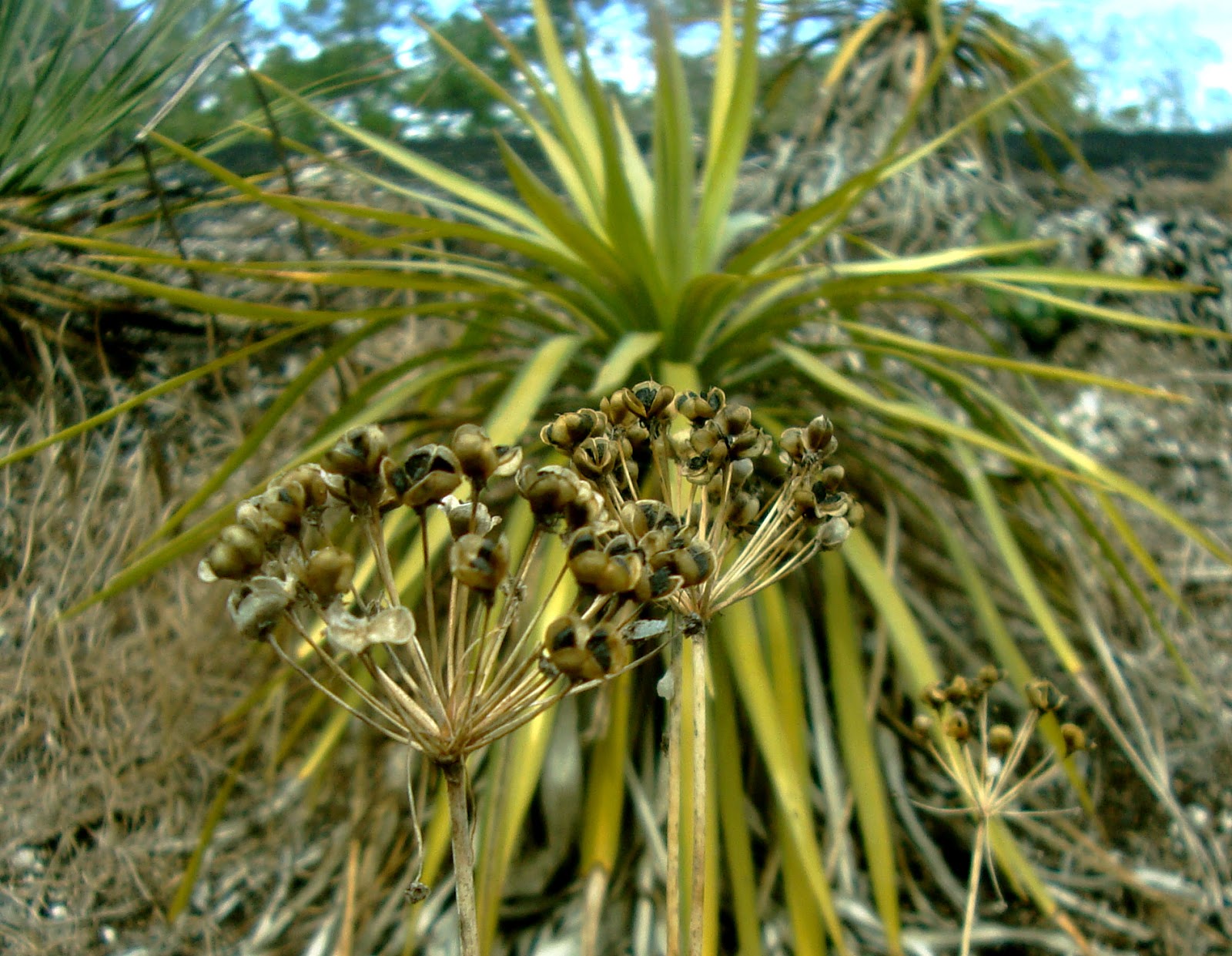
The below photo shows an Allium species on a Florida Green Roof with dried seed ready to drop.   The seeds are large and heavy enough to prevent wind from scattering them about the adjacent areas.  When they do fall from the dried flower stems, they will drop to the green roof and hopefully germinate with spring rains.

Green Roof Seeds - Allium
Choosing native species and non-invasive species is an important part of designing a successful green-roof.

As always - email us with your questions!

Happy Green Roofing!

Kevin

Monday, October 25, 2010

Plants for Green Roofs and Living Walls - Photo Gallery

We are working hard on developing a complete plant list that includes;
  • Plant scientific name and common name
  • Photographs
  • Case histories
  • Requirements
  • Ethnobotanical history
  • Growing requirements and limitations
  • and other important horticultural factors.
Living Wall Plant - Trumpet Vine, Campsis radicans

    The plant list will create a reference database for those plants we find successfully used in and on living walls and green roofs in Florida and the Southeast US.

    For a quick preview of the photo documentation - check out the MetroVerde living wall plant photo gallery by clicking here.

    We will be adding new plants daily, so come back often.

    Happy Green Roofing and as always, feel free to email us with your questions here.

    Kevin

    Sunday, October 24, 2010

    Green Roofs and Living Walls - Defense Against Cancer and Other Diseases!

    Volatile Organic Compounds (VOCs) are chemicals created by industrial pollution and automobile engines among other processes.  VOCs are the primary cause of Urban Smog.  They are also responsible for the formation of cancers, respiratory problems and other serious health issues.

    According to the EPA, the Health Effects of VOCs include:

    Eye, nose, and throat irritation; headaches, loss of coordination, nausea; damage to liver, kidney, and central nervous system. Some organics can cause cancer in animals; some are suspected or known to cause cancer in humans. Key signs or symptoms associated with exposure to VOCs include conjunctival irritation, nose and throat discomfort, headache, allergic skin reaction, dyspnea, declines in serum cholinesterase levels, nausea, emesis, epistaxis, fatigue, dizziness.

    The ability of organic chemicals to cause health effects varies greatly from those that are highly toxic, to those with no known health effect. As with other pollutants, the extent and nature of the health effect will depend on many factors including level of exposure and length of time exposed. Eye and respiratory tract irritation, headaches, dizziness, visual disorders, and memory impairment are among the immediate symptoms that some people have experienced soon after exposure to some organics. At present, not much is known about what health effects occur from the levels of organics usually found in homes. Many organic compounds are known to cause cancer in animals; some are suspected of causing, or are known to cause, cancer in humans. 


    For more health information on VOCs from the EPA click here. 

    According to a new study - one confirming what we already know - plants -  - clean these harmful VOCs out of the air.   Read about the study in a National Science Foundation Article here.

    This study makes it clear that it is especially important to have as many plants inside your building or home as the levels of VOCs inside a structure can be up to ten times the ambient levels outside.

    As we are bombarded with pollutants each day, in our water and in the air - installing interior living walls, exterior vertical green - green roofs and living walls, Urban Permaculture - City Gardens, wildflowers and trees - can pay off with significant benefits.

    Ultimately, we may live longer.  Ultimately, we may beat the odds with cancer or respiratory diseases.

    Restoring Volumetric Green to the Urban Core is critical.  Today, go out and plant a plant.  Bring another inside.  Hang plants from your patio walls and your kitchen window.  Keep plants in your home.  Install a green roof.

    Green roofs and living walls - cleaning stormwater, creating habitat, providing a sense of place and beauty and - importantly - fighting disease by removing pollutants!

    Surround yourself with plants today.  You may breath better and live longer.

    We will be glad to help you with your next living wall or green roof design project!


    Email us here!


    Happy Green Roofing...

    Kevin


    Friday, October 22, 2010

    Bat Houses for Urban Permaculture - Free Fertilizer and Pest Control

    Bat House at University of North Florida
    Bat houses are an excellent choice to add to any Urban Garden.

    Bats are voracious devourers of pesky mosquitoes, gnats and other flying fierceities.

    Guano's reputation for premier fertilizer ranks high among all the organic nitrogen and nutrient choices.

    Bat houses need to be out in open fields.  A bat house nestled in a wooded area may never be used.

    According to the USFWS, a colony of 100 bats can eat over 2,200 pounds of insects during a smmer feeding season - and make alot of good fertilizer!


    Click here for a link to 22 Free Bat House Designs and

    Happy Urban Gardening!

    Kevin

    Thursday, October 21, 2010

    Green Roofs, Green Walls, Frost and Pseudomonas

    Green Roofs behave differently in the cold seasons here in Florida and the Southeastern U.S..  Because cold weather will be here soon, I am re-posting an article from two years ago (December 2008) about bacteria, green roof plants and frost.  Enjoy!.........   Also - Check out the follow-up Pseudomonas blog post here.

    In general, plants used in exterior living walls appear to be more resilient to cold than those flat on the ground. Dismantling one of my oldest walls last night, I was amazed to see one of the cactus plants, Disocactus flagelliformis, not only survive the cold but thrive. Amazingly, most of the literature on the web specifies a minimum temperature of 50 degrees F and clearly warns against frost exposure. Last year we experienced several nights in the low twenties. However the cactus keeps on growing.

    With my curiosity peaked, I researched frost, cold and plants on Google trying to sort through the thermodynamics of air movement, heat and cold transfer and the five different types of frost. It seems that as the ground layer of air cools, the warm air rises. So the vertical positioned plants on the wall could actually be several degrees warmer than those plants on the ground. There are several interesting stories of how orange grove owners use helicopters to keep warm air blown back down into orchards in California on occasional nights with freezing temperatures or where frost may become a threat.

    Additionally and to my surprise I read where many plants on the ground support epiphytc bacteria growth of Pseudomonas bacteria, a gram negative bacteria that also acts as an ice nucelator. From the available literature it seems that the presence of ice-positive Pseudomonas can actually cause ice/frost to form on the plant surface. Frost damages the epithelial layer, in many instances killing the plant.

    There is a ice-minus strain of Pseudomonas also, a mutant bacteria that also occurs naturally that does not possess the ice formation encouraging mechanism that its non-mutant sibling possesses.

    Leave it to capitalism to go figure out how to profit on these two types of bacteria. SnoMax - made by Johnson Controls - see SnoMax's website, is a product made from the ice-plus variety and is used for making snow! On the other hand, FrostBan - see article - creates a crop resilient to frost. FrostBan was the subject of many GMO battles during the 1980's and early 1990's.

    I don't have the testing equipment to see if my Disocactus cactus had the ice-minus Pseudomonas, or if the plant growing vertically with excellent air flow had just avoided the dispersal of common Pseudomonas.

    But the fact that it survives the cold and continues to grow on the wall is another piece in the green roof and green wall plant database we are all developing.

    Amazing stuff.

    Happy green roofing!

    Green Roofs, Florida and Hurricane Wind Force Testing

    Green roofs in Florida must be designed to withstand tropical storms and hurricane force winds.

    Hurricane winds speeds can easily reach 130 mph.

    Loose edges or other exposed corners, trays on a Florida green roof can be grabbed by the winds and flung across and off the building.

    The photo below depicts the hurricane simulator at the University of Florida.  The system will be conducting a hurricane simulation test on a MetroVerde green roof panel.

    Hurricane Simulator at UF - Testing MetroVerde Green Roof Panel


    The tested panel is a mat based system.

    We will be posting results soon.

    As always, feel free to email us with your Green Roof or Green Roof Design questions.

    Happy Green Roofing!

    Kevin.

    Tuesday, October 19, 2010

    Nature Irrigated Green Roofs and Dew Catchers

    Green Roof irrigation, dew and alternative irrigation has been the topic of the last several posts.

    And I have come to a realization today.  I've been referring to green roofs designed as fully sustainable units requiring zero mankind provided irrigation as 'non-irrigated' green roofs.

    Studying the dew catchers opened my eyes to the proper term for green roofs that do not have additional mankind provided irrigation.

    'Nature irrigated green roofs' is the proper term.

    Today I want to share a photo of a very effective, cheap to make and made from 100% post consumer recycled materials - Dew Catcher.

    Yes, this simple dew catcher is highly effective.


    A system of these dew catchers for a green roof or even an Urban Permaculture garden somewhere could save thousands and thousands of gallons of potable water from being used as irrigation water.

    15 milliliters of water was collected from the dew catcher shown below on October 18th, 2010 at 8:00 am.

    The dew catcher was placed on a piece of plastic wrap and set on a western exposure roof.

    20 milliliters does not sound like much at first glance.  However by placing 100 of the dew catchers (no cost - only your time and effort) you would collect approximately 2000 milliliters per morning.

    2000 milliliters is equivalent to approximately 1/2 gallon, so you ask - 1/2 gallon - so what?

    If you place one dew catcher per square foot then a ten thousand square foot roof would harvest approximately 50 gallons of water every morning where the dew point is sufficient for harvesting.

    As we mentioned in earlier blogs, cooler months facilitate the formation of dew.  Here in north Florida, as well as in many other world locations, cooler months are also the months where precipitation amounts are significantly reduced.

    So just when the green roof needs additional water the most, nature provides dew.

    50 gallons of irrigation water saved over hundreds of thousands of square feet of green roofs and gardens adds up to alot of water saved.  Stewardship.

    And possibly the key to understanding the proper design of a self-sustaining Nature Irrigated Green Roof.

    So here is the photo.

    Urban Permaculture Dew Catcher - Irrigation for Green Roofs
    Basic design is the top cut off of a plastic water bottle and slit down the side.

    Arguments the unstable plastic will photo-degrade and leach plastics into the roof are probably valid, however there are plenty of other UV stabilized PPE's that would work just as well.

    Recycled glass is another option as well as certain fabrics.

    The important issue to remember though is that with a little ingenuity we can harvest air laden humidity and create sustainable irrigation systems if we choose.

    50 gallons per day on a 10,000 SF roof offers 15,000 gallons per year potential.

    Dew Catchers - Nature Irrigated Green Roofs!

    As always, Email us with your questions here.

    Happy Green Roofing!

    Kevin

    Exporting Urban Permaculture Technology as a Mission

    Check out Echo Gardens in Ft. Myers, Florida.

    ECHO - http://www.echonet.org/

    You can view their website by clicking above.

    ECHO stands for Educational Concerns for Hunger Organizations

    When visiting or traveling through the Ft. Myers area, a visit to Echo is a must.

    Well System at Echo
    Growing Vegetables at Echo Inc in Ft. Myers
    Urban Permaculture at its finest!

    Green Roof Irrigation and Dew Catchers - 5 Important Factors

    Irrigation provided by nature exists and understanding how dew works can make the  Florida (or Arid Locale) Green Roof successful.

    Here in North Florida we are in the middle of an on-going three and a half week drought with no rain in sight.

    You put water in the birdbath and the water has evaporated by the middle of the day.

    Our Urban Permaculture Garden is growing just fine but craves water.

    We are abiding by the watering restrictions we have in place here set by the St. Johns River Water Management District.

    Yet look at the following photo my daughter took early in the morning!  There was water everywhere, especially on the green roof plants!

    Irrigating Green Roof Plants - Dew Catchers

    The amount of available water for plants is truly amazing.

    We have noticed several interesting factors:

    1. Dew occurs early in the morning - before the sun gets too hot and evaporation occurs
    2. Early morning dew allows more water to be adsorbed by the plants.
    3. Waxy plant leaves - those typically found on recommended green roof plants - encourage the condensed dew to roll off the leaves into the root area soil.
    4. Many plant leaves seem to possess a natural form that directs dew to the middle of the leaf, down the stem and onto the root area.
    5. Dew seems to be most prevelant during dryer, cooler periods - and those factors correspond exactly with our dry season.
    6. The amount of dew is significant, as much as drip irrigation may produce.

    So Mother Nature is offering up alternative irrigation means.

    And we here in Florida and across the world have a water supply crisis.

    Again, I ask - why are we irrigating Green Roofs with costly potable water that truly has a high carbon footprint?

    When Mother Nature offers irrigation up for free.

    Over the next couple of days I want to discuss dew catcher design and nutrients found in both dew and rainwater.

    Happy Green Roofing!

    As always - email me with your questions and dont forget to check out Dave Hillary's Free Green Roof Mini-Course.

    Kevin