Tuesday, November 15, 2011

Green Roof & Nature Photography Unparalleled - Ryan Ketterman

I love nature photography, especially Ryan Ketterman's images.  Captivating.  Ryan is setting the standard for world class green roof and nature photography.  Ryan was gracious to forward me green roof, desert and ocean photos.  Today I am posting the green roof & beach shots.   I'll push the desert shots later this week.  Be sure to check out his website here! http://www.kettermanphotography.com/.  .  Ryan's cool time lapse photography clips can bee viewed here .  http://vimeo.com/21849160 and http://vimeo.com/15382956

Enjoy!  Contact Ryan next time you need a great nature photographer!

http://www.kettermanphotography.com/

http://www.kettermanphotography.com/

http://www.kettermanphotography.com/

http://www.kettermanphotography.com/

http://www.kettermanphotography.com/

http://www.kettermanphotography.com/

http://www.kettermanphotography.com/

http://www.kettermanphotography.com/

http://www.kettermanphotography.com/

http://www.kettermanphotography.com/

http://www.kettermanphotography.com/

http://www.kettermanphotography.com/

http://www.kettermanphotography.com/

http://www.kettermanphotography.com/

http://www.kettermanphotography.com/

http://www.kettermanphotography.com/


Saturday, November 12, 2011

Green Roofs & Frost - We had frost in Jacksonville last night!

I think this climate change is kicking into high gear!  I can't remember a frost this early in the season - especially along the Atlantic Ocean but we have on this morning.

Frost on my #green roof heirba buena this am
So with frost comes a host of new green roof issues here in Florida.  Of course you can take the boring way out and just be happy with a dead roof for half of the year.

Or you can use those plants capable of surviving hard freezes and our torrent summers.

I prefer the later - year round green and color.  Costs the same.   Looks much better than brown mushy bah.

One of the issues we learned over the years centered around frost bacteria.  Certain bacteria can cause premature frosts on a roof at higher temperatures and then others can depress frost formation until significantly lower temperatures are reached.

Sounds like cool information for a gren roof designer.  So I'm cutting and pasting here an excerpt from a previous years Pseudomonas post (the thing about SnoMax is too cool!).

Green Roofs behave differently in the cold seasons here in Florida and the Southeastern U.S..  Because cold weather will be here soon, I am re-posting an article from two years ago (December 2008) about bacteria, green roof plants and frost.  Enjoy!.........   Also - Check out the follow-up Pseudomonas blog post here.

In general, plants used in exterior living walls appear to be more resilient to cold than those flat on the ground. Dismantling one of my oldest walls last night, I was amazed to see one of the cactus plants, Disocactus flagelliformis, not only survive the cold but thrive. Amazingly, most of the literature on the web specifies a minimum temperature of 50 degrees F and clearly warns against frost exposure. Last year we experienced several nights in the low twenties. However the cactus keeps on growing.

With my curiosity peaked, I researched frost, cold and plants on Google trying to sort through the thermodynamics of air movement, heat and cold transfer and the five different types of frost. It seems that as the ground layer of air cools, the warm air rises. So the vertical positioned plants on the wall could actually be several degrees warmer than those plants on the ground. There are several interesting stories of how orange grove owners use helicopters to keep warm air blown back down into orchards in California on occasional nights with freezing temperatures or where frost may become a threat.

Additionally and to my surprise I read where many plants on the ground support epiphytc bacteria growth of Pseudomonas bacteria, a gram negative bacteria that also acts as an ice nucelator. From the available literature it seems that the presence of ice-positive Pseudomonas can actually cause ice/frost to form on the plant surface. Frost damages the epithelial layer, in many instances killing the plant.

There is a ice-minus strain of Pseudomonas also, a mutant bacteria that also occurs naturally that does not possess the ice formation encouraging mechanism that its non-mutant sibling possesses.

Leave it to capitalism to go figure out how to profit on these two types of bacteria. SnoMax - made by Johnson Controls - see SnoMax's website, is a product made from the ice-plus variety and is used for making snow! On the other hand, FrostBan - see article - creates a crop resilient to frost. FrostBan was the subject of many GMO battles during the 1980's and early 1990's.

I don't have the testing equipment to see if my Disocactus cactus had the ice-minus Pseudomonas, or if the plant growing vertically with excellent air flow had just avoided the dispersal of common Pseudomonas.

But the fact that it survives the cold and continues to grow on the wall is another piece in the green roof and green wall plant database we are all developing.

Amazing stuff.

Friday, November 11, 2011

Friday's Residential #GreenRoof Photo - Genora's Nature Irrigated Living Roof

Quaint and strikingly beautiful, Genora Crain-Orth's is shown here in the photo my daughter, Jincy took with her Ipod day before yesterday.

Genora's nature irrigated living roof with native plants
The roof is lightweight, actually less than 50mm soil media, irrigated only with available precipitation, dew and water vapor.

Native species were used including Yucca filamentosa and Helianthus debilis.

The bees and butterflies love the roof!

Looking good after a long hot summer.

Thursday, November 10, 2011

Green Roof Plants - choosing between those plants that produce seed and those propagated vegetatively

When choosing plants for green roofs one is always faced with a decision to specify those species with a tendency to bloom and flower then set seed, or on the other hand go with those plants who normally are propagated primarily by vegetated cuttings.

Green Roof plants setting seed in Jacksonville, Florida
 Yet the decision is not a simple one and carries far reaching consequences.  Arguments for and against highlight the many benefits and disadvantages for selecting either approach.  I prefer to integrate in so many plants who reliably produce viable seed for the following reasons discussed below.

November seeds sprouting on a Florida Green Roof
Seed provide variability.  Like a roll of the dice, the many combinations of predictable but also unpredictable color, patterns and texture always provide a surprise waiting once plants set seed and those seed germinate into a new generation.  Because of inherent variability, seeds are generically difficult to remove from the open source system and patent.  Plants propagated via cuttings or asexual reproduction are much easier to protect under intellectual property rights laws and remove from public domain.  So by adding plants who reproduce by seed to your green roof design, you ensure for the time an ongoing, royalty-free plant source season after season.


Green Roof Salvia lyrata and green roof seeds sprouting
Longing for seasonal variability including color hue shifts, texture changes and other plant responses is a fundamental part of humankind's side by side relationship with the plant kingdom.  Plants who do  not rise and fall with nature's cycles seem almost 'plastic' to me.  Granted I use these 'plastic' plants to create central design structure and they serve faithfully providing green and form month in and month out.  But these structure plants are only a backbone.  The skins are the many hundreds of species, genus and families of flowering ephemeral and persistent native wildflowers, grasses and food plants.


Once established, seed producing green roof plants are an economic & ecological benefit

Familiarity with the signs of plant growth teases the senses like aroma from fresh baked bread.  The Salvia lyrata in the above photo for instance is preparing to cover certain areas of the green roof with her wonderful lavender spring flowers, one of the first sights across the roof as winter recedes.

Life is a complexity of changing interactions.  Green roof designers can tap into the interest of nature's spectacular array of surprising variability by using lots of plants who seed and reseed.

Wednesday, November 9, 2011

Nature Irrigated Green Roofs - how much water do you need!

Nature is amazing.  It has not rained for several days here and though we did recently have a little rain we are still far below our normal.  In fact Jacksonville is still classified as officially experiencing severe drought conditions.

National Weather Service Drought Index
Yet nature provides ample water, even in times of drought here in the form of water vapor.  Good green roof design takes advantage of all sources of water, including morning dew.

Nature's irrigation - morning water vapor

I am constantly amazed at just how much water rests on the green roof plants some mornings.

As though an irrigation sprinkler has been turned on across the roof, opportunities exist for the plant designer to use those species capable of condensing (those with fine leaves, hairs or waxy surfaces) to capture the water then direct the droplets to the green roof planting media below.

Working with an international hotel chain to improve their landscape vegetation I was asked to diagnose why a large collection of very big planters were doing so poorly.  A large roof overhang directly above prevented morning water vapor from reaching the plants.  However, only a few feet over and out from under the overhang other planters looked lush.

Fog and morning dew can contribute an important source of nature supplied irrigation.

I make it a regular habit to walk green roofs early, middle of the day and late.  Surprises abound always.  This morning I was amazed at just how much water was on the plants.  Who needs a sprinkler?

Tuesday, November 8, 2011

Green Roofs - many times the last line of defense for water quality

Green and living roofs are so very important to our water quality, sometimes being the last line of defense for removing pollutants before runoff enters our waterways.

Green roofs slow down stormwater, cleaning and sequestering pollutants 
Even small green roofs can provide a significant benefit to reducing peak runoff amounts and reducing loadings on creeks, rivers and ponds.
Blue Hole, Ichetucknee Springs
Once stormwater hits a roof and flows to the street below it may only be a matter of minutes before the water and any contaminants picked up as the volume flows across streets, drives and roads enters Florida's drinking water supply.

Floating wetlands, Gainesville, Florida - greenroof on a pond
Storm drain allows pollutants to enter waterways
Florida has a unique geology across many parts of the state called Karst.  Karst formations are typified by limerock with caves, tunnels and holes throughout the  formation.  Once stormwater runoff enters the limerock above drinking aquifers the flow to the pools of underground water can be very quick.

Many times storm drains are a direct connect to water supply aquifers
Green roofs, living walls, floating wetlands and other best management practices can help keep water clean by slowing the runoff and removing contaminants from the water.

Wekiwa Springs, Florida - higher in nitrogen and algae
 Wekiwa Springs, located just north of Orlando, Florida and shown above is surrounded by houses, streets, roads and commercial development.  Though many good best management practices are in place to contain nutrients and runoff, the springs still suffer from high nutrient contents such as nitrogen and phosphorous.
Salt Springs, Ocala National Forest, not as impacted by development
Salt Springs in the Ocala National Forest on the other hand, though threatened by development, does not have all the septic tanks, stormwater runoff and as you can see, the water is much clearer, contains less nitrogen and other nutrients and is so much more healthy.

Installing a green roof on your commercial or residential building is just one small contribution you can make int he Urban Core to help protect water supplies.

Wednesday, November 2, 2011

Green Roofs and Rooftop Gardens can help defeat Urban Core hunger


We can defeat hunger in the Urban Core - on the roofs, on balconies, in small yards and across patios! Food is so easy to grow in the harshest of places, with little of no soil and even when water supply is limited.  All it takes is a basic understanding of the important factors impacting growth, such as wind, light and available water vapor.

Though permaculture has always addressed simple food growing principles, most of the time this focus has been about ground level growing.

Growing food on walls, roofs, buildings, and shacks up off the ground is important in the crowded urban core, high rises and slums.  Ground level food production is many times impractical in cities because of the lack of open land.  But there are plenty of walls and roofs to grow food on!

We believe educating the young about how to grow 'rooftop gardens is a way to capture their interest, create economic opportunity for them, create habitat, restore ecology and bring peace to the world.

Harvesting Green Roof Seeds, Educating the children
It is really exciting to see students become interested in urban agriculture.

Young children's minds are so fresh and thinking so quickly!  They see opportunities to improve and enhance our green roofs, living walls and rooftop systems.

Offering the next generation hope through empowerment is what we need to be doing every day.  Placing control of their food and water supply into our children's hands is so important.

Making educational videos about rooftop permaculture to teach the children.
It is a path to world peace and freedom from those who may want to try and control other's lives through food and water.

And growing food and recycling water does not have to be expensive or difficult.  This is why education is so important.

But we have a fight ahead of us.  Large corporations see opportunity through control of food, water, seeds and the knowledge of how to grow food and collect water.

The 'I don't have a green thumb and can not grow food' storyline is often repeated and many of the world have come to believe they can't grow sufficient supplies of food in the urban core.

We must show our children the path to breaking reliance from those who would control our lives and souls in exchange for food and water.

A small living wall or rooftop garden can provide enough seeds in a growing season to grow five more gardens the same size the following year.  Seeds are free.

Systems can be designed to cheaply capture and store water and to grow food on even shacks made from rusty tin.

The students harvested a giant luffa sponge from the roof this week.  Organic luffa sponges cost five dollars or more in the store.  The enterprising young person growing luffa gourds across the roof of their inner-city barrio could earn hundreds of dollars each season.

Plants not only provide food but they provide security, shelter and medicine.

I love Lydia Cabrera's quote I use over and over, paraphrased "there are more spirits in the plants than in the sky".

Aloe growing out of walls and on roofs becomes the local doctor's office in many instances.
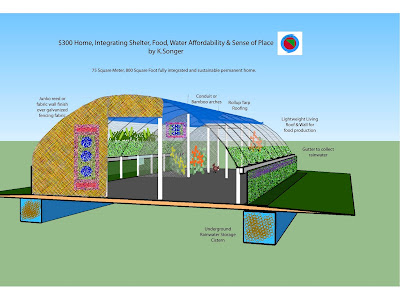
Low cost Barrio-type house with living walls, food roofs & water recycling
Structure walls made from wire with grapes abundantly growing provides fruit, sugar, vine and community opportunities.

Rooftop beans and peas can feed the masses, not only providing daily food but offering up the following years crop of seeds.
Reusing water and controlling flooding

Native wildflowers planted across window openings and on the roofs and walls bring in the pollinators, crucial for food production.  One must have native wildflowers growing side by side with food plants.

Collectively we have found a way to travel to the moon, harvest the atom and talk across the globe.

But this awesome generation has forgotten how to feed themselves.

Now is the time to relearn.  Now is the time to show our children how to break leashes and create freedom.

Give me one month and the seeds I can carry in my pocket, a few wiling youth from the urban core and  the plants of medicine, food, fiber and economy will be growing across the landscape.  It can be done in a desert or a wetland, hurricane or earthquake prone areas.
We've answered the critics who say it can't be done, designed systems withstanding cyclones, created highly productive food systems in 30mm of sand, implemented bee hives on roofs, built water storage systems for practically no cost and are working now on a rooftop chicken system.

Control of your food is the path to freedom and peace.  Reliance on the corporations for food is the path to bondage.

Friday, October 28, 2011

Florida Extensive Green Roof Systems, Green Roof Depth Considerations and Root Architecture

I ran across an interesting article in the American Journal of Botany entitled 

Root deployment and shoot growth for two desert species in response to soil rockiness by Gretchen B. NorthEdward G. Bobich and Park S. Nobel.

The article confirmed interesting data we've been seeing with respect to root formation in coarse and shallow green roof soils.

MetroVerde Green Roof system, shallow, extensive and well-drained

Shallow green roof soils work well for us  we believe, for a number of reasons, including;

1. Except for the rare lengthy, monsoon-like downpours that occur annually and deliver the false impression Florida is more rain forest like than desert, water penetration into green roof soil media is minimal and lengthy periods of drought are frequent.  Therefore growing systems that force shallow root growth also promote stronger rainwater contact for those light drizzles we may experience.

2. Shallow growing systems combined with appropriate soil media enhance root-oxygen contact.  Root-oxygen contact importance has been especially shown as important through agrinomy studies in hydroponics.  Shallow root systems on extensive green roofs allow for increased oxygen uptake leading to significantly more biomass production.

Agaves and Yuccas are some of our standard green roof plants for use here in Florida.  There are two agave species native to Florida (and the Southeastern U.S.) - they are false sisal (Agave decipiens) and wild century plant (Agave neglecta).  Native Yuccas include:  Spanish bayonet (Yucca aloifolia), Adam's needle (Yucca filamentosa), and moundlily yucca (Yucca gloriosa), and curve-leaf yucca, Yucca recurvifolia.

Though the paper looks at Agave deserti and bunchgrass, Pleuraphis rigida, the concepts and conclusions are important.

Observations included:

1.  Water potential was higher in sandy soils than in rocky soils.

2. Agave deserti preferred rocky soils and was absent in pure sandy soils.

3. Root growth was greatest in sandy soils 

4. Agave deserti had twice the biomass and root surface area in sandy soils over rocky soils (example of environmentally induced acclimination)

5. Agave deserti leaf's water potential was the same at rocky and sandy sites but the transpiration rate was twice as high in rocky soils.

Conclusions and assumptions Green Roof Designers can use are:

Certain agaves (and yuccas) growing in well drained soils (rocky instead of sandy) exhibit acclimation characteristics of slowed growth rates and biomass production.  Slow growing plants on the green roof may be  more likely to survive long periods of drought.

Agave root architecture will develop slower and more shallow in rocky soils than in sandy soils.  Again, on an extensive green roof - one with relatively shallow soils - a plant with a shallow root system does better than a plant requiring a deep root system.  Agaves can acclimate to the coarse soils. Again, a shallow root system plant may be preferable over the deep rot system species.  A deep root species may have the tendency to assert agressive root barrier or roofing membrane attack.

Agaves do not want wet feet.  Where there is an over-abundance of moisture (very sandy soils) agaves may not be present.  Keep the green roof well drained.  This concept is in general disagreement with the school of thought that green roofs should serve as stormwater retention volumes or basins in conjunction with cisterns.  We've made the suggestion many times that due to Florida's water crisis, an irrigated green roof may not be considered sustainable - as one third to one half of the year it will end up irrigated with potable (during times of drought).  Within rainy season periods one will being irrigating the roof more frequently to empty the ever filling cistern - thus exposing the agaves, or any slow growing and green roof tolerant plant to 'wet feet' conditions.  Keep your green roof plants in conditions that do not generally comprise long term saturation.

Rocky soils may have a tendency to absorb and capture more dew than sandy soils.  This assumption/conclusion has many important implications for green roof plants water needs.  Because air can flow more easier through rocky soils, the dew has a tendency to penetrate to rockier soils.  Sandy soils may block moisture laden air.

I like to compare the ability of rocky or coarse soils to capture dew to the summer morning wet grass in your front yard.  There will always be more visible dew on the high surface area grass blades than say, on flat concrete.

Capturing all the water  from dew, fog and slight drizzles is important for our approach to green roof design based on non-potable irrigation.

Nature is always the best teacher.

Thursday, October 27, 2011

Ethnobotany for Green Roofs, Achillea millefolium, Yarrow on Florida Green Roofs

Rooftop ethnobotany should be a part of all green and living roofs as plants have given humans food, fiber and medicine throughout the ages.


One of my favorite green roof plants rich in ethnobotanical history is Yarrow.


Green Roof Achillea millefolium, ethnobotanical wonder and living roof beauty


Yarrow is a hardy Northern Hemisphere native wildflower suited for hot, dry green roofs. Yarrow is found growing as a native plant around the world in the northern hemisphere. 

Her Mexican name is plumajilla or ‘little feather’ due to the feathery shape of her leaf.
Important to biodiversity support, many birds (including sparrows) use the soft leaves of the plant to line their nest.  The leaves are quite soft and add a blanket of light green color across the green roof for much of the spring and early summer.  When the blooms began to appear during late May and June the plant sends up shoots, supporting beautiful umbells of flowers. 
Green Roof Achillea millefolium, Breaking Ground Green Roof
Yarrow has a rich ethnobotanical history having been used for centuries as a wound herb, and is famous for the capability to stop bleeding from cuts. The leaves may be used as a spinach like vegetable, cooked or in salads.  The plants has also been used as a flavoring in beer. Yarrow has EO data suggestion insecticidal qualities against common mosquitoes.

MetroVerde Green Roofs supporting biodiversity on many levels, Yarrow


Yarrow can tolerate hot, dry soils with little organic material.  A member of the Asteraceae family the plant is very drought tolerant once established. The flowers add a variety of surprisingly bright color to the green roof as many other flowering plants are seeding out and loosing their color.  The perennial plant usually comes back and flowers reliably, year after year.

During the harvest season when most green roof plants are beginning to wear a tired look from summer's heat and humidity, Yarrow is just beginning to develop a rich, deep rainforest-like green hue.

Shown growing here with Pennywort, Hydrocotyle spp. and Aloe, Yarrow serves as a weed blocking  groundcover worthy of any living roof.

Wednesday, October 26, 2011

Another Florida Green Roof and Sedum Note - Vernalization

I am daily emailed about sedum and Florida Green Roofs.  Today you will find my brief answer to an interesting perspective someone emailed me concerning Florida Green Roofs and Sedum.
Sedum devoured by Southern Blight Fungus

The question was focused on Sedum and vernalization.

Below is my response.


I am certainly the wrong person to ask about success with sedum.  I have tried for years in Florida with zero success.

We now believe the humidity, combined with other environmental factors such as fungi create such hostility towards the plant that she will not grow reliably on roofs here.

Most people in the green roof industry I speak with say they will not try and use sedum below a certain latitude - they typically say that when you are coming south and see the dominant tree canopy change from hardwoods to pine trees.

The sedum I've had the most luck with is the 'Blue Spruce' variety, Sedum reflexum.  Yet this variety of sedum does not thrive and simply 'hangs on' longer than most other varieties.

Because sedum is propagated primarily by cuttings and rootings vernalization is not a survival issue here, in my horticultural opinion.  I see many plants, such as Bradford pear, Pyrus calelryana, for instance grow quite well here - they simply do not flower.

There are two primary suspects, in my opinion that afflict sedum here and prevent the plant from surviving year after year on the roof.  They are:

1. Sclerotium rolfsii aka Southern Blight Fungus (see a post about Southern Blight here), and
2.  Pseudomonas bacteria (another post re Pseudomonas here)

There are many other plants such as Aptenia, Delosperma and others that respond the same way.

One way to avoid the fungus and bacteria is to use sterile soil.  But as soon as a bird drops or wind blows debris onto the roof the Sclerotium establishes residency.

So rather than continue to battle trying to use this non-native plant on roofs here, I find better use of native plants and wildflowers who the local pollinators and wildlife value much more highly than the sedum.

I am sure someday GMO technology will create a super sedum for Florida. 

Sometimes information on what hasn't worked is just as important for Green Roof technology as are success stories.

Hope this helps!

Tuesday, October 25, 2011

Green Roofs in Florida

Lots happening in Florida with respect to green roofs.  To bring you up to speed here are a few noteworthy items of interest:

Genora Crain-Orth will be interviewed on public radio this morning here in Jacksonville about her efforts to secure permission for a small green roof on her historic home.  The interview will be aired at 9 am EST and can be heard online around the world from WJCT, First Coast Connect'd live stream.

Genora's living roof may be small but the impact is important.  She has placed a vision into action.  Those visions we have, once placed into action can change the world.  You can also read more about Genora's living roof here.

Secondly, Sustainable Florida is hosting the 2011 Sustainable You conference in Tallahassee this week.  You can see the green roof presentation slideshow here!


Thanks to Breaking Ground Contracting for use of some great slides and photos!

Thirdly, a live video filming on the Breaking Ground Green Roof will be taking place Thursday, October 27th, 9 am EST.  The focus will be on the newly emerging winter food crops.  Interested adults are invited to attend by RSVPing Catherine Burkee.

Jimmy Sterling and I are headed to South Florida next week to design a 6,000 sf rooftop garden!

The Jacksonville Zoo green roofs are coming up in November!

Florida is leading the way in the south for green roofs!

Friday, October 21, 2011

Green Roof Photos for a Florida Friday Morning

Green Roof plants seem to love the respite from the harsh summer temperatures.  Check out these flowering beauties.

Green Roof Roselle bloom, Hibiscus sabdariffa, tea & ethnobotanical plant

Florida Green Roof calabasa

Early morning Florida Green Roof cosmos

Green roof early morning pink muhly native grasses

Green roof early morning pink muhly native grasses

Wednesday, October 19, 2011

Green Roof Design - Biaxial Geogrids, Wind and Water Erosion

Here in hurricane or cyclone alley we have always recommend use of a restraining weave embedded in green roof soil media.

I like the thick three dimensional weaves of non-woven geogrids.  Those offering multi-axial reinforcement are even better.  However sustainability probably lies in coir or hemp and not in the nylons and polypropylenes.

Regardless, three dimensional weaves have a huge impact on erosion control for green roofs!  Check out this video!


Green Roofs, Backyards and Hens in Jacksonville - An Ordinance Change.


Rooftop Urban Ag is coming.  I am seeing more and more rooftop beekeeping and of course, pigeons have long occupied building tops, along with other birds and fowl.  As always, Europe is light years ahead of us here in Florida with respect to hens on the roof.  Except for Nichole & Matt.

Chickens too could be integrated into balconies, across roofs and especially on planted, living roofs.

Be sure to check out this really cool website discussing Green Roofs for chicken coops and the 'Omlet' Coop design.

There is a really strong grassroots urban agriculture movement happening here in Jacksonville and in other cities across the U.S.


Of course, I am working to design a cool (temperature-wise) rooftop coop capable of withstanding hurricanes.


We are asking everyone for their help in legalizing fresh eggs for our families.

So I thought today we'd look at a few FAQ's concerning hens and dispel a few rumors and misconceptions about hens, and clarify a few others.

Here in Jacksonville, backyard hens are not allowed under present code.  This doesn't mean they don't exist.  In fact, Jacksonville has a rather large domestic hen population.  Chickens are literally found in every neighborhood, rich and poor.

If you want to follow our efforts like the Facebook Page or sign the petition located here (HensInJax)!


Here a few questions I normally hear when people start discussing backyard hens.


Jacksonville Backyard Hens FAQs.

Are roosters required to  make eggs?


Nope!  Fresh hen eggs are healthy to eat, a good source of protein and important to feeding the urban core residents.  We get four to five eggs per week per hen (eggs without hormones and other drugs).  The eggs you buy in the store may be months old.  Backyard or rooftop hens allow for daily freshness.

Are backyard hens noisy?

Roosters are loud, however we are proposing to prohibit roosters under the ordinance we are writing.

I think hens are quiet but chatty creatures.  Listen in on ours during egg laying sessions.


Are backyard hens dirty? Foul fowl?


Depends on the caretaker.  Is your dog dirty?  Is your cat dirty?  All depends on how well you care for your animals.  I find hens are exceptionally clean, much cleaner than dogs or cats.  And they are the very best at catching pest bugs hiding in the yard for snacks.  I see no termites, roaches, flies or ants in our coop!  Got rooftop bugs?  Turn the hens loose...

Do coops or hens smell?


Nope.  But I keep mine clean as we do with our dog's rug.

Do we  propose to let hens run free?


As a pet or backyard hen owner you are responsible for keeping all your animals in your yard.

Do hens attack?


Hens are extremely docile creatures.  They like to be petted.

How long do hens live?


Typically a couple years up to six or so.

Do they attract rodents or raccoons?


Processed food attracts rodents, including compost scraps, or dog and cat food.  If you have a moveable hen tractor type coop then the birds can keep your lawn mowed instead of using lots of processed food.  Keep the food areas clean!  Rodents and raccoons will not catch a bus and come into town in hopes of finding hen food.  If you have rodents or raccoons in your hood, then they are already there.  I have never once seen a rodent in our backyard coop.

What about eating the hens?


The ordinance we propose contains a 'no-kill' clause.  Go to Whole Foods for fresh hen meat.  I prefer the vegetarian route.

Why are you proposing another Ordinance that will create a potential problem here in Jacksonville?


Hens can already be found across the city in large numbers and are readily for sale at the local feed and garden centers.  We want to legitimize a very large existing issue, not create a new one.

What about pigs and cows?


The existing ordinance addresses only backyard hens.

Are hens considered 'gateway' fowl - leading to desires of keeping pigs, cows, bears, camels and other animals?


Are you lucid?

What about other cities across the U.S.?


Most other cities across the world and the U.S. allow for a limited number of backyard hens.  You can find reference to and summaries of other cities Urban Ag code here.

Here is the backyard domestic hen language we are proposing for Jacksonville:


The keeping of domestic hens is permitted outright on lots zoned for a single-family dwelling as an accessory use to any principal permitted use.

Up to six (6) domestic hens may be kept per single-family lot.

Enclosing structures for domestic hens shall be provided and shall be screened from street view.  

Enclosing structures shall comply with Section 656.403 and shall be consistent with setback requirements.

Structures for domestic hens and flock care shall be consistent with University of Florida, IFAS Publication AN239 Basic Guide for the Backyard Chicken Flock as amended.

Roosters are not permitted.

Killing and dressing domestic hens is not permitted except at a permitted processing facility.

More soon!

Kevin