Healing Powers of Medical Qigong especially for seniors & those challenged with trauma from stroke and cancer. Traditional Chinese Medicine (TCM), Acupuncture, Chinese Herbs, Ancient Medical Tattooing & Yang Sheng, Nature Art & Music. Blogging about how to grow, obtain & create your survival medicine supply.
Sunday, February 13, 2022
Planting Bed Prep for Spring Organic Hemp Crop
Friday, February 4, 2022
Asian Lady Beetles and Organic Hemp (Cannabis) Cultivation
I've been seeing Asian lady beetles, Harmonia axyridis, almost everywhere lately (early February 2022).
| Asian Lady Beeetle, Harmonia axyridis, exotic insect and Organic Hemp Cultivation |
Though they do little direct harm to cultivation (they do eat aphids) these exotics can cause serious nuisance issues around plants and especially in buildings. They certainly are not my preference for natural IPM across the hemp farm as they compete with native lady beetles.
| Asian Lady Beetles on pepper plants at a local Tallahassee Nursery |
Mostly, I tend to ignore them because they do not rise to the nuisance level of a 'key pest'. Beware though the Asian lady beetles can bite humans and they do leave a yellowish staining, foul smelling excretion when congregating in and around building windows.
| Asian Lady Beetles should be monitored however across the hemp farm for potential damage |
All in all, I'd rank them as a low species of concern, one worth notation (I certainly would not want too many of these insects foraging in plant flowers and buds) but not worth immediate worry over, across the hemp farm.
Monday, January 31, 2022
January Fungi, Florida Hemp Cultivation Integrated Pest Management
Fungi play an important part in our integrated pest management program. Tracking fungi appearance and location is an important part of the organic matrix at Arendell Hill. January fungi under live oaks, coral fungi, Ramaria sp. considering R. formosa. Leon County
Tracking fungi across Hemp Cultivation area helps us understand the role fungi play in pest control
Friday, January 21, 2022
Organic Hemp Cultivation, Pests in the Leaf Litter
Caterpillars, when their population numbers grow unchecked, can devastate a hemp or cannabis crop in a matter of hours.
| Organic Hemp Cultivation Pest Control, Managing Eastern Tent Caterpillar Web Masses |
Last year there was a significant population bloom of the Eastern Tent Caterpillars, Malacosoma americanum in east Leon County. The thick, web masses began to appear during spring and continued to grow in size through summer into autumn, finally falling to the ground with winter winds and rainstorms.
Here across Arendell Hill we counted thousands of the Eastern Tent Caterpillars over the course of the growing season. They would crawl down from the safety of their web nests, across the ground and find any number of plants, including trees, to feed on, devouring blossoms, buds and leaves alike.
Our Myers lemons were hit especially hard from hungry caterpillar appetites.
Arendell Hill Nursery was not the only place infested with an over-population of the M. americanum, I encountered significant numbers of these caterpillars all across the city. Park benches placed around our local library green space were often covered in masses of M. americanum.
As autumn leaves fall, so often do Eastern Tent Caterpillar eggs. Their eggs are usually laid en masse around twigs, at the base of leaves. Winter storms often blow these egg masses to the ground where they become mixed with leaf litter and await warmer weather before hatching.
An important part of any organic based integrated pest management program is prevention. One way to control on-site Eastern Tent Caterpillar populations is through daily ground surveillance. Make it a habit to be on the lookout for fallen egg or web masses. When you come across the eggs or webs on the ground, pick them up, place in a trash bag, tie securely then drop the bag into the garbage can for landfill destination pick up.
Chances are the web masses may not actually contain eggs but chances are also they may.
Eastern Tent Caterpillar egg and web masses blend in well with fallen leaf litter. With a little practice one can soon find these well camouflaged potential future pest masses and begin disposing of in a convenient refuse container.
Much of the time the most successful organic pest control practices spring forth from common sense practices and an understanding of pest insect and bug life cycles.
Controlling Eastern Tent Caterpillars before they hatch is much easier than battling hoards of hungry pests.
Monday, January 3, 2022
Leaf Footed Bugs, Friend or Foe to Organic Hemp Cultivation?
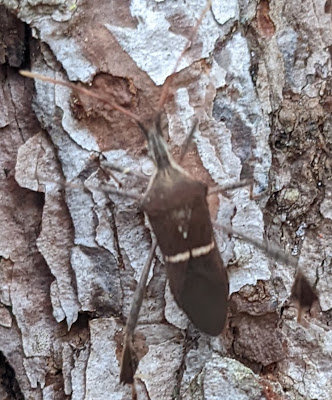
| Adult leaf footed bug, Leptoglossus spp. on a pine |
| Leaf footed bugs can damage hemp and vegetable crops |
Birds, spiders and predatory wasps, possibly the sand wasp, are all natural enemies of leaf footed bugs and help keep their population numbers managed.
Though not the worst pest insect to the organic hemp or vegetable grower, they can inflict damage to both plant and flower. In a well balanced horticultural ecosystem they can provide forage to other insects and wildlife and as such provide a certain level of food chain importance.
Certain species of thistles seem to attract leaf footed bugs as well as citrus. Thistles are also quite beneficial in their supporting relationship to useful pollinators, birds and other natural pest predators. Native plant species such as milkweeds and mints are an important tool as they attract leaf footed bug enemies, such as predatory wasps.
A organic based integrated pest management approach to managing leaf footed bugs on the hemp farm should include;
- native plants that attract predatory wasps
- plenty of bird feeding opportunities
- removal of unnecessary wood and debris piles
- spider habitat
- sighting notations in daily grow journal.
As long as the leaf footed bug population numbers are not out of control, their occasional presence should not be a priority concern to the hemp grower. They can be however, a dynamic variable in the hemp garden's ecosystematic matrix and as such their presence should be recognized by the grower in the daily journal.
Saturday, January 1, 2022
Assassin Bugs, An Organic Hemp Cultivator's Helper
Assassin bugs are a great pest control partner to have when growing hemp organically.
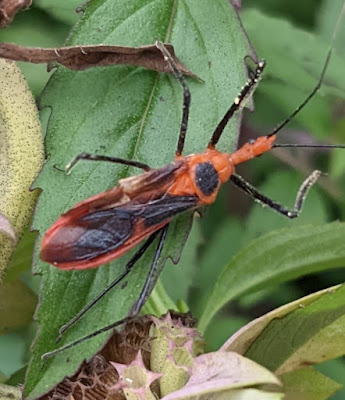
| Milkweed assassin bug, Zelus longipes, is an important part of an organic hemp pest management program |
Members of the Reduviidae insect family, assassin bugs are the perfect hemp (or for that matter any organically grown garden plant) pest predator. They inject a digestive secretion into their prey and then suck out their prey's body fluids through a straw-like snout. Assassin bugs favorite hunt includes; aphids, beetles, caterpillars, leafhoppers and even bees and flies.
Included with the Assassin bugs in the Reduviidae family are the closely related ambush bugs (subfamily Phymatinae), wheel bugs (Harpactorinae) and kissing bugs (Triatoma spp.). Some Reduviidae can and will bite humans. As with any insect bite, a bite from these insects may be painful and proper first aid should be administered.
Foraging across the garden, the assassin bug's appetite is voracious and non-discriminatory, devouring both bad and beneficial insects. But on the whole, the assassin bug is welcomed as an eat all pesty pest bug control partner.
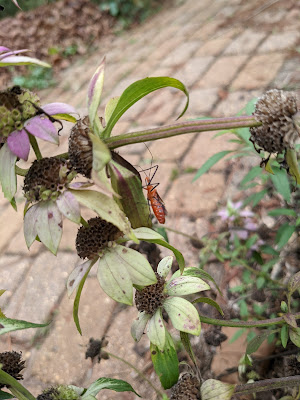
| Milkweed assassin bug, Zelus longipes, foraging on Monarda punctata |
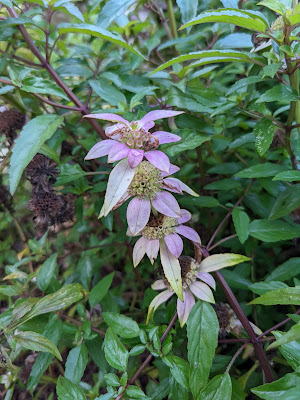
The key to managing the assassin bug in the hemp growing area includes the use of nectar producing native plants the bug is naturally attracted to. Strategic plantings of spotted bee balm, milkweed, goldenrod, mountain mint and other wildflowers can direct assassin bug's attention into those areas needing urgent pest control attention.
There are about one hundred fifty species of assassin bugs. One of the most common assassin bugs seen in the garden is the Milkweed assassin bug, Zelus longipes.
| Milkweed assassin bug, Zelus longipes, have a never ending appetite for hemp cultivation pests |
Though assassin bugs may look wicked, they can help the organic hemp grower keep pest insects to a minimum.
The native plants mentioned are known to attract assassin bugs looking for high-energy packed nectar. Organic hemp integrated pest management will always use assassin bug attracting native plants around growing areas, either as permanent plantings or in movable growing containers for spot pest control.
The organic hemp nursery is a dynamic site, rich in complex ecosystematic matrices. The relationships between native wildflowers, the Reduviidae family of insects and the hemp farm are important for the grower to understand.
Welcoming these colorful but alien looking bugs is another key component in a successful organic hemp growing program.
Thursday, December 30, 2021
Raptor Perches for Organic Integrated Pest Management
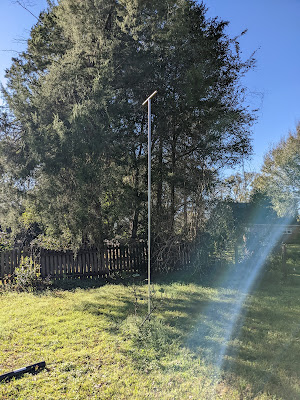
Arendell Hill has two new raptor perches now and we hope the birds of prey make themselves at home on the fourteen feet tall bird stands. These raptor perches are inexpensive and easy to build, and can be moved as necessary to different locations in the future.
| Organic Hemp Cultivation incorporates birds as pest control partners. Here is one of two raptor perches at Arendell Hill. |
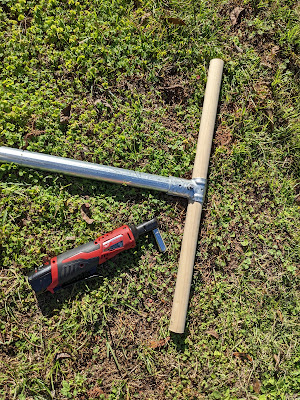
The horizontal perch section is a 1 1/4" diameter wooden dowel and is fastened to the vertical support pole.
| Raptor perch, horizontal wooden dowel attached to vertical metal support pole |
The materials list is for two perches:
- Three 10' galvanized chain link fence top rail posts for vertical support
- One 4' in length 1 1/4" diameter wooden dowel for horizontal perch
- two galvanized chain link fence 1 3/8" T connectors
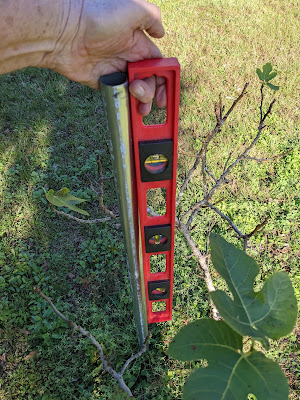
| Raptor perch support pole should be plumb vertical |
I cut one of the three ten foot top rail posts in half and drove the smaller diameter end into the ground using the pipe hammer approximately three feet or depending on the soil composition deep enough to keep the five foot pipe section sturdy.
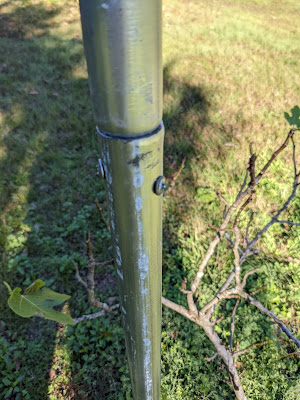
| Raptor perch support poles are fastened together and secured with metal screws |
Once the support pipe is hammered into the ground then the small diameter end of the uncut ten foot six inch top rail pipe with the wooden dowel attached are placed into the support pipe. The two vertical pipes are fastened together with two metal screws. A pilot hole can be drilled for the two metal screws.
Monday, December 27, 2021
Rooting Bee Balm Cuttings Organically, Hemp Cultivation and Pest Control With Wasps
Monarda punctata, spotted bee balm, is a native wildflower here in Florida and an important pest control plant at Arendell Hill. Spotted bee balm attracts beneficial pollinators and wasps and beetles, such as native ladybugs. Spotted bee balm also serves as a decoy, diverting pest bugs away from hemp crops. Seeking out Monarda's nectar, potential pest insects soon find themselves consumed by lady beetles, dragonflies and other insects foraging in the bee balm.
| Organic Hemp IPM Incorporates Spotted Bee Balm, Arendell Hill Nursery |
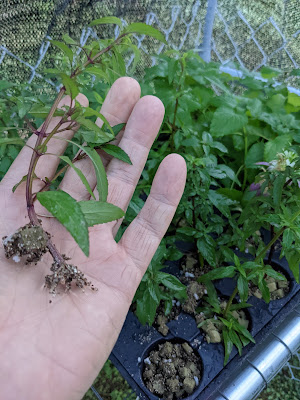
December, with its cooler and shorter days here in Florida is the perfect time to root cuttings. I cut six to eight inch healthy stem tips from a thriving bee balm plant and place the cuttings in a 72 count seed tray filled with a mixture of perlite, vermiculite and rockwool. Cuttings are placed in a shade house and misted every twenty minutes for ten seconds.
| Organic Pest Control Plants; Monarda cuttings root easily without hormones |
That is it. In two to three weeks the cuttings are rooted and ready to be potted up into four inch pots filled with an organic potting mixture.
Moreover, a very important benefit of incorporating Monarda punctata into a native plant based organic pest control management plan for the hemp garden is the plant's ability to attract the predatory sand wasps! Sand wasps are highly effective at controlling hemp damaging marmorated stink bugs.
A stink bug infestation can quickly devour much of a hemp crop in short time.
Fortunately sand wasps love to feed their larvae stink bugs. Sand wasps are a group of predatory wasps that include the Astata and the brightly colored Bicyrtes species. Sand wasps seek out the nectar of Monarda, mountain mint (Pycnanthemum spp.) and milkweeds (Asclepias spp). Adult sand wasps especially love to hone in on the odor of marmorated stink bugs.
Mamorated stink bugs, Halyomorpha halys, are an exotic pest native to the far east but now widespread in North America. These pests can inflict significant damage on hemp crops as well as cannabis and other agricultural plants. Yet sand wasps will kill these stink bugs and carry their bodies into tunnels in the ground to feed wasp larvae where they live during maturation.
A single sand wasp may kill dozens of stink bugs across the hemp cultivation area, greatly reducing potential pest damage risk.
| Organic Hemp Pest Control involves many native plants, like Spotted Bee Balm which attracts beneficial insects |
Spotted bee balm is also one of the most carefree and easiest native plants and wildflowers to grow, requiring little if any attention while being resilient to salt, wind and drought.
Native plants are often ignored when integrated pest management programs are developed for organic hemp cultivation, yet native plants offer so many benefits to the hemp and cannabis grower. Just as Monarda punctata attracts the stink bug killing sand wasp, other native species too play host to insects, amphibians, reptiles and birds that work together as an efficient team, keeping ecosystem balanced and effectively reducing pest pressures on crops.
Thursday, December 23, 2021
Organic Hemp Pest Control, a Native Plants & Songbird Partnership
Last post we discussed the important roles wild birds have in organic based pest control for hemp cultivation.
| Ruby throated hummingbird, Archilochus colubris attracted to the many native plants of Arendell Hill Nursery, feeds on nectar & tiny insects |
As we previously read, a wild songbird partnership begins with native plant landscaping. Birds have always sought out native plant species for foraging, communal and safe harbor habitat. Native plant species are their first choice when they are deciding to take up residence on a site. This also holds true for raptors and migratory birds. The connection with native plants lies deep within all birds DNA, a quid pro quo arrangement formed during earth's deep time.
Certainly non-native horticultural type plants may be popular and even attractive, however they do not offer the level of wild bird provisions afforded by native plant species. This is a proven fact. Moreover, non-native horticultural plants may also provide unwanted hemp pests a place to proliferate and do harm to native plant species through hybridization and even DNA alteration.
Many non-native plants can quickly spread across the landscape, their seeds dispersed by winds, wildlife and human activity. An organic hemp farmer will need to be able recognize invasive plants, such as Coral Ardisia, Ardisia crenata, or air potato vine, Dioscorea buldifera and implement control actions to stop the non-native's spread throughout the hemp agriculture site.
Importantly, one of the keys to high terpene content in flower buds of any variety is a high level of biodiversity and complexity in the surrounding ecosystem matrix. Non-native species reduce biodiversity, sometimes drastically. The coral ardisia and air potato vines mentioned above are one particular threat to hemp farms because invasive plants can quickly displace hundreds of native plant species that previously existed within the hemp ecosystem matrix depleting biodiversity and throttling production of complex terpene expression in hemp flowers.
Complexity of terpenes in hemp due to biodiversity is what makes a flower special. When a flower is desirable to the consumer, demand and sales increase. High quality hemp is the goal of most growers. By attracting cultivation site songbirds and planting a diverse landscape of native plants the grower gains more control over unwanted pests and also increases the quality of the hemp product by keeping cultivation site biodiversity high. The songbird-ecosystem matrix complexity-terpene-hemp plant relationship is a very important grow optimization concept for the farmer to explore.
History is full of examples of plants providing humans with amazing phytochemicals, substances rich in healing properties. For instance, yaupon holly, Ilex vomitoria contains caffeine and many terpenes too. Songbirds love to eat holly berries. Yaupon also provides a home across its bark for countless different species of lichens and mosses. Older yaupon plants support a complexity of fungi and mushrooms. All of these ecosystem variables; the fungi, the lichens, mosses, birds, plant and wildlife litter interact together to help form a web of ecosystem matrix diversity that is essential to comprehensive terpene creation in hemp and other plants.
Native plants have evolved over the ages alongside soil formation, fungi & lichens, plants, weather trends, insects, birds, fish, lake, river and stream creation and flow, climate changes and other biological and geophysical factors. The ecosystems we are a part of today were fashioned and shaped through millennia, a result of 'trial and error' over vast expanses of time.
Native ecosystems are the product of natures long term refinement processes. In fact the time factor nature has invested into forming the ecosystems around us is so vast that it is practically impossible for us to comprehend what has taken really place.
The result of these evolutionary process can be witnessed in the precisely balanced interactions associated with native ecosystems. Natural checks and balances keep seasonal life cycles functioning smoothly. This way no one or two life types becomes over abundant or out of control.
So for the hemp farmer, outdoor growing can expose hemp plants to geophysical and biological variables that may activate both biological and epigenetic process resulting in increased terpene production and diversity. Many terpenes important to humans for cosmetic, pharmaceutical, agricultural and food purposes are synthesized by plants as responses to outside influences, or ecosystem variables. Some of these may be related to the ecosystematic complexities surrounding presence of native plants, insects, fungi, birds and wildlife.
A strategically designed native plant filled landscape not only provides the basis for increased terpene development but also serves as the foundation for organic integrated pest management purposes.
Once native flora is established, birds will make themselves at home and begin to assist in managing insect populations.
I've found the following native plant species to be especially helpful in recruiting songbirds, raptors and other wild birds.
Shrubs and small trees:
- Wax myrtle, Morella cerifera
- Yaupon holly, Ilex vomitoria
- American holly, Ilex opaca
- Gallberry, Ilex glabra
- Elderberry, Sambucus nigra
- Firebush, Hamelia patens
- Beautyberry, Callicarpa americana
- Hoptree, Ptelea trifoliata
- Coontie, Zamia integrifolia
- Red mulberry, Morus rubra
- Seagrape, Coccoloba uvifera & Pigeon plum, C. diversifolia (cold tender)
- Groundsel tree, Baccharis halimifolia
- Paurotis palm, Acoelorraphe wrightii (cold tender)
- Coco plum, Chrysobalanus icaco (cold tender)
- and many more.
- Oaks, such as;
- Live oak, Quercus virginiana
- White oak, Quercus alba
- Myrtle oak, Quercus myrtifolia
- Shumard oak, Quercus shumardii
- Swamp chesnut oak, Quercus michauxii
- and many more
- Red maple, Acer rubrum
- Hickory, including
- Mockernut hickory, Carya tomentosa
- Pignut hickory, Carya glabra
- Black walnut, Juglans nigra
- and others
- Magnolia, Magnolia grandiflora
- Black gum, Nyssa aquatica
- Cypress, Taxodium distichum & T. ascendens
- Pines species:
- Sand pine, Pinus clausa
- Slash pine, Pinus elliottii
- Spruce pine, Pinus glabra
- Longleaf pine, Pinus palustris
- Loblolly pine, Pinus taeda
- Sabal palm, Sabal palmetto
- Sycamore, Platanus occidentalis
- Tulip popular, Liriodendron tulipifera
- Silver buttonwood, Conocarpus erectus
- Mangroves;
- Black mangrove, Avicennis germinans
- Red mangrove, Rhizophora mangle (cold tender)
- White mangrove, Laguncularia racemosa (cold tender)
- and so many others
- Florida Wildflower Foundation
- Florida Association of Native Nurseries
- UF/IFAS
- Florida Native Plant Society
Wednesday, December 15, 2021
Birds and Hemp Cultivation Organic Pest Control
Guarded greenhouse cultivation of hemp and cannabis is the best way to avoid birds when growing hemp. Yet, the grower might ask, 'why would I want to exclude a great organic pest control partnership from my grow operation?'
| We make sure the bluebirds have plenty of nesting boxes ready to use each year. Bluebirds consume a significant amount of pest insects across the Arendell Hill Nursery. |
Birds are practically ubiquitous. Fences don't prevent their presence, neither does hunting. Birds always come back to the garden.
The smart organic hemp farmer understands that though birds will always be around and may present some negative issues (such as potential vectors of disease and damage to crops), they also provide a number of significant benefits, including;
- good control of caterpillar populations
- mitigation of excess squirrel numbers
- reduction in rodent infestations
- removal of unwanted seed fall from adjacent landscape plants
- aphid and bug control
- cricket and grasshopper management
- and more
- feces and droppings
- seeded bud damage
- broken branches
Tuesday, December 14, 2021
Organic Hemp Pest Control and Anolis carolinensis (Florida's Green Anole)
Lately we've focused on discussing some of the many ecosystem variables associated with hemp (Cannabis sativa) cultivation in an effort to understand how to grow hemp organically, without the need for chemical pesticides and herbicides that may be implicated in toxic or carcinogenic potential.
| The green anole is an important member of organic IPM efforts for hemp crops |
Though native to North America the small green anole is also recognized as an invasive species in eastern countries such as Japan. But here in Florida Anolis carolinensis is considered a beneficial native lizard.
Importantly to the hemp grower, the green anole is a highly beneficial ecosystem component to include when developing an organic integrated pest management plan. Although any wildlife, insect or bird can be a vector for diseases that may affect hemp, Anolis carolinensis offers more benefits than risks to the grower. With their big appetite for pest bugs green anoles can be a beneficial partner, on duty twenty four seven (I've seen them feeding at night), always looking to devour smaller pest organisms.
![]() |
| Organic Hemp Cultivation, Anolis carolinesis's throat fan |
Unfortunately for the hemp farmer and for the native green anole, a larger anole has appeared in Florida. This also hungry, larger, invasive anole is known as the Cuban brown anole, Anolis sagrei. Though native to Cuba and the Bahamas, the Cuban brown anole has spread through the Southeastern US by laying eggs in horticultural potted plant soil.
The photo sequence here starts with a green anole resting on the palmetto frond siding of a chickee attracting flies (and female anoles) with his 'dew lap' or 'throat fan'.
![]() |
| Green anoles play an important role in organic integrated pest management programs. |
The fly, Musca domestica, soon lands and the always searching for bug anole grabs and eats the first fly of many for the day. This seemingly insignificant act of predation is so important to hemp IPM. Common house flies are a significant vector of diseases that may affect hemp. Flies frequently regurgitate their stomach contents and leave fecal matter after landing on a hemp bud. Salmonella, aspergillus and other noxious organisms can be spread through hemp crops by house flies. Because the green anole eats copious numbers of house flies daily, they contribute to positive hemp crop ecosystem criteria.
The Florida green anole and native plant species that provide communal habitat for the anoles are two very important components of a successful organic hemp integrated pest management system. Ultimately, both the grower and consumer benefit from organically grown hemp. First, the consumer benefits from the organically grown hemp because the product is free from pesticides and industrial type chemicals that may be toxic or carcinogenic. Second, the grower can command higher prices for their crops due to the demand for healthier organic products.
Saturday, December 11, 2021
Organic Hemp Cultivation and Pest Control, Documenting Weather Patterns
Some of the most important variables the organic hemp farmer can record and analyze are weather patterns impacting the growing area.
Weather patterns are often predictive of pest outbreaks. Droughts, floods, excess heat or cold, humidity levels, solar radiation, geomagnetism and barometric pressure fluctuations can trigger pest population explosions and also initiate certain pest activities.
Temperature changes, such as prolonged heat waves may cause insects to become much more active. Insects are cold-blooded (poikilotherms) organisms, meaning their body temperatures fluctuate with outside temperature variations and heat is not generated internally through biological processes. Prolonged heat waves can fuel insect activity due to increased body temperatures.
Some have estimated that for each two degrees Fahrenheit rise in temperatures over normal ranges, pest insects may inflict ten to twenty percent more damage as their metabolism and body temperatures increase. These observations suggest climate change could have serious impacts on hemp organic integrated pest management as well as for other agriculture product pest management systems.
Droughts too may trigger prolonged insect feeding activities as bugs search for water sources within plant buds, stems and leaves. During droughts, hemp and cannabis pest insects may be driven to eat plant matter in search of moisture. Regular precipitation measurements may provide the hemp farmer with patterns that help predict pest activity.
![]() |
| Organic Hemp Pest Control, Ambient Weather wifi enabled rain gauge |
Climate and weather patterns can also be helpful in determining which beneficial insects, or pest predators are most productive in an organic pest control role under certain climate conditions. Abnormal weather patterns such as drought, extreme temperatures, winds and humidity levels may actually work against beneficial insects and favor hemp pests.
There are many low cost, reliable weather stations available today that monitor, record and summarize growing area weather variables. Ambient Weather, La Crosse Technology and Davis Instruments are a few of more popular retail available weather instruments.
![]() |
| Organic Hemp Cultivation, IPM methods, Ambient Weather Station |
I use an Ambient Weather ultrasonic unit that measures temperature, relative humidity, wind speed, barometric pressure, sunrise and sunset hours and other important ecosystem geophysical variables. The Ambient Weather station was inexpensive, easy to set up and summarizes weather trends over time.
Most of the small personal weather stations also provide the capabilities to connect to the internet, allowing for participation in crowd sourced weather data sites.
Weather and climate data are an important but small part of a hemp cultivation site's ecosystem variable population.
Our agrarian ancestors understood the importance of understanding weather patterns. Their food growing efforts depended on weather systems knowledge. They watched and listened to the clouds, birds, animals and other tell-tale signs of impending climatic events.
![]() |
| Organic Hemp Pest Control, Ambient Weather data display |
Today, the hemp farmer must also be able to comprehend meteorological impacts on crops. A daily log of cultivation site weather data provides so much important information.
A thorough understanding of geophysical weather variables driving much of the hemp farm's growing parameters will support successful organic cultivation efforts.
The successful hemp cultivator will use all available organic-based integrated pest management tools. Weather recording systems are a critical part of any organic IPM program on hemp farms.
Thursday, December 9, 2021
Organic Hemp Farming, Pest Control and Annual Ecosystem Matrix Data
Last post we discussed the importance of codifying the hemp cultivation area's biological and geophysical characteristics into a chart or graph. We call this site summary the ecosystem matrix.
![]() |
| Four season data provides the most accurate ecosystem matrix data to the hemp grower for pest control efforts. |
Smaller sites may possess a single ecosystem matrix while large sites, spread across acres of land may involve many different existing ecosystem types.
There are many variables interacting with each other in a functioning ecosystem. The whole of these variables comprises the ecosystem matrix. Documenting hemp farm ecosystem matrix biological and geophysical variables in a summary table or graph can provide the grower with valuable tools for best growing results and pest control.
Importantly, many of these variables act differently according to seasonal variations. Recording the growing site's variables during one month may provide valuable growing information for that month but may be irrelevant for different months or other seasons.
The ideal ecosystem matrix analysis will contain site data from one or more complete annual growing cycles, including data from spring, summer, fall and winter.
With respect to hemp plant pest control, the knowledge of when certain pests appear and when they inflict their respective damage is a vital part of the organic integrated pest management program.
It is a given that there are quite a number of pest insects that can harm hemp crops. Importantly, these pests not only appear at different times of the year, during different seasons but they also have their own set of biotic and abiotic ecosystem variable requirements for growth and survival.
A few of the seasonal variables that should be noted when developing an organic pest control program include; day length (photoperiod), wind speed and directions, rainfall amounts, leaf litter amounts, air quality, temperature, bloom types, mushroom growth, relative humidity, barometric pressure and others.
The goal for the hemp grower should be to avoid surprise with respect to pest organism emergence. By collecting hemp growing area ecosystem matrix observations and measurements throughout the year, predictive patterns will begin to emerge with respect to fly, caterpillar, fungus and insect population growth.
All pests have specific requirements for successful growth. When the ecosystem is favorable to their needs, pests will flourish.
The ability to recognize patterns in seasonal occurrences affords the hemp farmer warning that certain pests may be expected, and then also the opportunity to manage variables in order to prevent pest outbreaks.
Though it requires time and effort, an on-going, annual ecosystem variable analysis effort is truly the backbone of any organic integrated pest management program. The hemp farmer must understand what they are dealing with and when they will be facing specific pests. It can't be overstated enough, the hemp farmer must intimately know their growing site ecosystem(s) through all the seasons.
The benefits of ecosystem matrix tools for organic pest control are many, not the least of which is a healthy agricultural product free of toxic sprays and powders. Organic integrated pest management focused hemp growing operations will always produce the very best hemp products.
Friday, December 3, 2021
Developing an Ecosystem Matrix for Hemp Cultivation, Organic Integrated Pest Management
In the last several posts we've introduced the concept of ecosystem matrices into our discussion of organic integrated pest management (OIPM). A balanced ecosystem exists when all of the many existing biological and geophysical entities are functioning in equilibrium with themselves and each other. This seamless functioning forms the basis of an organic integrated pest management approach for the hemp farm.
Balanced ecosystems function efficiently. Throughout deep time nature has refined how ecosystems work so that all life within an ecosystem has a place, function and role to play. Within the biological and geophysical parameters of a balanced ecosystem, all life forms carry out predictable, functional duty. Change does occurs but in a measured sense. Functional ecosystem homeostasis is usually maintained on a rolling basis.
However, when the ecosystem becomes unbalanced some life forms may become overly dominant, consuming and damaging to other ecosystem entities. Hemp farm pests such as certain caterpillars for example may play an important role in a balanced ecosystem yet in the absence of normally present control factors and predators, such as fire or birds, may experience such a rise in population numbers that they disrupt the predictable garden homeostasis and cause uncontrolled damage to crops.
The key to maintaining ecosystem homeostasis begins with an understanding of the hemp growing areas' biological and geophysical dynamics. What fungi, plants and animal live on and use the hemp farm land? What are the typical weather trends including rainfall amount and wind characteristics? What is the soil comprised of? How is the air quality? Every life form and geophysical variable that interacts with other farm life forms and geophysical parameters becomes an important part of the ecosystem matrix flux.
A good start to understanding ecosystem matrices begins with a list of what exists and what is happening across the growing area. A hemp farmer who has a good understanding of his or her farm's ecosystem matrix should be able to jot down a relatively comprehensive bullet list of their garden's parameters . This list will represent the existing site variables. The existing state is a reflection of the site in the present moment. The list of existing site parameters will usually be somewhat different than the site's historical, or intrinsic list of what has previously existed and happened across the site previous to human development impacts.
This list should evolve into an ongoing effort in identifying the hemp farm's ecosystem variables, much like a diary. The process of journalling identifies plants, animals, insects, weather conditions, sunrise and sunset times, weather events such as snow, rain and wind, and other variables. The hemp farm ecosystem matrix variable journal can be developed over time by notation of observed variables into a notebook, on a phone or the computer.
The hemp farm journal will become more and more accurate and comprehensive over time as documentation accumulates. Certainly collection of data requires a focused effort. Day in and day out the hemp farmer must record what they encounter during the day. Often, the most seemingly insignificant events can many times be the trigger that exerts influence over pests. Many times these trigger events can go unnoticed, all the while supporting an increased pest presence.
As the amount of information in the journal grows, the usefulness of the data increases. For me, the key to understanding volumes of hemp farm journal data is found in how the data is presented. The journal's daily entries need to be arranged in a visually coherent manner to be most relevant and useful. Once the raw data is compiled into a logical presentation, relationships between pest damage and ecosystem matrix variables can be more easily identified.
Although any collected data can be useful to the hemp farmer, a comprehensive journal will contain a minimum of one complete years observations. A multi-year hemp growing journal will contain invaluable information that can provide worthwhile tools to the grower.
There are several approaches to organizing hemp farm existing matrix variables. Table format is one way and graphs are another approach. As a visual learner I do best with data arranged in graphic presentation. There are any number of ways to arrange hemp farm ecosystem matrix data and while developing the existing ecosystem matrix variable list it is worthwhile to also research what the site's historical (intrinsic) ecosystem matrix might have been like. Sometimes, on non-disturbed high quality successional or native forest sites there will be few differences between the existing ecosystem matrix or matrices and the intrinsic, historical ecosystem matrices.
Across farmed, agricultural or in disturbed urban garden sites the existing and historically intrinsic ecosystem matrices will differ. As there will usually be a number of remnant matrix variables still interacting on disturbed sites, it will be important for the hemp grower to have a broad understanding of both the intrinsic and existing ecosystem matrices on their cultivation plot or greenhouse.
Knowledge of how the growing plot evolved on a historical basis and how the land functions today will allow the hemp grower to quickly assess trends, those beneficial to desired plant growth and those detrimental to the hemp crop (or any other organically grown crop).
A highly successful Organic Integrated Pest Management System must be based in comprehensive knowledge of how the growing area functioned as an ecosystem in past times and how the farm's present ecosystem variables interact.
With this knowledge the grower can hopefully begin to manage ecosystem matrix variables with organic based approaches. The finest hemp plants may be grown this way, without toxic and industrial chemicals. The beauty of organically grown plants encompasses so many health and quality benefits, always appreciated by both the consumer.
How you depict your ecosystem matrix depends on what table, illustration, chart or list works best for you. Each grower will have their own method. The important fact is that the grower understands that the cultivation site possesses a historical (intrinsic) set of ecosystem variables which have evolved over time into the unique matrix of today.
A grower who understands how their intrinsic and existing ecosystem matrices function will produce the very best organic agriculture product with minimal pest pressure. Organic integrated pest management must begin with this broad understanding of site dynamics.
Tuesday, November 30, 2021
November 31st Overnight Audio, Marsh Shoreline, SMNWR
![]() |
| Into the Saw Palmetto dominated pine flatwoods to the marsh waterline where I'll set up recorders for overnight audio collection |
An hour of sunlight left, heading into the wet saw palmetto dominated pine and cypress lined sloughs to set up Sony recorders for overnight field recordings. Lots of migratory birds have made their way to the St. Marks National Wildlife Refuge and they are quite vocal after dark & just before sunrise. I enclose the recorders set at 24 bit/96000 (50% gain) in drybags and cover the stereo mics (PIP power lav type, usually MikroUsi or Clippy) with fuzzy wind covers. Hang the drybags on a tree branch, draping mics over branches or using a wire hair tie place around trunk with a binaural mic arrangement. So excited to go back out at sunrise & collect recorders. Not quite like sleeping under the stars but listening to the night sounds of the marsh & flatwoods is healing. Check out bio link for a sampling of field recordings from the marshes of SMNWR
Wednesday, November 24, 2021
Organic Hemp Cultivation, Integrated Pest Management (IPM) & Birds
We encourage birds to make themselves home here in the Arendell Hill nursery gardens.
![]() |
| Wild birds, song birds, raptors and more. Winged creatures serve an important part of our Organic IPM |
I consider birds to be better than 'human help' at picking caterpillars and other potential pest insects out of our gardens. Songbirds can keep the ground and shrubbery around a hemp cultivation area significantly free of larvae that are crawling around looking for leaves or flower buds to chew on. Larger birds also, like red shouldered hawks here are vigilant in keeping the nursery free of disease vectoring rodent populations.
Winged creatures have a definite advantage over crawling pests. Winged predators can conduct reconnaissance across a ground area much quicker than most crawly pests can escape. It is true that many insects can fly and are beneficial in their own ways, such as for pollination. The advantage however lies with birds though due to their size, advanced development of senses and ability to quickly forage across large areas of garden.
Maintaining quality bird habitat for hemp farms should include practices that ensure ample bird forage provisions exist. Feeders are one obvious way to attract birds and work well in creating a basic Integrated Pest Management program. Yet bird feeders are just a start. Native landscape plants that flower, fruit and produce seed are another worthwhile addition to bird feeders in hemp cultivation areas.
Importantly, once the grower begins to attract birds to their hemp growing area and the birds begin their caterpillar and pest insect control duty, the grower must also ensure that the farm provides a place for the birds to 'stay' and nest. Communal habitat is best established by planting native landscape and wildlife value shrubs.
![]() |
| American holly, Ilex opaca, provides forage and evergreen communal habitat to wild songbirds and as such can be an important part of an Organic Hemp IPM program. |
Native shrubs, rather than horticultural imported shrubs, will always be a wild songbird's and raptor's preference, for the native shrub's habit and familiarity are transcribed by countless previous generations into a bird's DNA. Simply put, the wild songbirds are attracted to those native shrubs they and their ancestors have always lived in and around.
It is true that some non-native horticultural shrubs and plants will also be utilized by wild birds. However the net benefit to the hemp farm efficiency matrix will be reduced when using non-native landscape species. In fact, it is possible non-native landscape plants can cause significant ecological systems damage. When the growing ecosystem matrix becomes unbalanced pest pressure will increase.
As we will see in other posts, not only do native plant species support all important bird populations across the hemp farm, but native plant species also provide a number of other important pest control and nursery management functions.
We will also discuss in future posts, how to visualize the hemp farm bio-geophysical ecosystem matrix. Though the name 'bio-geophysical ecosystem matrix' may sound complex, the concept is a simple one. Everything affecting the hemp farm makes up the matrix. There are many variables, such as birds, wildlife, rain, wind, temperatures, pests, soil, water and others. The way these variables act upon and influence hemp plant growth in the garden is what the matrix is all about.
Another term I like to use when thinking about the ecosystem matrix is the phrase 'Languages of Nature'. Each variable asserts an influence, good or bad, on the hemp plants. Each good or bad influence can be known through interaction with our senses. Ecosystems communicate the effects of most impacts they experience through measurable responses. An expert hemp farmer 'reads' and understands these ecosystem responses and utilizes the information to maximize crop efficiencies.
Importantly, songbirds and raptors are not the only winged creatures employed by organic hemp and plant nursery growers as part of an organic IPM program. Chickens, bats and other critters have been successfully integrated into hemp farm pest control programs. We will discuss these too in future posts.
Finally, it must be understood that birds can be vectors of plant diseases. However when weighing the risks of potential bird vectored plant diseases versus the insect control benefit, the pest control benefit is usually greater than the disease risk.
IPM risk benefit analysis can be established through trial and error on the farm, through research of peer reviewed literature and also through coordination with experts working with a local agricultural extension service.
Birds are just one part of a hemp farm ecosystem matrix complex, yet they are a beneficial part.
Now it is time for me to go add bird food to the feeders!
.