Showing posts with label green roof plant selection. Show all posts

Monday, February 21, 2011

Green Roof Vegetables - A List of Recommended C4 Plants

Let's take another look at growing rooftop food gardens.  Rooftop permaculture is a rapidly growing movement across the world.  Highly productive vegetable gardens can be found on green roofs in nearly every city. 

Choosing vegetables that possess C4 photosynthesis capabilities can help ensure rooftop garden success. 

Examples of C4 plants include;

Vegetables & Flowers -
  • Cabbage
  • Broccoli
  • Cauliflower
  • Turnip
  • Mustard Greens
  • Wasabi
  • Cress & Watercress
  • Rapeseed
  • Horseradish
  • Most lettuces
  • Chicory
  • Artichoke
  • Jerusalem artichoke
  • Yacon
  • Echinacea
  • Tagetes marigold
  • Marigolds
  • Zinnias
  • Chrysanthemums
  • Heleniums
  • Artemesia
  • Dandelion
  • Goldenrod, and more
The beauty of C4 plants is their ability to withstand drought and the harsher environment of many rooftops.

Generally, C4 plants loose only one third the amount of water to evapotranspiration as C3 plants, giving them a great advantage on the roof.

Remember, we've discussed C$, C3 and CAM photosynthesis processes in prior posts.  

Review:

Photosynthesis occurs in most C3 plants by:
  • 'Breathing' in CO2 and combining the CO2 with a 5-carbon sugar
  • The reaction is facilitated by an enzyme, Ribulose Bisphosphate Carboxylase Oxygenase or RUBISCO abbreviated
  • Now there are 6-carbons
  • The 6-carbon chain breaks into 2 molecules of a glyceric acid called PGA - 3-phosphoglyceric acid
  • The completed reaction is called the Calvin cycle and the PGA is the base for glucose synthesis, along with other carbohydrates
However, some plants have an supplemental or alternative method of implementing the above food production cycle. 

C4 plants generally conduct photosynthesis by:
  • Absorbing CO2 into the mesophyll - 
  • Once the CO2 is in the mesophyll it combines with a 3-carbon compound called PEP, phosphoenolpyruvic acid to form a 4-carbon substance called oxaloacetic acid - hence the C4
  • The C4 is moved into the deep bundle sheath layer of cells away from the leaf surface
  • Inside the bundle sheath the C4 breaks down into the C3 base and eventually PEP for the Calvin Cycle food production
CAM plants are different from C4 plants in several ways such as CAM plants taking in CO2 only at night. 


Interestingly, many C4 plants have developed the capabilities to switch back and forth between C3's 'full-steam ahead' photosynthesis on the leaf's surface (where the process can be interrupted by environmental conditions) to the C4 process where the photosynthesis required compounds are protected by layers of plant cells.

The process of switching back and forth between C3 and C4 gives a plant the opportunity to grow quickly, a survival advantage, during good weather and the switch into energy conservation survival mode when extreme and damaging weather arrives.

C4 plants, since the plant's photosynthesis process is protected deeper under the surface of the leaf, are more resilient to drought and extreme temperatures.

Therefore, under certain conditions and when placed in certain roof locations, make very good green roof plants.

Realize however, green roof plant selection is modeled on many inputs, C3, C4 or CAM type just being one factor.

However the green roof plant designer must understand the difference in the photosynthesis processes taking place in the plants being specified on any green roof.  

There are many interesting discussions about  C4  and C3 plants and climate change.  We will reserve a future discussion on insights into whether C3 or C4 or CAM plants will have an evolutionary advantage in the future with increased levels of CO2.  Surprisingly - no - not so surprisingly, 'Mother Nature' always steps in and provides adaptation mechanisms.  We will discuss these adaptations both C3 and C4 plants implement to survive either higher or lower levels of CO2.

Having moved through some heavy technical facts on C3, C4 and CAM plants we hope the discussion has not been too boring.

The real photosynthesis processes are much more complicated than we've talked about in these articles.  Understanding the basic differences between C3, C4 and CAM plants will allow the green roof plant designer to greatly increase survival opportunities for their green roof design.


Happy Green Roofing!

Kevin

Tuesday, October 26, 2010

Preventing Green Roofs and Green Roof Plants from Becoming Vectors of Exotic Invasives Species

Green Roofs provide many benefits.  We have mentioned many of the positive facets of green roofs in past blogs, in presentations and in our passion to see Green Roofs become a part of every sustainable and green project.

Our motto - "Restoring Volumetric Green to the Urban Core'" reflects our beliefs plants need to be in our homes, buildings and cities.  Green Roofs and Living Walls clean stormwater, provide wildlife with habitat, they create a sense of place for people, sequester carbon, uptake CO2, pump oxygen into our atmosphere, remove pollutants, prevent and cure cancers, provide food and the list goes on and on.

Plants are living organisms with many purposes!  They eat sunshine and convert the sun's energy into a host of benefits for our world.

These are some of the reasons we love Green Roofs and Living Walls.

With passion comes responsibility too.  As a certified arborist I hear the phrase - 'Right Tree, Right Place' and 'Right Plant, Right Place' many times a week.

The same slogan should hold true for Green Roofs and Living Walls.  In our rush to install volumetric green in the Urban Core we should not forget to remember some plants are considered aggressive and invasive in certain locations.

Florida, for instance has designated certain plant species to be exotic and invasive.  Typically those plant species are so aggressive they out compete native species - and can form monoculture stands.  For more information on Florida's Exotic and Invasive Plants click here.

I am working with a University here on installing a small green roof and a series of living walls and the University Botanist and Natural Area curator expressed concern about the selection of species to be used on both the roof and walls.

The University policy specifies using only native species or Florida Friendly Species that are not aggressive.  This holds especially true when working near the conservation and natural areas on the campus.

Seed source potential was another question addressed.

Green roof plants with tiny, lightweight seeds will serve as seed sources to surrounding areas with wind and bird dispersal.

Planting a non-native plant on a green roof almost always guarantees the plant will eventually spread into adjacent areas.  Of course the heavier the seed the less likely and slower the spread potential becomes.

It is possible some of the more popular non-native, drought tolerant ground covers could potentially become a nuisance in natural areas.

In our rush to grow green everywhere, let's make sure the plants we are using are compatible with surrounding environments.  Plant selection should always be coordinated with an area conservation botanist to ensure compatibility.

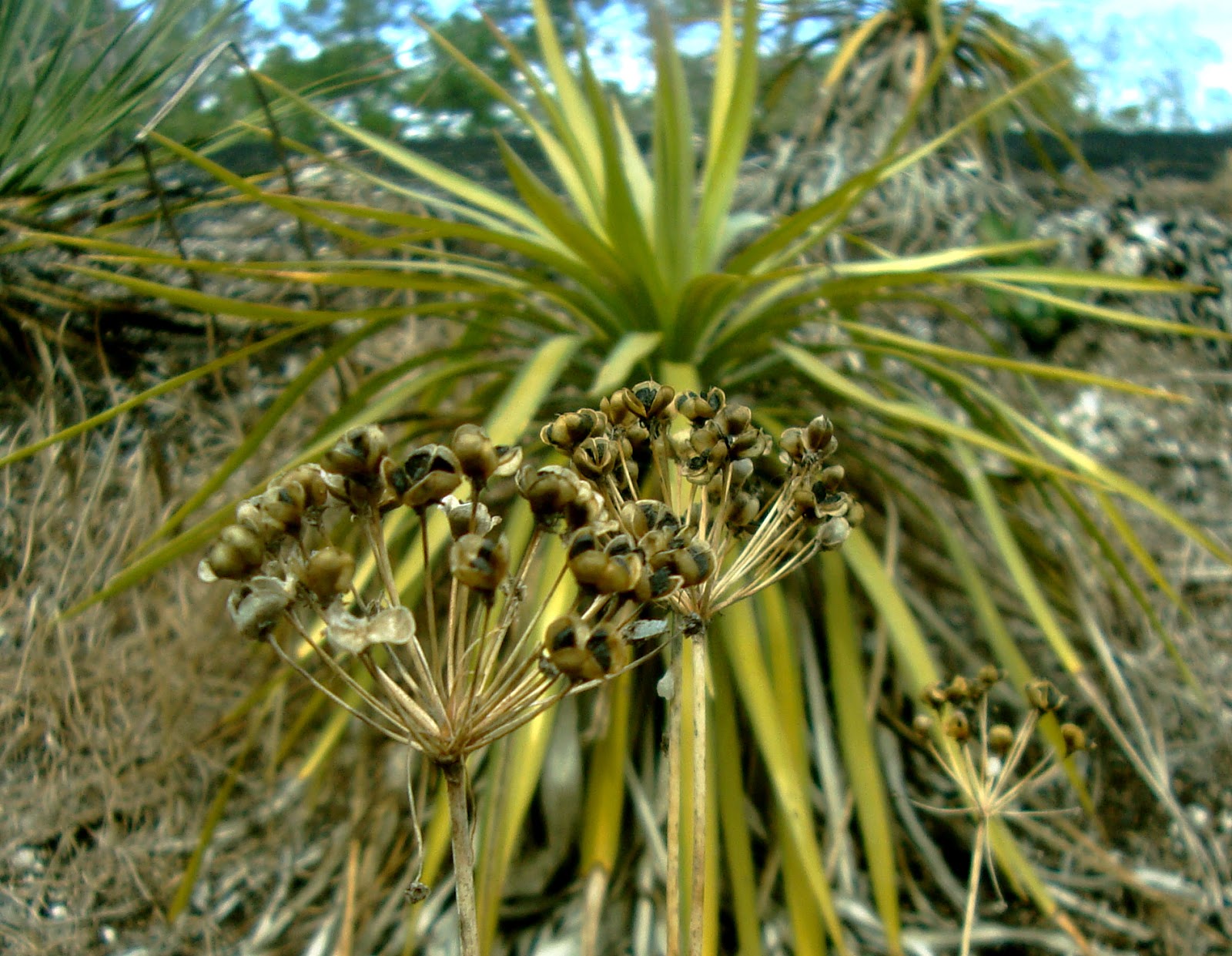
The below photo shows an Allium species on a Florida Green Roof with dried seed ready to drop.   The seeds are large and heavy enough to prevent wind from scattering them about the adjacent areas.  When they do fall from the dried flower stems, they will drop to the green roof and hopefully germinate with spring rains.

Green Roof Seeds - Allium
Choosing native species and non-invasive species is an important part of designing a successful green-roof.

As always - email us with your questions!

Happy Green Roofing!

Kevin

Saturday, August 21, 2010

Plants for Green Roofs - The new MetroVerde Carbon Pirate Variety


First off, even though we are a registered nursery in the State of Florida we do not generally sell green roof plants.  The plants here and the way they were raised are for our own green roof projects.  We are sharing the information of both our successes and failures in hopes we will someday have a greener world.  Our commitment is to restore volumetric green to the urban core.

We've mentioned before in the blog the practice of hardening off drought tolerant and succulent plants before installing them on green roofs, but today MetroVerde officially rolls out its Carbon Pirate (trademarked) line of green roof plants.

What is so special about the MetroVerde Carbon Pirate plant line is the time and preparation put into the plants in anticipation of roof duty.

Realize we focus on the Southeast US and especially Florida, so our approach may not be the best approach for other regional climates.  But here in Florida - green roofs face the big 5 H's, Heat, High Humidity, Hard Freezes, Hard Dessicating Winds, Hurricanes, Heavy Downpours, Hot Periods of Long Drought (Looks like 7 and I could add a Host more) - the point is that once you step up onto a Florida roof, no matter what time of the year, your breath can be taken away.  And you understand why you cannot just plant a nursery grown specimen on the roof.  May look good for a few months but after that - well just look at most of the previous attempts here across the state (except for a select few).

Drought tolerant plants possess specialized physiological processes that respond to changes in nature such as rainfall patterns and temperature.  They have developed these functions over the eons and rely on these adaptations for survival in areas where water supply is unpredictable.  Many have very shallow radial root architectural structure with diameters that exceed many times the plants actual form.  These roots want to grow laterally rather than downward in response to the infrequent rainfalls typical of their native habitat.  During a light rainfall event the stormwater tends to barely penetrate soil surface (depending on soil types).

As the rain ends and the water either evaporates or infiltrates, the drought tolerant plant broad surface area of roots responds quickly, storing the liquid for later use.

Additionally the drought tolerant have developed an array of mechanisms for dealing with drought such as CAM - or Crassulacean Acid Metabolism, and we will discuss these in upcoming posts, but lets get back to root structure.

For example, a two foot tall cholla plant often has a thirty foot architectural root diameter.  The fundamental distinction of any drought tolerant plant is the broad lateral root architecture.  Note the difference between some plants that do well in dry areas yet long, vertical systems that tap into the ground water supply.  Examples of these would include; Acacia, Parsley, Burdock, and Mesquite (whose roots have been know to grow down vertically over 200 feet!).

In choosing a green roof plant you first want to select one with roots that want to grow radially, not vertically.  But there are logistical limitations with plants that have radial root systems - they do not like pots or containers.  They need room for their roots to grow.

Recall the times you have gone to a nursery and purchased a plant and returned home to find the plant's roots had circled and circled the inside of the pot - we call this being 'root bound'.  Not good for the plant.

However, practically speaking nurseries are not going to grow one plant in a large tray because of the economics of space, real estate and cost-effective efficiency (I couldn't afford to either).

Hence the dilemma.  A drought tolerant plant grown in a two inch deep container that is three inches by three inches wide will not survive over term on a green roof.  The available functioning root area will only be approximately four and one half cubic inches.  Now as long as the plant is in the green house with irrigation applied (strange to think of applying irrigation to a drought tolerant plants) the plant will probably survive.   However, if raised in a small pot and irrigated, the green roof plant when planted on a roof most likely won't make it.

Drought tolerant plants for the most part have water intake processes that work gradually.  They are used to taking in required water volumes at a lower rate per root surface area using a large root diameter rather than absorbing large volumes of water with a limited root surface area.

The change from greenhouse container with irrigation to the roof is usually just too much and the plants will not function as expected without intense maintenance, watering and fertilization.

Though a topic for another blog session, my firm belief is because here in Florida we have a severe water crisis and nutrient pollution crisis, designing a green roof with irrigation is a fundamentally not environmentally sound.  I know, the cistern argument - hold the rainwater and irrigate with rainwater, but anyone with a cistern in Florida will tell you it is empty most of the time and then you have to use potable makeup water.....  I'll reiterate - my firm belief is because here in Florida we have a severe water crisis and nutrient pollution crisis, designing a green roof with irrigation is a fundamentally not environmentally sound.

Working with some of our green roof species we've 'trained' (this almost sounds cruel) certain plants to bridge the gap between being raised in containers and roof plantings.  Using drought tolerant plants (we will discuss in future blogs) - and let me note here there is a difference between drought tolerant plants and the succulents and cacti - we are not referring here now to succulents or cacti - using drought tolerant plants grown in standard nursery containers, we apply restricted watering schedules over a long period of time - usually over a year, to harden off the plants and prepare them for roof service.

These plants are grown in hot greenhouses with background humidity levels and irrigation amounts of less than 1/2 inch per month.

Once installed on a green roof with a mat based foundation, their roots quickly grow out laterally and with cumulative input from humidity and natural rainfall, they survive and begin to fill in the roof area.  In contrast to the irrigated, happy plants that are fatally shocked once installed on a roof, these plants are relieved to find their home on a roof.  We call these plants MetroVerde Carbon Pirates (trademarked).  They sequester C through respiration, produce oxygen, clean stormwater, provide habitat and create a much need sense of place.

There is so much to talk about here - tray systems versus mat  based systems, whether or not to irrigate, cost, weight, fire hazards, maintenance, volunteer species, disease - but we have plenty of more blog discussions coming!  In the meantime happy green roofing and as always you can e-mail Kevin with your questions - kevin@metroverde.com.