Showing posts with label organic hemp pest control. Show all posts

Saturday, January 1, 2022

Assassin Bugs, An Organic Hemp Cultivator's Helper

 Assassin bugs are a great pest control partner to have when growing hemp organically.  

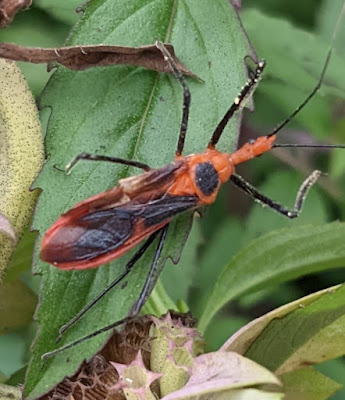
Milkweed assassin bug, Zelus longipes, is an important part of an organic hemp pest management program

Members of the Reduviidae insect family, assassin bugs are the perfect hemp (or for that matter any organically grown garden plant) pest predator. They inject a digestive secretion into their prey and then suck out their prey's body fluids through a straw-like snout.  Assassin bugs favorite hunt includes; aphids, beetles, caterpillars, leafhoppers and even bees and flies.

Included with the Assassin bugs in the Reduviidae family are the closely related ambush bugs (subfamily Phymatinae), wheel bugs (Harpactorinae) and kissing bugs (Triatoma spp.).  Some Reduviidae can and will bite humans.  As with any insect bite,  a bite from these insects may be painful and proper first aid should be administered.

Foraging across the garden, the assassin bug's appetite is voracious and non-discriminatory, devouring both bad and beneficial insects.  But on the whole, the assassin bug is welcomed as an eat all pesty pest bug control partner. 

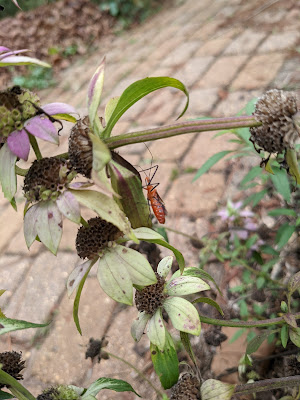
Milkweed assassin bug, Zelus longipes, foraging on Monarda punctata

The key to managing the assassin bug in the hemp growing area includes the use of nectar producing native plants the bug is naturally attracted to.  Strategic plantings of spotted bee balm, milkweed, goldenrod, mountain mint and other wildflowers can direct assassin bug's attention into those areas needing urgent pest control attention.

There are about one hundred fifty species of assassin bugs.  One of the most common assassin bugs seen in the garden is the Milkweed assassin bug, Zelus longipes.  

Milkweed assassin bug, Zelus longipes, have a never ending appetite for hemp cultivation pests

 The photos above are of a Milkweed assassin bug foraging across one of Arendell Hill's spotted bee balm, Monarda punctata, plants.

Though assassin bugs may look wicked, they can help the organic hemp grower keep pest insects to a minimum.

The native plants mentioned are known to attract assassin bugs looking for high-energy packed nectar.  Organic hemp integrated pest management will always use assassin bug attracting native plants around growing areas, either as permanent plantings or in movable growing containers for spot pest control.

The organic hemp nursery is a dynamic site, rich in complex ecosystematic matrices.  The relationships between native wildflowers, the Reduviidae family of insects and the hemp farm are important for the grower to understand.

Welcoming these colorful but alien looking bugs is another key component in a successful organic hemp growing program. 


Monday, December 27, 2021

Rooting Bee Balm Cuttings Organically, Hemp Cultivation and Pest Control With Wasps

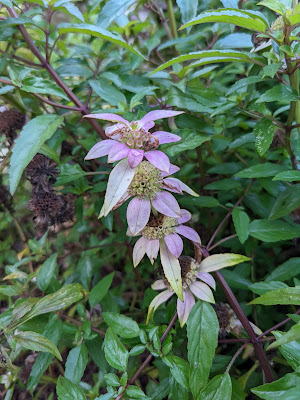
 Monarda punctata, spotted bee balm, is a native wildflower here in Florida and an important pest control plant at Arendell Hill.  Spotted bee balm attracts beneficial pollinators and wasps and beetles, such as native ladybugs. Spotted bee balm also serves as a decoy, diverting pest bugs away from hemp crops.  Seeking out Monarda's nectar, potential pest insects soon find themselves consumed by lady beetles, dragonflies and other insects foraging in the bee balm.

Organic Hemp IPM Incorporates Spotted Bee Balm, Arendell Hill Nursery


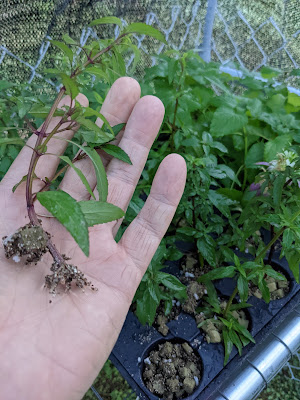
December, with its cooler and shorter days here in Florida is the perfect time to root cuttings.  I cut six to eight inch healthy stem tips from a thriving bee balm plant and place the cuttings in a 72 count seed tray filled with a mixture of perlite, vermiculite and rockwool.  Cuttings are placed in a shade house and misted every twenty minutes for ten seconds.

Organic Pest Control Plants; Monarda cuttings root easily without hormones

That is it.  In two to three weeks the cuttings are rooted and ready to be potted up into four inch pots filled with an organic potting mixture.

Moreover, a very important benefit of incorporating Monarda punctata into a native plant based organic pest control management plan for the hemp garden is the plant's ability to attract the predatory sand wasps!  Sand wasps are highly effective at controlling hemp damaging marmorated stink bugs.

A stink bug infestation can quickly devour much of a hemp crop in short time.

Fortunately sand wasps love to feed their larvae stink bugs.  Sand wasps are a group of predatory wasps that include the Astata and the brightly colored Bicyrtes species.  Sand wasps seek out the nectar of Monarda, mountain mint (Pycnanthemum spp.) and milkweeds (Asclepias spp).  Adult sand wasps especially love to hone in on the odor of marmorated stink bugs.

Mamorated stink bugs, Halyomorpha halys, are an exotic pest native to the far east but now widespread in North America.  These pests can inflict significant damage on hemp crops as well as cannabis and other agricultural plants.  Yet sand wasps will kill these stink bugs and carry their bodies into tunnels in the ground to feed wasp larvae where they live during maturation.

A single sand wasp may kill dozens of stink bugs across the hemp cultivation area, greatly reducing  potential pest damage risk.

Organic Hemp Pest Control involves many native plants, like Spotted Bee Balm which attracts beneficial insects


Spotted bee balm is also one of the most carefree and easiest native plants and wildflowers to grow, requiring little if any attention while being resilient to salt, wind and drought.

Native plants are often ignored when integrated pest management programs are developed for organic hemp cultivation, yet native plants offer so many benefits to the hemp and cannabis grower.  Just as Monarda punctata attracts the stink bug killing sand wasp, other native species too play host to insects, amphibians, reptiles and birds that work together as an efficient team, keeping ecosystem balanced and effectively reducing pest pressures on crops.


Tuesday, December 14, 2021

Organic Hemp Pest Control and Anolis carolinensis (Florida's Green Anole)


Lately we've focused on discussing some of the many ecosystem variables associated with hemp (Cannabis sativa) cultivation in an effort to understand how to grow hemp organically, without the need for chemical pesticides and herbicides that may be implicated in toxic or carcinogenic potential.

The green anole is an important member of organic IPM efforts for hemp crops

Today we will briefly discuss one particular lizard, Anolis carolinensis, the common green anole.  The green anole is an insectivore and a native lizard here in the southeastern US.  But what is the difference between lizards and anoles?  Are anoles lizards or are lizards anoles?  

The green anole is a member of the Dactyloidae family, a group sometimes classified as a subgroup of the Iguanidae family (Iguanas).  Anoles and Iguanas are both considered to be 'lizards'.  Anoles range in size from small to large.  

Though native to North America the small green anole is also recognized as an invasive species in eastern countries such as Japan.  But here in Florida Anolis carolinensis is considered a beneficial native lizard.

Importantly to the hemp grower, the green anole is a highly beneficial ecosystem component to include when developing an organic integrated pest management plan.  Although any wildlife, insect or bird can be a vector for diseases that may affect hemp, Anolis carolinensis offers more benefits than risks to the grower.  With their big appetite for pest bugs green anoles can be a beneficial partner, on duty twenty four seven (I've seen them feeding at night), always looking to devour smaller pest organisms.


Organic Hemp Cultivation,  Anolis carolinesis's throat fan

Unfortunately for the hemp farmer and for the native green anole, a larger anole has appeared in Florida.  This also hungry, larger, invasive anole is known as the Cuban brown anole, Anolis sagrei.  Though native to Cuba and the Bahamas, the Cuban brown anole has spread through the Southeastern US by laying eggs in horticultural potted plant soil.

Unfortunately for the native green anole, the larger Cuban brown anole is a predator who loves to dine on green anoles.  But because the Cuban brown anole is significantly larger and heavier, the Cuban brown anole generally avoids heights.
Green anole quickly eats the pest housefly; Organic IPM in action!

Heights however are a preferred foraging and communal area for the native green anole.  The more plant matter growing above, say one meter, the better for the green anole.  Vertical green, especially in the form of native vines such as: Carolina jessamine, Gelsemium sempervirens; Coral honeysuckle, Lonicera sempervirens; and Virginia creeper, Parthenocissus quinquefolia grow above the larger Cuban anole's normal roaming territory and provide a safe-haven of vertical green to the hemp farm's green anoles.

So by adding what we call 'Vertical or Volumetric Green' to the hemp garden, the grower is providing the Florida green anole with a place to escape predators and contribute to organic hemp cultivation IPM by devouring flies, aphids, caterpillars and more.

The photo sequence here starts with a green anole resting on the palmetto frond siding of a chickee attracting flies (and female anoles) with his 'dew lap' or 'throat fan'.

Green anoles play an important role in organic integrated pest management programs.

The fly, Musca domestica, soon lands and the always searching for bug anole grabs and eats the first fly of many for the day.  This seemingly insignificant act of predation is so important to hemp IPM.  Common house flies are a significant vector of diseases that may affect hemp.  Flies frequently regurgitate their stomach contents and leave fecal matter after landing on a hemp bud.  Salmonella, aspergillus and other noxious organisms can be spread through hemp crops by house flies. Because the green anole eats copious numbers of house flies daily, they contribute to positive hemp crop ecosystem criteria.

Nature is constantly providing examples of how ecosystem matrices and integrated pest management function. 

The Florida green anole and native plant species that provide communal habitat for the anoles are two very important components of a successful organic hemp integrated pest management system.  Ultimately, both the grower and consumer benefit from organically grown hemp.  First, the consumer benefits from the organically grown hemp because the product is free from pesticides and industrial type chemicals that may be toxic or carcinogenic.  Second, the grower can command higher prices for their crops due to the demand for healthier organic products.

Learning to understand the variables in a hemp farm's ecosystem matrices can be a complex undertaking yet the efforts will pay big dividends in sustainability, quality product, health and biodiversity. 

Shout out to Anolis carolinensis! 

Thursday, December 9, 2021

Organic Hemp Farming, Pest Control and Annual Ecosystem Matrix Data

 Last post we discussed the importance of codifying the hemp cultivation area's biological and geophysical characteristics into a chart or graph.  We call this site summary the ecosystem matrix.

Four season data provides the most accurate ecosystem matrix data to the hemp grower for pest control efforts.

Smaller sites may possess a single ecosystem matrix while large sites, spread across acres of land may involve many different existing ecosystem types.

There are many variables interacting with each other in a functioning ecosystem.  The whole of these variables comprises the ecosystem matrix.  Documenting hemp farm ecosystem matrix biological and geophysical variables in a summary table or graph can provide the grower with valuable tools for best growing results and pest control.

Importantly, many of these variables act differently according to seasonal variations.  Recording the growing site's variables during one month may provide valuable growing information for that month but may be irrelevant for different months or other seasons.

The ideal ecosystem matrix analysis will contain site data from one or more complete annual growing cycles, including data from spring, summer, fall and winter.

With respect to hemp plant pest control, the knowledge of when certain pests appear and when they inflict their respective damage is a vital part of the organic integrated pest management program.

It is a given that there are quite a number of pest insects that can harm hemp crops.  Importantly, these pests not only appear at different times of the year, during different seasons but they also have their own set of biotic and abiotic ecosystem variable requirements for growth and survival.

A few of the seasonal variables that should be noted when developing an organic pest control program include; day length (photoperiod), wind speed and directions, rainfall amounts, leaf litter amounts, air quality, temperature, bloom types, mushroom growth, relative humidity, barometric pressure and others.

The goal for the hemp grower should be to avoid surprise with respect to pest organism emergence.  By collecting hemp growing area ecosystem matrix observations and measurements throughout the year, predictive patterns will begin to emerge with respect to fly, caterpillar, fungus and insect population growth.

All pests have specific requirements for successful growth.  When the ecosystem is favorable to their needs, pests will flourish.

The ability to recognize patterns in seasonal occurrences affords the hemp farmer warning that certain pests may be expected, and then also the opportunity to manage variables in order to prevent pest outbreaks.

Though it requires time and effort, an on-going, annual ecosystem variable analysis effort is truly the backbone of any organic integrated pest management program.  The hemp farmer must understand what they are dealing with and when they will be facing specific pests.  It can't be overstated enough, the hemp farmer must intimately know their growing site ecosystem(s) through all the seasons.

The benefits of ecosystem matrix tools for organic pest control are many, not the least of which is a healthy agricultural product free of toxic sprays and powders.  Organic integrated pest management focused hemp growing operations will always produce the very best hemp products.


Wednesday, November 24, 2021

Organic Hemp Cultivation, Integrated Pest Management (IPM) & Birds

 We encourage birds to make themselves home here in the Arendell Hill nursery gardens.

Wild birds, song birds, raptors and more.  Winged creatures serve an important part of our Organic IPM

I consider birds to be better than 'human help' at picking caterpillars and other potential pest insects out of our gardens.  Songbirds can keep the ground and shrubbery around a hemp cultivation area significantly free of larvae that are crawling around looking for leaves or flower buds to chew on.  Larger birds also, like red shouldered hawks here are vigilant in keeping the nursery free of disease vectoring rodent populations. 

Winged creatures have a definite advantage over crawling pests.  Winged predators can conduct reconnaissance across a ground area much quicker than most crawly pests can escape.  It is true that many insects can fly and are beneficial in their own ways, such as for pollination.  The advantage however lies with birds though due to their size, advanced development of senses and ability to quickly forage across large areas of garden.

Maintaining quality bird habitat for hemp farms should include practices that ensure ample bird forage provisions exist.  Feeders are one obvious way to attract birds and work well in creating a basic Integrated Pest Management program.  Yet bird feeders are just a start.  Native landscape plants that flower, fruit and produce seed are another worthwhile addition to bird feeders in hemp cultivation areas.

Importantly, once the grower begins to attract birds to their hemp growing area and the birds begin their caterpillar and pest insect control duty, the grower must also ensure that the farm provides a place for the birds to 'stay' and nest.  Communal habitat is best established by planting native landscape and wildlife value shrubs.  

American holly, Ilex opaca, provides forage and evergreen communal habitat to wild songbirds and as such can be an important part of an Organic Hemp IPM program. 

Native shrubs, rather than horticultural imported shrubs, will always be a wild songbird's and raptor's preference, for the native shrub's habit and familiarity are transcribed by countless previous generations into a bird's DNA.  Simply put, the wild songbirds are attracted to those native shrubs they and their ancestors have always lived in and around.   

It is true that some non-native horticultural shrubs and plants will also be utilized by wild birds.   However the net benefit to the hemp farm efficiency matrix will be reduced when using non-native landscape species.  In fact, it is possible non-native landscape plants can cause significant ecological systems damage.  When the growing ecosystem matrix becomes unbalanced pest pressure will increase.

As we will see in other posts, not only do native plant species support all important bird populations across the hemp farm, but native plant species also provide a number of other important pest control and nursery management functions.

We will also discuss in future posts, how to visualize the hemp farm bio-geophysical ecosystem matrix.  Though the name 'bio-geophysical ecosystem matrix' may sound complex, the concept is a simple one.  Everything affecting the hemp farm makes up the matrix.  There are many variables, such as birds, wildlife, rain, wind, temperatures, pests, soil, water and others.  The way these variables act upon and influence hemp plant growth in the garden is what the matrix is all about.

Another term I like to use when thinking about the ecosystem matrix is the phrase 'Languages of Nature'.  Each variable asserts an influence, good or bad, on the hemp plants.  Each good or bad influence can be known through interaction with our senses.  Ecosystems communicate the effects of most impacts they experience through measurable responses. An expert hemp farmer 'reads' and understands these ecosystem responses and utilizes the information to maximize crop efficiencies.

Importantly, songbirds and raptors are not the only winged creatures employed by organic hemp and plant nursery growers as part of an organic IPM program.  Chickens, bats and other critters have been successfully integrated into hemp farm pest control programs.  We will discuss these too in future posts.

Finally, it must be understood that birds can be vectors of plant diseases.  However when weighing the risks of potential bird vectored plant diseases versus the insect control benefit, the pest control benefit is usually greater than the disease risk.  

IPM risk benefit analysis can be established through trial and error on the farm, through research of peer reviewed literature and also through coordination with experts working with a local agricultural extension service.

Birds are just one part of a hemp farm ecosystem matrix complex, yet they are a beneficial part.  

Now it is time for me to go add bird food to the feeders!


.


Wednesday, November 17, 2021

Eastern Tent Caterpillars (Malacosoma spp.) and Other Caterpillars in Hemp Cultivation

 Quality, organically grown hemp can bring a high level of demand and offer significant economic gain to the organic grower.  But tent caterpillars can devastate any crop, especially plump, fresh leaves and buds in a matter of hours when they are in a feeding frenzy.  In the eastern U.S. there are several species of tent caterpillars including the Forest Tent Caterpillar, Malacosoma disstria and the Eastern Tent Caterpillar, Malacosoma americanum.  

Eastern Tent Caterpillars crawling across the pavement in search of host plant material

The forest tent caterpillar typically weaves silken mats on tree trunks where they congregate after feeding and for protection.  Similarly, silky tents observed in the branches of trees are usually constructed by the eastern tent caterpillar.

Does Malacosoma americanum pose a serious threat to hemp?  Hemp may not be the first host plant of choice for the eastern tent caterpillar but there are reports in literature (Alexander 1984b) of M. americanum exerting negative pest influence on hemp.  It is possible that once a hungry population of tent caterpillars encounters hemp in cultivation, the caterpillars devour much of a crop without a second thought.  Moreover, in addition to the defoliation, many caterpillars leave copious amounts of feces in hemp's flower buds.

Regardless, this past year brought significant numbers of tent caterpillars to Arendell Hill's trees.  Several of our mature fruit trees were attacked by the caterpillars.  Unfortunately, they ate the majority of buds, blossoms and leaves from many of our citrus and fruit trees. 


It is easy to see just how many tent caterpillars are in a population once they are in their 'tent'.   During their developmental phases, tent caterpillars will crawl out of their nest and feed on the host plant leaves.

Caterpillar eggs can survive the winter attached to leaf litter and fallen tent masses

Worth repeating because of the tremendous potential economic damage a hemp cultivator can suffer is the fact that in addition to tent caterpillars damaging hemp plants by eating their foliage, caterpillars can leave copious amounts of feces as they crawl across and into, eating hemp flower buds.  A feces filled flower bud will usually be considered a total loss.

Eastern Tent Caterpillar's woven 'tent'.

The hemp farmer can avoid significant tent caterpillar damage by taking a few common sense pest management steps including; good housekeeping and a focus on cleanliness, support of biodiversity,  understanding host plant potential and actual pest identification.

First it is important to be able to correctly identify any potential hemp pest caterpillar.  Here in Florida the University of Florida's (UF) agricultural extension program can offer important help to farmers when it comes to growing almost any crop, including hemp.

Most counties in the state have an agricultural agent assigned and if the agent does not personally have the particular pest control experience one needs they will have access to the experts who do.

Here is the link to 'Find Your Local Agricultural Extension Office' website.

Your local agricultural extension agent will be able to assist you in identifying which of the species of tent caterpillars your growing operation may be challenged with.  In addition to the tent caterpillar issue, your UF extension agent can help with most any other crop pest issues. 

Along with the agricultural extension services discussed above, the internet is another resource to assist with in pest caterpillar identification.  One hack I always turn to includes snapping a photo with my phone camera and in turn doing a Google image search.  Although not as accurate by any means as the extension expert's identification help, the Google image search usually narrows down pest species choices to family or genus.  Many times however, I've been able to successfully identify caterpillar types through the Google image search function.

Once the caterpillar has been identified, in this case we've identified some of our caterpillars as the Eastern Tent Moth Caterpillar rather than the Forest Tent Caterpillar, then the grower must decide what level of attention needs to be aimed at the potential pest caterpillar.

If the ecological, environmental and economic damage potential is great then the hemp farmer may want to consider an eradication or extra strong management approach.  Eradication often involves pesticide applications, that though they may be considered 'organic' still possess moderate toxicity and lower the value and quality of the final hemp crop.  Additionally, organic pesticides ultimately make a pest problem worse by unbalancing of the farm's long-term, functioning ecosystem dynamics.

If the ecological, environmental and economic damage potential is more moderate but certainly in need of addressing then a focused management approach may be advised.  Moderately focused approaches can be taken many times when pest caterpillars first begin to appear and can include; traps, hand removal, facility cleaning, personal protective equipment, soil and container sterilization and more.

Caterpillar eggs may be attached to fallen leaves and hatch the next warm season.

Finally, if the potential pest is a slow reproducing and easy to control organism them monitoring may be all that is necessary.  Always keep good notes, including dates, times, events, pest numbers and types and control measures taken. 


One of the most common vectors of caterpillar and larvae are fallen leaves

Once the caterpillar has been identified and the level of necessity for adequate response has been decided them control actions can be implemented.

Most importantly, it is crucial to understand the best ecological, environmental and economic outcome will be achieved only when the hemp farmer can bring the growing operation into balance with the surrounding ecosystem that itself is functioning within normal ecological variables.  What this means from a pest control perspective is that any hemp operation will be mostly affected by pests which are themselves existing in an unbalanced state in the soil, vegetation and air in and around the hemp farm.

An eradication effort on the hemp growing area will be effective only as residual pesticide exists.  As soon as the pesticide is degraded additional pests will enter the growing area from the surrounding ecosystem where they are out of balance with respect to excess population numbers.  As the caterpillars continue to overwhelm more pesticides must be applied.  Eradication and pesticide measures use can easily turn into an unnecessary and damaging repetitive cycle.

In the end, many times eradication efforts do more crop damage than the original pest issue the grower sought to control.

However, once the surrounding ecosystem is balanced with respects to ecological dynamics then hemp crop pest control becomes much more manageable.

The hemp farmer must also consider and strive for ecological balance within the totality of their plot, not just their greenhouse or outdoor hemp garden.

As a hemp farmer I can keep tent caterpillars out of my green house on a consistent basis only if the surrounding land is balanced with normal tent caterpillar population dynamics.  If the tent caterpillar populations surrounding the hemp greenhouse are out of balance then eradicating them from the green house will only have momentary benefit.  They will crawl right back in once the pesticide level is no longer a deterrent. 

Supporting a natural ecological balance in and around the greenhouse or growing plot the farmer should manage the growing areas in a native and natural manner.  Area native ecosystems have evolved over the millennia into a harmonious complex system of interacting life forms.

Usually nature has fine tuned native ecosystems to function in a precise balance, one where all forms of life play a part and one where all natural geophysical and climatic conditions help maintain homeostasis.

Once humans become involved though we have a tendency to change an ecosystem's natural variables to suite our plans.  Examples of these impacts include; lack of fire, artificial irrigation, replacement of native plant flora with pest prone landscape plants, alteration of natural hydrology, alteration of native soils, change of noise levels, urban heat island effect and much more.

With respect to our tent caterpillars, annual wildfires suppressed for the safety of lives and property, allow a much greater quantity of tent caterpillar eggs to survive in the ground, on bark and on fallen leaves.

Historically, fallen leaves were usually part of the fuel annual lightening fires burned with and much of the egg bank was burned away.  However with a lack of fire today potential pest eggs can exponentially accumulate, creating population numbers that are much higher than in fire acclimated ecosystems.

In the hemp greenhouse and across the hemp cultivation area it is important to keep leaf litter cleaned up.  Leaves left to lie over the winter, especially those in piles under shrubs or around the base of fences make good incubation areas for next years caterpillars.

In the absence of fire, mowing and raking can help control pest eggs.

Leaf litter control is just one of the many integrated pest management control approaches a hemp grower can take.

I try and visualize my growing area as it would have functioned from a biophysical perspective as it might have before humans arrived.

Of the three pest management approaches mentioned above, an IPM approach to hemp cultivation, based on ecosystem principles consistent with balanced, native communities works best for growing quality, organic hemp products. 

We will look at the value of using native plants and avoiding horticultural landscape plantings around the hemp farm, as well wildlife and other IPM tools in upcoming posts.




Thursday, November 11, 2021

Hemp Organic Integrated Pest Management (IPM); Thistles, Painted Lady Butterflies and Larvae

 Almost nothing can do as much damage to hemp plants and flower buds as caterpillars can. 

Painted Lady butterflies are attracted to aster-like wildflowers for use as host plants.

Most larvae go through a number of developmental changes (instars) during their transition from egg into butterfly form.  While in the caterpillar stages these larvae consume as much plant matter as they can and store the foraged protein for future use in egg production as mature butterflies.

There are quite a few caterpillars attracted to and often found on hemp plants.  Today I'd like to briefly talk about the Painted Lady Butterfly, Vanessa spp, butterflies and caterpillars.

Painted Lady caterpillars are often found growing and foraging in hemp leaves and hemp flower buds.  

Painted Lady butterflies will typically lay a single egg on a hemp leaf.  Once the egg hatches and the larvae begins to develop, a thread-like silky mesh will appear wrapped around two or more leaves as the caterpillar builds protective shelter.

Circular chew marks may appear of the edges of leaves as the larvae begin to feed.  In their early stages, the Painted Lady larvae may be light brown colored and spiny.  

During outbreak periods, a large number of Painted Lady caterpillars can significantly damage hemp plants with their voracious plant matter diets.  Not only can the Painted Lady caterpillars eat hemp plant biomass, but they can also (as with any other caterpillar and larvae) leave significant amounts of feces in hemp plant flower buds.  Hemp plant flower buds destined for edible product consumption may be seriously damaged or may even become a total loss.

Painted Lady butterflies and caterpillars serve an important role in our ecosystems however.  Even though they may be considered a pest to hemp cultivation efforts, Painted Lady butterflies should be accepted as a vital component of the ecosystem surrounding hemp cultivation operations.

The key to controlling Painted Lady crop damage lies not in eradication, but in supporting a balanced matrix of insect role within the overall surrounding ecosystem.  Painted Lady butterflies as well as other species are important pollinators for native plants.  Their long proboscis can be more effective at pollination for certain native wildflowers than bees for example.  Native plants are likewise essential for maintaining homeostasis with natural population balances, keeping fungi, bacteria and insects numbers relative to proper balances.

As Painted Lady larvae mature they may develop yellow and black stripes.  One important facet of organic based Integrated Pest Management is an understanding of where pests come from, or pest vector recognition.  Although native insect eradication is not a good idea, and actually a practice that may further aggravate invasive pest problems, it is important to understand where and under what conditions insects thrive.

Painted Lady butterfly host plants include thistles, wild asters and plants in the Boraginaceae and Malvaceae (okra, cotton and mallow) families. 

Large populations of thistle or aster plants may become breeding grounds that create out of balance, excessive population numbers of Painted Lady butterflies.  In natural systems fire among other events control host plant populations thereby keeping insect population numbers in balance.

Within today's agricultural systems many natural events, like fires and deep biodiversity, are suppressed.

Once the hemp grower recognizes host plants for their importance and limiting roles they serve then overall ecosystem and pest balancing is easier to achieve.

Bird feeders around thistle or sunflower patches are one potential approach.  Birds utilize caterpillars as food.  Several bird feeders set up just inside your fence adjacent to a roadside thistle patch can serve to keep Painted Lady butterfly and caterpillar populations from becoming destructive and overwhelming.

Painted Lady caterpillars and butterflies are just one type of many native yet potential destructive 'bugs'.

Learning to recognize the 'bug' and understanding their lifecycles and host plants are all necessary components of an organic IPM program designed to maximize hemp production.  Rather than approach organic IPM from the perspective of 'how do we keep nature out of our hemp populations', we must figure out how to effectively integrate hemp cultivation into a balanced ecosystem in which we live.

Hemp cultivation operations existing 'in-sync' with a balanced surrounding ecosystem will be highly productive and efficient.  Organic IPM programs can be one of the hemp farmer's best grow partners.