Showing posts with label Florida hemp. Show all posts

Friday, June 2, 2023

IPM: Whitewashed Hemp Leaf Appearance, Classic Glassy Winged Sharpshooter Damage

This is a photograph of one of our more aggressive pest insects here at Arendell Hill Nursery, commonly known as a Glassy Winged Sharpshooter, (Homalodisca vitripennis).
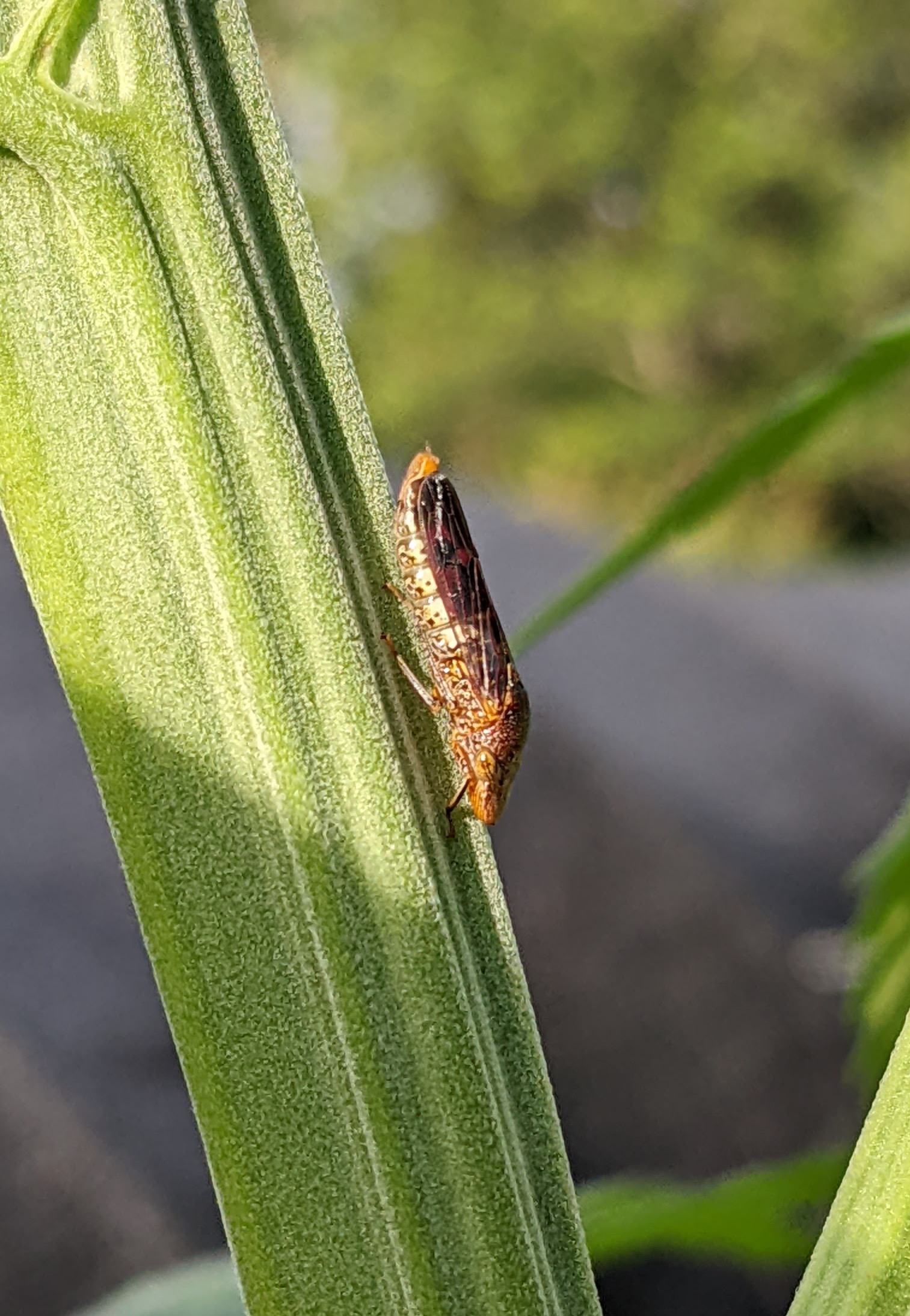
Glassy Winged Sharpshooter on the stem of one of our hemp plants

When we first began growing hemp I would sometimes mistake the whitewashed appearance of hemp leaves as white mold. However what we learned was that the leaves' white coating was actually defecation material from the glassy winged sharpshooters.

Glassy Winged Sharpshooter 'Whitewash' on one of our hemp plant leaflet

Glassy winged sharpshooters require copious amounts of liquid to grow and reproduce. Much of this liquid is excreted out in the form of a white paste, hence the whitewash effect across our hemp leaves.

Across Florida and throughout much of North America, the glassy-winged sharpshooter is a serious agricultural pest known for its potential to spread bacterial diseases to a variety of plants, including agricultural hemp. It feeds on a wide range of host plants and can spread the bacterium Xylella fastidiosa, the causal agent of diseases such as Pierce's disease in grapes and leaf scorch in a variety of other plants.

The glassy-winged sharpshooter, like other members of the leafhopper family, has specialized mouthparts adapted for piercing plant tissues and sucking out fluids. These mouthparts, known as stylets, function much like a straw. However, unlike a typical straw, the process involves more than just applying suction.

When feeding, the sharpshooter pushes its stylets into the plant tissues, navigating past cells until it reaches the plant's xylem - the system of tiny tubes that transport water and dissolved nutrients from the roots to the rest of the plant. Xylem fluid is under negative pressure, or tension, due to the process of transpiration (water evaporation) at the plant's leaves.

Once the sharpshooter's stylets are in the xylem vessels, the tension within these vessels causes the fluid to move into and up the insect's food canal (formed by its stylets), similar to how water will rise in a thin tube or straw. Thus, the sharpshooter doesn't need to actively suck up the fluid. In fact, the sharpshooter has to work to prevent the xylem fluid from flooding its alimentary canal and has a special filter chamber to help manage the volume and pressure of the ingested fluid.

It's worth noting that feeding on xylem fluid presents nutritional challenges, as this fluid is low in nutrients compared to the sugary sap in the plant's phloem (which many other sucking insects, like aphids, prefer). Sharpshooters have adapted to this diet in part through symbiotic relationships with bacteria that help them metabolize and extract nutrients from their food.

When it feeds, it can also introduce the Xylella fastidiosa bacterium into the plant, leading to blockages that can cause leaf scorch, wilting, and even death of the plant. Glassy winged sharpshooters also may be a host for Xylella fastidiosa, another significant plant pathogen.

As for the Integrated Pest Management (IPM) of the glassy-winged sharpshooter, here are some strategies that could be used:

Monitoring: Regular inspections of the hemp fields to catch any sharpshooter infestations early before they become a significant problem.

Biological control: There are several natural predators and parasites of the glassy-winged sharpshooter that could potentially be used for control. For instance, egg parasitoid wasps, such as Gonatocerus spp., lay their eggs inside the eggs of the sharpshooter, preventing them from hatching.

Cultural control: Changing farming practices to make the environment less conducive to the sharpshooter. This could include altering irrigation practices (since sharpshooters are attracted to water), removing potential host plants around the hemp field, or adjusting the timing of planting and harvesting to avoid peak sharpshooter activity.

Chemical control: If necessary, organic-approved insecticides could be used to control sharpshooter populations. These should be used judiciously to avoid killing beneficial insects and to prevent the development of resistance in the sharpshooter population.

As always, the specific IPM strategies used would need to be tailored to the individual farm and its unique conditions. Always consider local laws and regulations when implementing pest management strategies.

Thursday, June 1, 2023

IPM: Parasitoid Wasps Are Important Members of Our Hemp Integrated Pest Management Program

 Parasitic wasps can be highly effective in the biological control of pests like armyworms, an approach that aligns with the principles of Integrated Pest Management (IPM).

Armyworm crawling across one of our hemp plants

Its that time of year again here on the Arendell Hill Hemp and Veggie Farm and we are seeing hungry armyworms crawling over our crops.

We do not use industrial pesticides to control insects. Instead we employ Integrated Pest Management (IPM) techniques such as planting lure/trap plants & also planting host plants for beneficial insects such as parasitoid wasps.

There are different species of these wasps, and they each have their unique behaviors, but all work towards the common goal of pest control.

Parasitoid wasp laying eggs in a caterpillar

Parasitic wasps do not directly attack or consume the pests. Instead, they lay their eggs inside or on the body of the armyworms. When the wasp larvae hatch, they begin to feed on the host worm, ultimately leading to its death. This is a gradual process, and the host pest continues to live for some time even after the wasp eggs have been laid.

Two well-known types of these wasps are braconid wasps and ichneumonid wasps. Braconid wasps are generally smaller and often lay their eggs inside their hosts. Ichneumonid wasps, on the other hand, are larger and usually deposit their eggs on the host's exterior.

Parasitoid wasp larvae eat pest insects

Importantly, these wasps target a variety of pests beyond armyworms, such as caterpillars, aphids, and other insect larvae. This makes them incredibly beneficial for maintaining balance in garden ecosystems.

By encouraging the presence of parasitic wasps in your garden, you can help keep armyworm populations under control. This can be achieved by planting a variety of native flowering plants (my favorite is a native mint, Monarda punctata) that provide nectar for adult wasps, or by avoiding broad-spectrum insecticides that can harm these beneficial insects along with the pests.

This approach not only helps manage pests in a way that's safe for the environment but also fosters a balanced and biodiverse ecosystem in your garden.

Let's hear it for the parasitoid wasps in our hemp garden here in Tallahassee!

Wednesday, May 24, 2023

IPM; Pokeweed, Phytolacca americana, an Important IPM Plant Protecting Hemp and Vegetable Crops

 Phytolacca americana, also known as pokeweed, poke sallet, or poke salad, is a perennial plant native to the eastern United States. It's known for its large, smooth leaves, clusters of dark berries, and distinct red stems. We welcome pokeweed plants and always invite them to grow in the hemp and vegetable gardens because of important roles pokeweed plays in our Integrated Pest Management (IPM) plan.

One of our FAMU pilot varieties of hemp, growing near a large pokeweed plant.

Pesky bugs will usually choose a pokeweed leaf over just about any other plant. Pokeweed's lure and trap capabilities have earned it a reputation as an important Integrated Pest Management (IPM) plan component.

Another potential benefit is that pokeweed can attract birds due to its berries. Birds play a crucial role in pest control, as they eat many types of insects. So, having pokeweed in your garden may draw birds that will feed on your pest population. However, be aware that the berries are toxic to mammals, including humans. We have also noticed that because pokeweed's leaves are rather large, pest insects, Southern Armyworm, Spodoptera eridana and other caterpillars make easy forage targets for our bluebird, nuthatch, finch and wren populations.

Yes, if certain pests in your local area are more attracted to pokeweed than to other plants, they may congregate on the pokeweed, reducing their numbers on more valuable plants. The efficacy of this would depend on the specific pests in question and their feeding preferences. We find that the armyworms love to forage on our pokeweed plants leaves. While these caterpillars are devouring pokeweed leaves they are not eating our other garden plants, including our hemp and they are becoming meals themselves for foraging songbirds.

Another pokeweed plant in the hemp garden, its leaves eaten by insect pests.


Pokeweed is a common plant native to the eastern parts of North America. It has distinctive red stems and produces dark purple berries that are attractive to many bird species. As for why garden insects are drawn to pokeweed, a few factors could be at play:

  1. Plant Chemistry: Like many plants, pokeweed has a unique chemical makeup that can attract certain insects. It's possible that some insects are attracted to particular compounds in pokeweed, whether for food, a place to lay eggs, or another purpose. For instance, pokeweed produces toxic compounds, such as saponins and oxalates, which deter many herbivores but may not deter certain insects adapted to handle these toxins.

  2. Leaf Characteristics: Pokeweed has large, soft leaves, which may be easier for certain insects to eat compared to tougher, smaller leaves on other plants.

  3. Availability and Accessibility: Pokeweed is a vigorous grower and can produce large quantities of leaves and berries, making it an abundant food source for insects. Its size and growth habit also make it accessible to a wide range of insects.

  4. Species-Specific Relationships: Some insect species may have developed a preference or even a dependence on pokeweed through co-evolution, much like monarch butterflies and milkweed. For example, the pokeweed leaffooted bug (Leptoglossus phyllopus) is known to feed on pokeweed.

However, using pokeweed as a trap crop can have some downsides. For example, if the pests are not adequately controlled on the pokeweed, it could become a breeding ground that exacerbates the pest problem. Moreover, pokeweed is a vigorous plant that can become aggressive in its growing habit if not carefully managed. Also, as previously mentioned, all parts of the plant are toxic to mammals when raw and can be dangerous if consumed.

We are convinced that the pokeweed plants growing alongside our garden vegetables, wildflowers and hemp plants offer important IPM benefits as pest insect trap plants. We always remember to treat pokeweed with care because of the plant's toxicity. Importantly, before deciding to use pokeweed as a lure or trap crop, it would be wise to conduct a thorough assessment of your garden's needs and the local pest and wildlife populations. Consulting with a local extension service or a pest management professional could provide valuable insights.

Remember, successful integrated pest management usually involves a combination of techniques, including biological control, use of resistant plant varieties, and crop rotation. A single plant species is unlikely to solve all pest problems yet pokeweed has demonstrated it can lure our garden's pest insects away from our important crops to pokeweed's broad leaves where songbirds and anoles then treat the pest insects as food.

Sunday, May 21, 2023

IPM: Species Biodiversity in the Garden Promotes Effective Integrated Pest Management Results

 We grow many Florida native plant species alongside our FAMU pilot project hemp (x Hepius & x Master Kush).  

The native wildflower, Rudbeckia hirta growing next to a FAMU pilot hemp x Hepius 

We've found the richer the growing area is with respect to plant species biodiversity, the more beneficial insects we notice foraging or taking up communal presence in the garden.

Hemp can be negatively affected by caterpillars and here in North Florida we have so many different types of caterpillars throughout the year.

Parasitoid wasps are helpful in controlling caterpillars by laying eggs in the caterpillar, using the living caterpillar as a larval host.  Parasitoid wasps are often attracted to the growing areas because of the presence of mint plants, like the native Monarda punctata.  Wildflowers also offer beneficial insect attraction potential.

In our hemp and food gardens, native plants and wildflowers are important components of our Integrated Pest Management (IPM) program.  We believe diversity in species not only plays an important role in pest management but also helps create high quality, unique niche plant product through environmental and epigenetic factors.

IPM is a comprehensive, environmentally safe approach to managing pests. It integrates different pest control methods to achieve long-term pest management solutions while minimizing the harm to people and the environment. Biodiversity in plants plays a critical role in this approach for several reasons:

  1. Habitat for Beneficial Insects and Organisms: Different plant species attract different types of insects and other organisms, including those that are beneficial for pest control, such as ladybugs, spiders, and predatory mites. These beneficial insects and organisms feed on pests, helping to keep their populations in check.

  2. Resilience to Pests: A diverse garden with a variety of plant species can be more resilient to pests. If a pest does become a problem, it is less likely to wipe out an entire crop because different plants are often susceptible to different pests.

  3. Disease Resistance: Just as with pests, different plant species have varying degrees of resistance to different diseases. Having a diverse range of plant species can help prevent the spread of disease in a garden or agricultural field.

  4. Crop Rotation and Intercropping: These are two techniques that rely on plant biodiversity. Crop rotation involves changing the type of crop planted in a particular area each season, which can help prevent pests and diseases that favor specific crops. Intercropping, on the other hand, involves growing different types of plants together, which can help deter pests.

  5. Healthier Soil: Biodiversity also contributes to healthier soil. Different plants contribute different nutrients to the soil and have different effects on its structure and microbial life. A diverse range of plants can thus help maintain a healthy, balanced soil ecosystem that can contribute to pest management.

  6. Cover Crops and Green Manures: Some plants can be used as cover crops or green manures. These plants are grown not for harvest but to improve soil health, suppress weeds, and manage pests and diseases. They can be an integral part of an IPM approach.

In conclusion, plant biodiversity is a crucial component of integrated pest management. It helps create a balanced, healthy ecosystem that can naturally keep pests in check while also providing other environmental benefits.

Saturday, May 20, 2023

Florida's Predatory Stinkbug, Natural Pest Control in the Hemp Garden

 Euthyrhynchus floridanus, commonly known as the Florida predatory stink bug, is a species of predatory stink bug in the family Pentatomidae. Like other predatory stink bugs, it can serve as a natural form of pest control in gardens due to its predation on various garden pests.

Adult predatory stinkbug on a hemp leaf

Here are some key benefits of having the Florida predatory stink bug in your garden:

  1. Predation of pests: Florida predatory stink bugs are voracious predators. They feed on a wide variety of insects that are considered pests in gardens and agricultural fields, including caterpillars, beetles, and other bugs. This can help keep pest populations in check, thereby reducing damage to your plants.

  2. Natural pest control: By serving as a natural form of pest control, Florida predatory stink bugs can reduce or even eliminate the need for chemical pesticides in your garden. This can benefit the environment by reducing the amount of toxic chemicals released into it.

  3. Biodiversity: Having a variety of different species in your garden, including predatory stink bugs, can help increase its biodiversity. This can lead to a healthier and more resilient ecosystem.

  4. Balance in the ecosystem: Predators such as the Florida predatory stink bug can help maintain balance in the ecosystem by controlling the population of pests. This can help prevent pest outbreaks that can cause significant damage to your plants.

  5. Cost-effectiveness: Since the Florida predatory stink bug feeds on various pests, encouraging their presence in your garden could potentially save you money on pest control efforts.

Predatory stinkbugs eat caterpillars, slugs, beetles and other garden pest insects

As with any form of biological control, the key is to maintain a balanced ecosystem where no single species becomes too dominant. If the predatory stink bug population grows too large, they might run out of prey and start feeding on your plants.

Predatory stinkbug nymph


So while they can be beneficial, it's still important to monitor their population and the overall health of your garden.

Saturday, May 28, 2022

Florida Hemp, Luna Moth & IPM


Luna Moth & Hemp Entourage Effect #biodiversity

Luna, the moon moth is a member of Actias genus in the Saturniid family. We love caterpillars & moths in our #Hemp cultivation area as they contribute to our amazing hemp #entourage effect & actually are an important matrix member of our #nativeplant & #biodiversity based #IPM efforts. #ArendellHillNursery #CBD #FreshFromFlorida #Permaculture #Organic

Florida Hemp, Leaf Miner Damage & IPM

Florida Hemp exhibiting leaf miner damage

 Leaf miner damage in #hemp leaves. Leaf miners are collectively a group of insects whose larvae 'mine' interior of leaves where minimal cellulose is encountered & where larvae are protected from predators. Many leaf miner species we see in our #hemp cultivation area are members of the moth, Lepidoptera, order. Leaf miner damage to hemp occurs via reduced overall plant photosynthesis & also from fungal & viral infections introduced into the plant through the leaf miner tunnels inside leaves. We use a combination of #IPM methods to control leaf miners including; bird feeding stations, yellow sticky cards with solar night lights, native plant companion plantings, lure plantings and occasional Neem or Spinosad spray applications (both organic approved). #integratedpestmanagement absolutely works best for our #FloridaHemp growing. #ArendellHillNursery #CBD #CBG #Fiber #FreshFromFlorida #Permaculture #Organic


Wednesday, May 25, 2022

Florida Hemp, Spiders Ambush Pest Insects

Spiders love flowers in our pollinator section of #hemp cultivation area. So many lying in wait to surprise unsuspecting bugs. Spiders are great #IPM team members! #arendellhillnursery #permaculture #spiders #bugs #integratedpestmanagement #floridahemp #cbd #850hemp https://t.co/YVDAUd1NMi

Sunday, May 22, 2022

Florida Hemp, Controlling Glossy Winged Sharpshooters


 Do you know this sucking bug?  It’s a Glossy Winged Sharpshooter, Homalodisca sp., & is sucking on xylem of my #hemp crop. A green anole though is about to catch & eat it. GWSSs transmit Xylella bacterium damaging plants. Birds & anoles are good controls for this native bug who also leaves copious amounts of anal discharge. #floridahemp #freshfromflorida #ipm #permaculture #organic #cbd #arendellhillnursery #welovebugs #bugs 
 Do you know this sucking bug?  It’s a Glossy Winged Sharpshooter, Homalodisca sp., & is sucking on xylem of my #hemp crop. A green anole though is about to catch & eat it. GWSSs transmit Xylella bacterium damaging plants. Birds & anoles are good controls for this native bug who also leaves copious amounts of anal discharge. #floridahemp #freshfromflorida #ipm #permaculture #organic #cbd #arendellhillnursery #welovebugs #bugs 
 Do you know this sucking bug?  It’s a Glossy Winged Sharpshooter, Homalodisca sp., & is sucking on xylem of my #hemp crop. A green anole though is about to catch & eat it. GWSSs transmit Xylella bacterium damaging plants. Birds & anoles are good controls for this native bug who also leaves copious amounts of anal discharge. #floridahemp #freshfromflorida #ipm #permaculture #organic #cbd #arendellhillnursery #welovebugs #bugs 

Saturday, May 21, 2022

Florida Hemp, Green Anoles for Hemp IPM

Green anole, Anolis carolinensis, on pest patrol duty in our #hemp cultivation area. The native green anole eats twice their weight in pesky bugs (we love most bugs!) every day. #Floridahemp #freshfromflorida #arendellhillnursery #ipm #anoles #pestcontrol #fiber #cbd https://t.co/wKMGh0bKzC

Sunday, May 15, 2022

Florida Hemp, Catnip Companion for IPM & Entourage Effect

Catnip growing in w our #hemp for #Entourage effect & #IPM. #terpenes #floridahemp #arendellhillnursery #cbd #cbg #catnip #permaculture #freshfromflorida #fiber https://t.co/FFtC0tKAXW

Friday, May 13, 2022

Florida Hemp BMPs, Black Soldier Flies

Happy to see Black Soldier Flies! Hermetia illucens, #stratiomyidae These insects work the soil as larvae as good as earthworms do & help decompose organic matter, making our soils even more productive. They make great chicken feed too!  #freshfromflorida #floridahemp #ipm https://t.co/VYa3mSl5wX