Showing posts with label urban permaculture. Show all posts

Saturday, February 18, 2017

Intense Small Scale Urban Permaculture, Urban Sustainability

Truly amazing how much food can be grown in a tiny space.
Urban Permaculture Genius. Maximize food and flower production in tiny city spaces.
Tried and proven permaculture methods can ensure fertilization, efficiency, pollination, irrigation and wind protection for maximized food production.

Though the above may sound industrial or way too mechanical, with plants the ends result is beauty.

Beauty and food.  Sense of place and habitat for pollinators.  Soil stabilization and enrichment. Urban heat island cooling remedy.  Carbon and nutrient sink.  And much better than turf grass lawns.

Kudos to Judy Songer on one of her urban permaculture garden designs!

Monday, February 13, 2017

Xeriscaping. Drip Irrigation DIY for Growing Locations Without Running Water

Not all locations have running water available for drip irrigation of food crops and other cash plants.
Urban Green and Permaculture sometimes requires irrigation where water supplies do not exist. DIY Drip irrigation can provide water efficient irrigation and nutrient systems and can be constructed from readily obtainable, even recycled materials.  Here a drip systems is made from a 5 gallon bucket, tubing and bamboo.

Here is an awesome DIY idea for an easy to construct yet very effective drip irrigation system.

If you are ever in the vicinity of Fort Myers be sure to stop by and visit ECHO Global Farm for permaculture support systems like this they refer to as 'appropriate technologies'.

With this portable and inexpensive but highly effective drip irrigation system a five gallon bucket is used as a water tower or water storage unit.  The five gallon bucket is covered with a filter cloth to keep leaves and debris out of the collected water (rainwater or added water) and hung from a bamboo stand..

Attached to the bottom of the bucket is a drip irrigation hose placed through the bucket wall in a drilled out hole, caulked around the edges.

The irrigation hose is woven through the planted crops needing irrigation, staked into the ground and fitted with drip nozzles.

Water conservation is an important part of sustainable agriculture.

Drip irrigation and water supply systems don't have to be expensive or complicated.  With a little creativity one can incorporate simple, appropriate technology growing systems into their permaculture project, green roof or urban farm.

Sunday, February 5, 2017

Raised Growing Beds & Permaculture Gardens

Below is a repost of a summer 2012 note on Urban Permaculture and raised beds.  It is never too early to start thinking about the upcoming planting seasons in the community gardens!

Summer is half over and that means we are thinking about raised bed fall and winter plantings.  Ordering seeds for the next season's crop is so much fun!  We love going through the catalogues, admiring the photos, thinking about the upcoming seed starting and transplanting efforts.

Here are some of our tried and true, favorite cooler weather plants we like to have started by mid September.  The links will take you to either a description or catalogue page. 


Don't forget to download our Urban Farming book from Amazon with all the secrets about gardening, coop building, hens and more by clicking here!

Florida Permaculture Raised Bed Chives & Lettuces
Also known as rocket, arugula with her bitter, earthy flavors is one of my favorite winter plants.  Excellent on sandwiches, in salads or by herself, arugula is easy to grow, hardy and a must for every Urban Farm garden.
Florida Permaculture Raised Bed Arugula
Famous heirloom varieties, both Mary and Martha Washington varieties were developed around at the beginning of the twentieth century for greater disease resistance. The 1930 Ferry catalog states that Mary Washington asparagus is  "A vigorous growing and productive asparagus bred to resist the disease known as asparagus rust". Mary is a Martha cultivar with oval tipped stalks and comes highly recommended by most asparagus growers.
Another well-known heirloom variety, use dating to just after the Civil War in the Americas but earlier in Europe, Calabrese broccoli is a dark green plant, twenty to thirty inches in height, producing fist-sized central heads, and many side shoots until frost. Noted for her texture and flavor.
Use a variety of Broccolis, cultivars including Belstar, Premium Crop, Packman, Gypsy, Major, Nutribud and Waltham all produce large amounts of food.
An 1820’s heirloom variety, the three inch, round, golden beet bulbs are known for their desirable sweetness. Golden beet’s unusual color adds to her versatility.  Very sweet beet.
The early 1900’s heirloom Early Wonder Beet produces well before the other full-sized beets, has medium to tall size tops that can be harvested and served as delicious greens. Early Wonder possesses a deep red color and rich, hearty flavor.
Deep crimson, dark red, vigorous growing beet producing ample greens. Red cloud beet is know for her resistance to bolting.  She can be harvested throughout most of the growing season.
St. Valery Carrot is an 1885 heirloom carrot and, according to James Vicks’ 1924 catalog, is the "best and most handsome main crop carrot. Enormously productive, very desirable for private gardens as well as for markets." St. Valery has ten inch roots and a strong sugar content (sweet).
The New Kuroda carrot is a strong preforming hybrid, exhibiting a deep reddish orange color. Kuroda may be used as the main carrot crop as it produces well on most small homesteads and growing operations.
Adelaide is a Dutch hybrid know by its more popular common name, Baby Carrot.  Easy to grow and a solid producer, Adelaide keeps its texture and fresh, sweet flavor longer than most carrots.  Very sweet carrot and great for salads.
Long Island Brussel Sprouts is an 1890 heirloom dwarf brussel sprout variety growing on average to approximately two to three feet depending upon climate. The Long Island Brussel variety can set up to one hundred sprouts per plant and was considered the primary commercial variety for years.
Early Jersey Wakefield has been considered one of the best varieties of early producing cabbages for several hundred years of homestead agriculture.  Early Jersey is a 1840 heirloom variety growing to approximately three pound.  She exhibits a pale green leaf color and can be planted close together. According to DM Ferry in 1930, "this most excellent variety is the earliest and surest heading" and one that resists yellowing.
Another cabbage variety highly resilient to yellowing and splitting, Quick Start hybrid is a strong grower, one that can be planted close together in raised beds and relied upon for steady production of three pound cabbage heads.
Danish Ballhead is an 1887 heirloom late fall, blue-green producer. Danish Ballhead was originally introduced by Burpee Seed and has been a popular variety for years.  This cabbage keeps well in storage.
Mills says that Mammoth Red Rock 1880 heirloom cabbage is the “largest of the red cabbages and the most sure heading, also the best for pickling". Mammoth Red had reddish purple leaves and produces a five pound plus cabbage head.  Strong producer and stores well.
This 1890 heirloom cabbage heirloom variety was introduced in the mid-1800's by P. Henderson, president of Henderson Seed Company.  Early snowball cabbage is a reliable early producer of firm texture.  Very popular variety among urban farmers.
Bright Lights Swiss Chard is a stunning plant, certainly desirable for garden appearance but most appreciably important because of her delicious taste and reliable food production.  Leaves are bright deep green, moderately savoyed with veins of stunning bright warm and hot colors, most commonly red, orange, or yellow.  Developed by Johnny's Selected Seeds, this variety is perfect for the smaller garden or those gardens looking to capitalize on visual effect.  Bright Lights is highly recommended by both judy and myself.
Fordhook, while not as visually stunning as Bright Lights, is a reliable performer producing strong and plump white stalks with savory, bright green leaves.
As with Bright Lights Chard, Pink Lipstick offers amazing bright pink-red color. Use Pink Lipstick Chard in salad mixes for color and taste.
This 1890 heirloom cauliflower heirloom variety was introduced in the mid-1800's by P. Henderson, president of Henderson Seed Company.  Early snowball cabbage is a reliable early producer of firm texture.  Another variety popular variety among urban farmers.
Another great cooler weather plant, Starbor Kale is perfect for raised beds because of her beautiful blueish-green hue, firm leaves, great texture and compact growing characteristics. Greens can be eaten cooked or raw in salads.
An 1885 heirloom variety previously referred to as Tuscan Black Palm.  Dinosaur Kale offers large, rounded, succulent greens. Plants are hardy, exhibit vigorous growth habit and are popular among urban farmers as a crop that will feed the family.  We have grown Dinosaur Kale reliably for years.  Greens are good either as a salad component or cooked.
One of my favorite urban farm Kales, the Ethiopian variety will produce like none other.  Very tender and tasty and very drought tolerant.  Grows well in raised beds and seems to be root-knot nematode resistant.
Kohlrabi is also known as a ‘cabbage-turnip’ and the Grand Duke Variety produces a larger, non-woody edible part.  Very interesting plant for the garden and reliable producer.

Excellent pre-Civil War heirloom Kohlrabi variety.  According to DM Ferry Early Purple Vienna Kohlrabi can be considered "early with small top, the leaf stems being tinged with purple. Bulbs of medium size, purple; flesh white. Desirable for forcing and early outdoor planting."  Another excellent vegetable for the urban farm homestead, preforming will in raised beds.
Leeks are an important part of all urban farm gardens.  Lincoln leek is a long , succulent variety that can last for much of the year.  Used in salads, stir fry and other dishes.  Here in the south, established leeks offer good winter color and texture to the urban farm garden.
One of my favorites, this variety is evergreen, drought tolerant and produces well year around.  Offers brilliant white flower spikes.  This is probably one of the most hardiest of the urban farm plants, almost always reliable to out-preform any other crop.
Beautiful red-green, crisp standard lettuce, this variety is a cornerstone of any winter garden in the urban core.  Asian red thrives when picked, producing more and more throughout the season. 
Another popular lettuce variety, especially in Europe, year-round lettuce is as what her name states, a reliable producer except in the hottest of climates where she does best grown in the shade.
Florida Permaculture Raised Bed Lettuces
Ours favorite mix includes; Green Ice, Midnight Ruffles, Black Seeded Simpson, Simpson Elite, Matina Sweet, Buttercrunch, Red Velvet, and May Queen varieties.  Perfect for adding color and a variety of textures to salads.  The urban core farm animals love lettuces too.
A 1949 heirloom, mild radish, Cherry Belle is a standard for urban core farming.  She will produce up to one inch in diameter radishes, perfect for salads and snacks.  Another reliable producer, Cherry Belle is a standard for urban core farms and gardens.
A mid-1800’s heirloom, this white radish has her history in reliable production and ease of growth traits.  Wonderful, narrow, finger-like radishes they are perfect for salads.  Serve crisp and cold.
A 1920’s heirloom and described by James Vick as a spinach that, "grows about ten inches high. Large deep green leaves, thick and tender, with rounded tips."  Giant noble spinach needs cooler weather but will faithfully give the urban farmer plenty of tasty greens for both salad and cooked dishes.  
Tyee spinanch is a slow to bolt spinach growing well in raised beds and intense urban core farm settings.  Tyee spinach leaves are smaller than Giant Noble but heavy producers.  Good companion spinach plant to grow alongside with Giant Noble.
Florida Permaculture Raised Bed Lettuces
Herbs/Spices
Borago officinalis grows to approxiately two to three feet in height and loves the cooler weather.  I’ve grown this plant successfully on urban core green roofs and in urban farm homestead raised beds.  The bright blue and purple flowers are visually an eye-opener and are often used as garnish for vegetable and fruit salads.  Good urban farm plant selection.
Standard pickling plant and herb, dill is an extremely drought tolerant urban farm plant with many culinary uses.  Our rabbits love the fresh picked leaves and the tall but tiny yellow flowers serve as an excellent attractant for pollinators.  Grows well in dry, neglected areas across the urban homestead.
An All America Winner in 1992 and introduced by W. Atlee Burpee Company, Fernleaf Dill exhibits a more compact growth habit than most of the other, sprawlingly large dill varieties.  Fernleaf dill is perfect for container growing or planting in heavily used raised beds.  As with the standard dill varieties, Fernleaf Dill provides good drought tolerant production as well as tasty culinary uses.
Fennel is popular for her licorice or anise-flavored seeds and bulbous base, both used in cooking.  Fennel is also a choice pollinator plant and brings a spray of light airy green to the urban core farmstead.  
An awesome landscape perennial, Bronze Fennel brings visual and culinary benefits to any urban farm garden.  Highly sought after by several Lepidoptera species, this hardy fennel can be used in cooking or as a tea.  Bronze fennel will grow about three to four feet high depending on climate and soil conditions and adds beauty and flavor to the herb patch.
A relative of oregano, marjoram is slightly sweeter and enjoys the cold weather.  She is very drought tolerant and her smaller leaves can be used to flavor meat dishes.  Marjoram is also used ethnobotanically in the Caribbean as a tea plant for both stomach and respiratory issues as she possesses an strong aromatic quality.
Standard flat-leafed parsley is a mainstay of urban core farms.  Used in Italian and Mediterrian cooking and for a variety of other uses (including keeping garlic fumes repressed in healthy diet breath), flat-leafed parsley is also sought after by many butterflies as larval food.
Curly parsley is a very hardy cultivar of the parsleys, reliable and useful as garnish, in soups, salads or to flavor meat dishes.  As with flat-leaf parsley, curly parsley is commonly used in Mediterranean dishes such as tabouli, hummus and other dishes.

Monday, May 20, 2013

Urban Green for Cardiovascular Health

Unfortunately I am having a very difficult time writing anymore, as you can see from the frequency of my posts.


Florida Urban Permaculture Garden by Judy - compost, plant a seed & grow food

Many of you are aware, but for those that are not, I 'encountered' an Type A aortic dissection that started with an aneurysm in my aortic root and split the aorta down through my chest, into my abdomen, into my kidney and down through my leg into my foot.

I am really supposed to be gone.  However there is more work to do first.  There are lots of opportunity for the world to plant Urban Green and benefit greatly with respect to cardiovascular health, and overall health in general.  On those days I can get out of bed, I am here to encourage you to plant!

Florida Urban Permaculture Garden by Judy -Mix flowers and veggies for pollinator attraction


Urban Green can translate into excellent quality of life and strong longevity for a city's general population.  Thank God I have a wife who's passion is plants, for I cannot anymore garden with my health as it is.

And you can do it!  There is no real secret to good permaculture practices.

All it takes is the time to plant a flower or vegetable or fruit tree or other plant - anywhere!  On a patio, balcony, windowsill, in your gutters or on a rooftop!!!

Florida Urban Permaculture Garden by Judy -sandy soil works too - with LOTS of leaves and compost!


You don't need a big farm or a big yard to bring Urban Green back to the Urban Core. 

Over the next couple months, as I can type, my thoughts on why Urban Green is so important to cardiovascular health are going to be the topic.  We'll be sharing all of what we learned on why it is so easy to create Urban Green & why it is so important cardiovascular-wise!
Florida Urban Permaculture Garden by Judy -cooking herbs, rosemary & garlic chives growing close to front door


Hope you join us on this journey into health for the body and health for the entire world!

P.S.  I am looking to the garden for my healthy diet that will help heal what most say is non-healable.  But we shall see..........

Wednesday, August 1, 2012

Native Plants for Urban Green, Permaculture & Green Roofs

The bioswale is looking great!
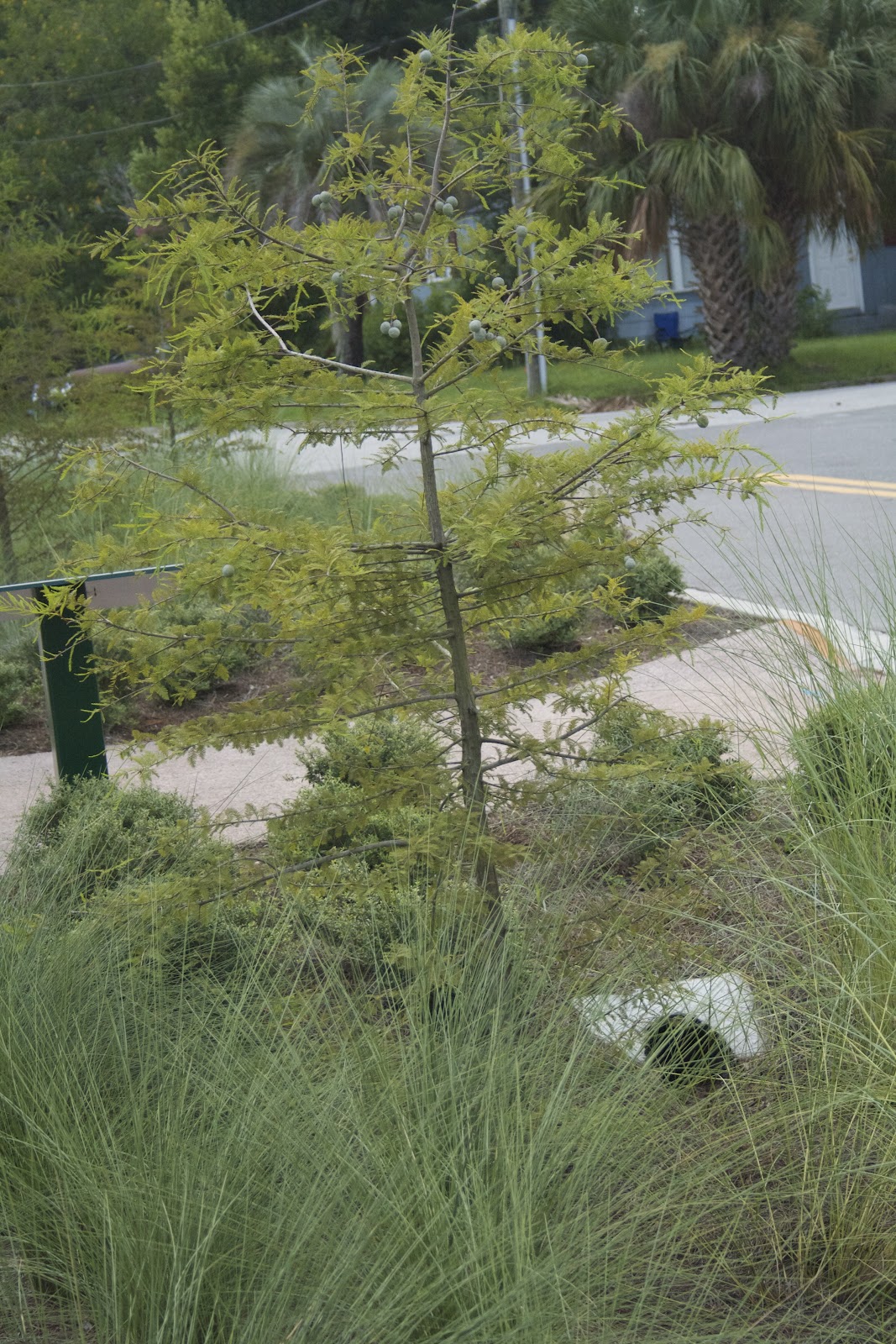
LaSalle Bioswale Project - Native Plants for the Urban Core
We were out on errands day before yesterday and Judy had library books due, so the San Marco library was a stop on the list, and I was thrilled.  You see, Riverkeeper and Coca Cola funded a stormwater project I've mentioned before called a bioswale in front of the city facility.

Of course there were engineers involved (Doug Skiles) and plant people like Bob Chabot and Chris Dailey from the Jacksonville Zoo and Gardens, and others.
The Bioswale takes the place of the old right-of-way landscape
Though a stormwater ditch may not sound much like an Urban Green project, nor may it be as glamorous as a green roof or front yard filled with food plants, it is important to all the above.

I have to keep reminding the botanist in me about the importance of native plants.

San Marco's library bioswale is filled with ethnobotanically important native plants.
Cordgrass, Muhly grass, Cypress, Ilex and curbcuts gather and treat stormwater

However, many times these native plants are looked down on by, yes, even those involved in Urban Green, Green Roofs and Permaculture efforts.

Maybe due to their 'commonness', or lack of pretty, patented fluorescent flowers (though many native species are stunning in their own right), or minimal fruiting-food production, natives are out-of-vogue with a large component of the Urban Green movement.  In fact, in the Urban Farm movement, little if any thought is given to the impact of planting food plants that may themselves be another eventually invasive or monoculture problem.
Native plants provide habitat for native pollinators
Sometimes this may be due to the fact that urban farmers, green roof designers and permaculturists are used to thinking along the lines of only one mindset (including myself).

Yet the plants here are just as rich in ethnobotanical value as any exotic plant such as moringa, without the dangers of becoming invasive.  Though preached and loved as the ultimate plant, moringa has been classified as a potential dangerous plant for native habitats (see Michigan Technological University's website).
Existing utilities were worked around during design and installation
Other times it may be because of a lack of education and information about the true value of native plants to Urban Green, Green Roofs and City Permaculture projects.

But the San Marco bioswale brings all that back to mind very quickly.

The native plants growing in the San Marco bioswale not only clean standing and flowing stormwater, they are able to withstand long periods of drought without additional irrigation.  This is important because of our present water supply crises.  The plants can adapt to either floods or dry periods, without having to turn on the hose.
Native plants provide the transition beauty from street to building
Urban landscape, green roof and farming irrigation add up to be a significant amount of water use in our cities.  Hopefully, projects like the San Marco bioswale can educate us all to the fact that native plants can provide landscape beauty without added irrigation.

Yet there is more.  As I was walking around the bioswale, I noticed hundreds, if not thousands of dragonflies, damselflies and other insects.
Because of low leaf litter rate and ability to survive drought or flood, Cypress is perfect for bioswales
The bioswale was acting as a virtual breeding nursery for pollinators, those same pollinators permaculturists pray for around their gardens.  The native plants provide habitat for native pollinators to breed, forage and live in.  Without native pollinators there can be no food gardens.  Without native pollinators there will be no flower pollination.  Without native pollinators there are no city farms.

Importantly, we must recognize mistakes we as a culture have made in the past bringing in exotic plants for food, erosion control and landscape beauty that eventually have turned into nightmare plants.  Kudzu, wisteria, Mexican petunia and potato vine are just a few of many.  Unleashing plant monocultures that choke out native grasses and other plants has been a process that once we start has been difficult to rehabilitate.

The disappearance of many native pollinators and beneficial insects, amphibians and reptiles can be directly related to the use of food and landscape plants from foreign ecosystems that having once arrived, take over and preclude habitat for the native species.

Once our native species are gone we are left with a hodgepodge of alien plants.

Unfortunately, though gaining in popularity, native plant landscape are still under-appreciated for their biodiversity, pollinator support and habitat providing value.

Permaculture, green roofs and Urban Green have come a long way.  They still have a long way to go with respect to incorporating native plants.

Hopefully, projects like the San Marco bioswale will teach us about why we need a majority of native plant species on our green roofs, permaculture gardens and Urban Core Green.


Sunday, July 15, 2012

City Farming in Jacksonville, a Permaculture Narrative

Read about Kevin and Judy's experiences with all things Urban farming.  Ducks, geese, turkeys, rabbits, hens and thousands of plants all on a city lot!

Available through Kindle here!

The Real Scoop about Urban Farming!


Wednesday, March 14, 2012

Florida Permaculture, Life on the Urban Farm


Never name an animal that you plan to cook later and don’t be surprised if the critters jump and fly or run after you’ve removed their heads.


Animals are put on the earth here for food for us, plain and simple.  And the whole purpose of starting with twenty six chickens was to have enough to cook one every couple of weeks on top of all the eggs we’d get.

Kevin & Judy's Urban Farm Fowl (Turkeys)

Kevin & Judy's Urban Farm Fowl (Ducks & Geese)

Kevin & Judy's Urban Farm Fowl (Baby Goose)
Even Momma told me about her Mom, my Grandma, who’d clean a chicken each week in Miami and cook the very best fried chicken one ever tasted. 


Never mind the fact that it has taken ten to twenty weeks to raise up the fowl from the cute little fluffy balls of chirps, gobble and quack, fifty pounds of weekly scratch feed, countless thousands of gallons of fresh water and the emergence of a strange but strong love-hate relationship, the animals are meant to be eaten.


My friend Pascale, the green roof expert from France even recommended mustard with cooked rabbit on a stick.


Judy however has decided that raising an animal from babyhood commands too many feelings of love and protection to take the killing and eating of what have essentially become our pets lightly. She woke up breathless one night from a dream in which we were eating rabbit stew.   We were eating Jack, Ruby, Thumper, or Midnight. This was when we understood we'd probably not try to breed more rabbits for food, them being mammals and all. 


The chickens should have been easier, but Judy grew very attached to the hens also. Raising them from fluffy little day old chicks (what could be cuter?) to awkward but endearing pullets and on to beautiful hens with iridescent beauty and sweet natures has made it very hard to want to eat our cluckers. I think we are just not hungry enough perhaps. 


Then there is the question of “embodied energy” and not just the spiritual idea of sacred life force. Embodied energy is the issue of how much water and food it takes to raise a chicken, duck, turkey, goose, or rabbit to a mature eating size. 


Judy has come to the conclusion that it isn’t wrong to eat meat or to raise and kill your own animals for food. Animal food is nutrient dense in a way that our bodies can utilize well. Raising your own meat animals is kinder to the critters in the long run than buying factory raised animals. 


Killing and eating an animal is a momentous act and shouldn’t be taken lightly. Perhaps this is why there were so many laws concerning the killing and eating of animals in the Old Testament, such as a lamb not being cooked in it’s mother’s milk and other rituals concerning the slaughter of animals including offering them to God. Contrast these ancient ways with the modern practice of supermarket meat wrapped in plastic and styrofoam and the practice of basing our diets on meat, such as some of  the ill-advised “low- carb” diets. 


Moreover, I’d suppose many of us would stop eating meat if we had to kill the critters and dress them out, disposing of the innards and carcasses.  Importantly, most cities and municipalities who allow for Urban Farm animals prohibit the slaughter of said animals in residential areas.  However, there are many licensed butcher and slaughter houses across the country, one probably not too far away from your farm.


A sharp machete and well placed swing will quickly dispatch most of the Urban Farm animals.    Butcher block and butcher knife will also work.  The knife’s motion must be swift though, to minimize pain.  Don’t be alarmed if the hen, goose or turkey continues to cackle, hoot or gobble, even without their heads.  A large, twenty pound headless turkey can especially put on a show, flying across the Urban Farm backyard, slinging blood everywhere.   If you are going to clean your own meat, be prepared to handle the gore.


Our uncomfortable adversity to killing and dressing backyard farm critters is only a couple generations displaced.  Grandparents thought nothing of slaughtering, cleaning and cooking a backyard bird or rabbit.  Really, it was the early Baby Boomer generation first forsaking the raising and killing of hens for Sunday dinner.  My mother has spoken of watching her momma cutting the hen into fryable sections soon to become delicious fried chicken.


Keep your knives sharp.  A sharp knife makes the job so much easier.  Once you’ve mastered the art of beheading and cleaning a farm critter, it should take no more than ten minutes from picking up the critter slated for the kitchen to the final wash of the meat.


I recommend a heavy butcher knife, a large, long serrated knife and a small paring type knife.  The head should be removed first, with a swift blow from the heavy butcher or a swing from a machete.  Be sure you don’t cut off your fingers and be ready for the blood.  A handy hose helps with the mess.


Separation of the legs and wings using the serrated knife follows the head.  Place the head, legs and wings in a garbage bag and using the small paring knife, slit the outer layer of skin from the neck down the chest about four inches.  Set the knife on the butcher table and using both hands pull the skin and feathers away from the underlying meat.  The skin should easily come off, similar to a pair of pajamas pulled off in the morning.


The feathers and skin goes into the same garbage bag as the legs, wings and head.  Once the bird is de-skinned it is time to remove the entrails.  Open the birds chest with the small sharp knife and reach in, grasping all the internal organs and intestines, pulling them out and placing all the guts in the garbage bag.  Try not to puncture to intestines.  Be sure to remove all internal parts and wash the cleaned bird down with the pressurized water nozzle.  Wash the carcass even more thoroughly if the intestines are punctures during the cleaning process.


Cleaned critters can be cooked immediately or wrapped in plastic grocery bags and placed in the freezer.


Urban Farm critters that are allowed to free range grow tough and stringy very quickly.  If you choose to eat your animals, consider cleaning the young and tender.  Sinewy meat may smell good in the oven baking or on the range frying but once stuck tightly in between teeth, opinions quickly change.


Killing and dressing your Urban Farm fowl and rabbits is the most honorable way to eat meat if you choose to do so.  Taking full responsibility for the death of and cleaning the of a creature before enjoying his or her meat is an educational opportunity.  Understanding the full impact of meat’s life cycle creates sustainability, it creates an intimate awareness of our actions.  Though we may choose for a season to ignore how  grocery store meat arrived on the shelves or in the freezer, the ignorance will eventually catch us individually and as a nation.  Participatory meat preparation celebrates the gift of meat made by your critter and sheds light on the true value of life.


Even better, consider becoming a vegetarian.  This may be easier than you think, for once you experience killing and dressing out a bird or rabbit, your personal attitude concerning carnivorous habits may change.   


Judy may agree to eat some of the ducks, geese and turkey that are already put in the freezer, but meanwhile it is still summer and it is easier to have a vegetarian diet supplemented with our fresh eggs and organic yogurt right now.   Me; due to the spiritual complexity and cost effectiveness of killing and dressing out, I am pretty much done with the meat (though it is amazing just how quickly we soon sometimes forget).