
Florida Hemp exhibiting leaf miner damage
Leaf miner damage in #hemp leaves. Leaf miners are collectively a group of insects whose larvae 'mine' interior of leaves where minimal cellulose is encountered & where larvae are protected from predators. Many leaf miner species we see in our #hemp cultivation area are members of the moth, Lepidoptera, order. Leaf miner damage to hemp occurs via reduced overall plant photosynthesis & also from fungal & viral infections introduced into the plant through the leaf miner tunnels inside leaves. We use a combination of #IPM methods to control leaf miners including; bird feeding stations, yellow sticky cards with solar night lights, native plant companion plantings, lure plantings and occasional Neem or Spinosad spray applications (both organic approved). #integratedpestmanagement absolutely works best for our #FloridaHemp growing. #ArendellHillNursery #CBD #CBG #Fiber #FreshFromFlorida #Permaculture #Organic
Saturday, May 28, 2022
Florida Hemp, Leaf Miner Damage & IPM
Tuesday, May 3, 2022
Florida Hemp, Pokeberry & Integrated Pest Management

Tuesday, April 19, 2022
xHepius Florida Hemp Genetics, IPM & UV Light

Wednesday, April 13, 2022
Florida Hemp, Native Wildflowers & Integrated Pest Management, Asclepias Seedlings

Thursday, March 10, 2022
Earwigs (Dermaptera) and Florida Organic Hemp Cultivation
 |
| Florida Organic Hemp Pest Management, Earwigs belong to the insect order Dermaptera |
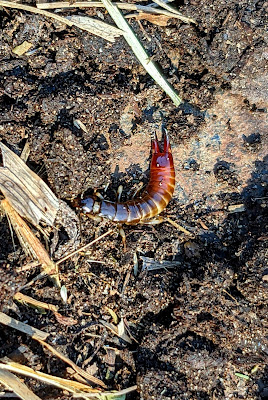 |
| Florida Organic Hemp Pest Management, Earwigs have 'pinchers' also called 'cerci' attached to the rear of their abdomen |
Sunday, February 27, 2022
Florida Organic Hemp Cultivation and Fungi Based Integrated Pest Management
Blue oyster mushrooms, Pleurotus sp., are an important part of our Integrated Pest Management program here across Arendell Hill nursery.
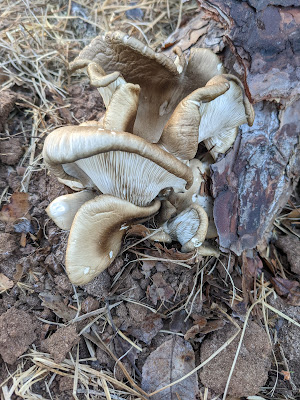 |
| Oyster mushrooms are an integral part of Organic Hemp IPM program here at Arendell Hill |
Oyster mushrooms help clean stormwater and detoxify any contaminants that find their way via wind, rain or drift into the garden.
Interestingly, many fungi are capable of absorbing complex carbon chains found in the environment and converting them into carbohydrates for their own growth.
Mycoremediation, as the mushroom's decon process is commonly referred to, has been shown to be an effective way to support hemp cultivation area cleanliness while helping to ensure pure surface water.
Additionally, mycobooms, which are a mixture of hay and fungal spores can be used to contain and cleanup most types of contamination spills and can be an effective pollution control management tool.
Because our cultivation areas are organically managed and free of pesticides and herbicides, the oysters in our garden are usually free of contamination and may also end up in our kitchen for dinnertime sauteing.
For decades, fungi have been successfully used in many organic-focused integrated pest management programs. Additionally, mushrooms are fun to grow. Cultivating oyster mushrooms as a companion species to hemp is just one, but an important part, of Arendell Hill's organic hemp integrated pest management program.
Wednesday, February 23, 2022
Sow Thistle & Hemp Cultivation
Pest plant (weed) alert!
 |
| Sow Thistle, Sonchus sp., an invasive weed in the hemp cultivation area |
Sow thistle, Sonchus sp., is native to Eurasia and Africa but can be found across Florida in yards, farms and in the woods.
Each plant can produce up to 10,000 seeds and each seed can last many years, laying dormant until the right conditions come along. The young leaves can also be cooked as potherb greens.
The problem with sow thistle is that the plant is so prolific and hardy with it's fat tap root that sow thistle takes away habitat from native flora (botanical adverse possession) and can crowd out hemp plants in the cultivation area.
I just mow or weed eat sow thistle down before flowers form, preventing the plants from reproducing, keeping them out of the garden.
Often mistaken for dandelion, sow thistle is in the aster family. Both have basal rosettes yet the leaves are considerably different. Aphids are often attracted to sow thistle.
Friday, February 18, 2022
Warrior Beetles and Organic Hemp Cultivation
Warrior beetle. Good insect for hemp cultivation.
Warrior beetles are excellent predatory pests to have in the Florida organic hemp cultivation area.

Pasimachus sp., plays an important role in our organic integrated pest management program.
Pasimachus has a never ending appetite for pest insects in the garden! What a great predatory beetle.
#IPM #organic #hemp #Florida #Floridahemp
Florida Hemp Cultivation Bed Preparation
Hay arrived yesterday for spring gardens.
Hemp cultivation is made easier with a quality mulch such as organic hay.

Excellent quality organic hay is useful as a mulch in the hemp garden, usually a bit more pest free than our mulched leaves.
We do mulch and reuse our leaves too however we find hay to be a favorite for maintaining soil moisture, keeping soils less compacted and not as hot, for buffering pH and contributing to overall organic matter content.
Hay is easily to spread, lightweight and readily & sustainably available on a local basis.
Friday, November 5, 2021
Growing Hemp on a Green Roof? Is it Possible?
 |
| Growing Tomatoes on a green roof is similar in many ways to growing hemp on a green roof. |
It is probable that hemp planted green roofs will become a norm in the future.
Hemp is a viable green roof crop with many positive economic and ecological attributes. For instance hemp is a choice raw material in the making of paper and rope.
But what are the challenges of growing hemp on a rooftop? There are many. However, I believe that as in any green roof plant, hemp can be grown across a green roof system with proper consideration given to those challenges.
First, one must be familiar with the hemp plant and its growing requirements. There are many varieties and cultivars of the hemp plant and each will have its own historically preferred conditions. So knowing your hemp plant is important.
In addition to understanding hemp's growing requirements you must have a solid knowledge of organic hemp pest control. I believe all rooftop grown hemp must be treated for pests using only organic integrated pest management (OIPM) principles.
Integrated, organic pest management with an emphasis on cleanliness and exclusion should be the management approach of all green roof operations, hemp or otherwise. Green roofs are subject to constant winds. Spraying chemical herbicides and pesticides on a rooftop could potentially expose adjacent neighbors to wind carried toxic compounds.
Irrigation is another issue to be resolved for hemp plants grown on green roofs. Hemp, as all members of the Cannabaceae, are C3 plants. C3 plants have evolved photosynthetic systems that are prone to support fast growth but also rapid desiccation potential. Hemp must not be overwatered yet the plant also requires consistent water supply to its roots.
Before deciding on the best irrigation system for a hemp planted green roof there are other factors to be considered, including; heat tolerance, light levels, flowering requirements and more. Some of hemp's optimal growing requirements can be addressed with either added mechanical systems or also with plant portability.
Temperatures on a rooftop can reach upwards of 150 degrees F or 66 degrees C. Hemp won't survive long under those temperatures without a level of temperature mitigation. Temperature mitigation options can include shade systems such as movable polypropylene screens or planting location strategies which take advantage of existing shade.
Other temperature options can include the possibility of utilizing a portable growing system that can be moved across the rooftop or off the rooftop as necessary.
Of course as with any mechanical system the rule should be; "the simpler the better ". All mechanical systems can fail.
Sunlight exposure and shading also have to be factored into flowering requirements.
Green roof winds can also be a serious challenge to fast growing and in some cases tall hemp plants. Storms can quickly develop and hail or high speed winds may break, damage or topple hemp plants.
Despite all the challenges and considerations a rooftop grower of hemp must take into account, there are potential advantages to green roof hemp cultivation.
Free sunlight, rain, constant breezes and a measurable reduction of vectored pests may be benefits of rooftop hemp farming.
We will look at the many disadvantages and positive aspects of growing hemp on rooftops in future posts.
In the meanwhile, consider the issues associated with growing hemp on a green roof. Talk with experienced green roof designers and growers. As hemp becomes more excepted the popularity of hemp green roofs will only increase.