Showing posts with label organic hemp growing. Show all posts

Thursday, December 30, 2021

Raptor Perches for Organic Integrated Pest Management

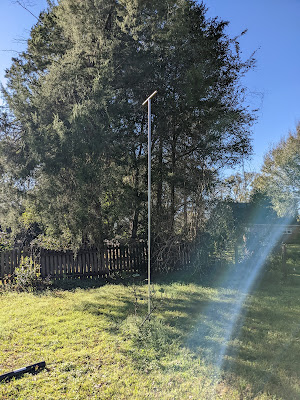
 Arendell Hill has two new raptor perches now and we hope the birds of prey make themselves at home on the fourteen feet tall bird stands. These raptor perches are inexpensive and easy to build, and can be moved as necessary to different locations in the future.

Organic Hemp Cultivation incorporates birds as pest control partners.  Here is one of two raptor perches at Arendell Hill.

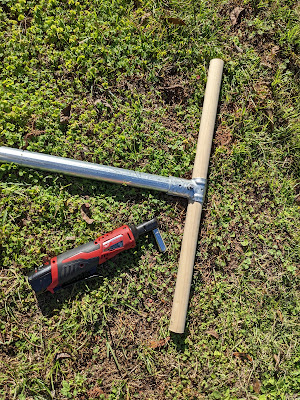
The horizontal perch section is a 1 1/4" diameter wooden dowel and is fastened to the vertical support pole.

Raptor perch, horizontal wooden dowel attached to vertical metal support pole

The materials list is for two perches:

  • Three 10' galvanized chain link fence top rail posts for vertical support
  • One 4' in length 1 1/4" diameter wooden dowel for horizontal perch
  • two galvanized chain link fence 1 3/8" T connectors 
Raptor Perch materials, IPM for Organic Hemp Cultivation

The tools I used to construct the raptor perches included; a fence post hammer (so much easier than a sledge hammer), level, portable ratchet, metal screws and portable screwdriver.

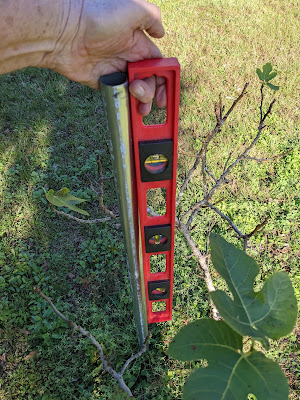
Raptor perch support pole should be plumb vertical

I cut one of the three ten foot top rail posts in half and drove the smaller diameter end into the ground using the pipe hammer approximately three feet or depending on the soil composition deep enough to keep the five foot pipe section sturdy.

Using the level I made sure the support pipe I was driving into the ground was vertically plumb, straight up and not skewed or leaning to the side.

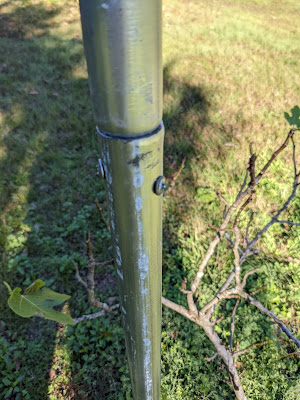
Raptor perch support poles are fastened together and secured with metal screws

Once the support pipe is hammered into the ground then the small diameter end of the uncut ten foot six inch top rail pipe with the wooden dowel attached are placed into the support pipe. The two vertical pipes are fastened together with two metal screws.  A pilot hole can be drilled for the two metal screws.

Because the raptor perch support post is not permanently anchored in concrete, it can be moved depending upon hawk or other raptor flight patterns.  Disassembly is easy; unscrew the two metal screws, remove the longer top rail with perch attached then pull up the support pipe hammered into the ground.

Birds of prey such as both the red-shoulder and red-tail hawks, swallow tail kites, sharp-shinned hawks, Cooper's hawks, broad-winged hawk, Swainson's hawk, Screech owls, Barred owls, Great horned owls, Barn owls, Peregrine falcons, Kestrels and even vultures scour hemp cultivation areas for rodents and other vermin.

Rats, mice and other vermin will eat hemp and cannabis plants and flower buds for food and also for the phytochemical action upon their bodies. Once a vermin devours enough cannabis flower they make an easy target for a nearby bird of prey.

Raptor perches afford the birds of prey a reason to stop and check out the hemp farm.  For the grower, hawks and owls are an important part of the beneficial organic pest control team.


Thursday, December 23, 2021

Organic Hemp Pest Control, a Native Plants & Songbird Partnership

 Last post we discussed the important roles wild birds have in organic based pest control for hemp cultivation.  

Ruby throated hummingbird, Archilochus colubris attracted to the many native plants of Arendell Hill Nursery, feeds on nectar & tiny insects
Today's post will consider what the hemp grower can do using native plant species to attract and manage birds interactions with the cannabis farm.

As we previously read, a wild songbird partnership begins with native plant landscaping.  Birds have always sought out native plant species for foraging, communal and safe harbor habitat.  Native plant species are their first choice when they are deciding to take up residence on a site.  This also holds true for raptors and migratory birds.  The connection with native plants lies deep within all birds DNA, a quid pro quo arrangement formed during earth's deep time.

Certainly non-native horticultural type plants may be popular and even attractive, however they do not offer the level of wild bird provisions afforded by native plant species.  This is a proven fact.  Moreover, non-native horticultural plants may also provide unwanted hemp pests a place to proliferate and do harm to native plant species through hybridization and even DNA alteration.  

Many non-native plants can quickly spread across the landscape, their seeds dispersed by winds, wildlife and human activity.  An organic hemp farmer will need to be able recognize invasive plants, such as Coral Ardisia, Ardisia crenata, or air potato vine, Dioscorea buldifera  and implement control actions to stop the non-native's spread throughout the hemp agriculture site.

Importantly, one of the keys to high terpene content in flower buds of any variety is a high level of biodiversity and complexity in the surrounding ecosystem matrix.  Non-native species reduce biodiversity, sometimes drastically.  The coral ardisia and air potato vines mentioned above are one particular threat to hemp farms because invasive plants can quickly displace hundreds of native plant species that previously existed within the hemp ecosystem matrix depleting biodiversity and throttling production of complex terpene expression in hemp flowers.

Complexity of terpenes in hemp due to biodiversity is what makes a flower special.  When a flower is desirable to the consumer, demand and sales increase.  High quality hemp is the goal of most growers.  By attracting cultivation site songbirds and planting a diverse landscape of native plants the grower gains more control over unwanted pests and also increases the quality of the hemp product by keeping cultivation site biodiversity high.  The songbird-ecosystem matrix complexity-terpene-hemp plant relationship is a very important grow optimization concept for the farmer to explore. 

History is full of examples of plants providing humans with amazing phytochemicals, substances rich in healing properties.  For instance, yaupon holly, Ilex vomitoria contains caffeine and many terpenes too.  Songbirds love to eat holly berries.  Yaupon also provides a home across its bark for countless different species of lichens and mosses.  Older yaupon plants support a complexity of fungi and mushrooms.  All of these ecosystem variables; the fungi, the lichens, mosses, birds, plant and wildlife litter interact together to help form a web of ecosystem matrix diversity that is essential to comprehensive terpene creation in hemp and other plants.

Native plants have evolved over the ages alongside soil formation, fungi & lichens, plants, weather trends, insects, birds, fish, lake, river and stream creation and flow, climate changes and other biological and geophysical factors. The ecosystems we are a part of today were fashioned and shaped through millennia, a result of 'trial and error' over vast expanses of time.

Native ecosystems are the product of natures long term refinement processes.  In fact the time factor nature has invested into forming the ecosystems around us is so vast that it is practically impossible for us to comprehend what has taken really place.

The result of these evolutionary process can be witnessed in the precisely balanced interactions associated with native ecosystems.  Natural checks and balances keep seasonal life cycles functioning smoothly.  This way no one or two life types becomes over abundant or out of control. 

So for the hemp farmer, outdoor growing can expose hemp plants to geophysical and biological variables that may activate both biological and epigenetic process resulting in increased terpene production and diversity. Many terpenes important to humans for cosmetic, pharmaceutical, agricultural and food purposes are synthesized by plants as responses to outside influences, or ecosystem variables.  Some of these may be related to the ecosystematic complexities surrounding presence of native plants, insects, fungi, birds and wildlife.

A strategically designed native plant filled landscape not only provides the basis for increased terpene development but also serves as the foundation for organic integrated pest management purposes.

Once native flora is established, birds will make themselves at home and begin to assist in managing insect populations.

I've found the following native plant species to be especially helpful in recruiting songbirds, raptors and other wild birds.

Shrubs and small trees:

  • Wax myrtle, Morella cerifera
  • Yaupon holly, Ilex vomitoria
  • American holly, Ilex opaca
  • Gallberry, Ilex glabra
  • Elderberry, Sambucus nigra
  • Firebush, Hamelia patens
  • Beautyberry, Callicarpa americana
  • Hoptree, Ptelea trifoliata
  • Coontie, Zamia integrifolia
  • Red mulberry, Morus rubra
  • Seagrape, Coccoloba uvifera & Pigeon plum, C. diversifolia (cold tender)
  • Groundsel tree, Baccharis halimifolia
  • Paurotis palm, Acoelorraphe wrightii (cold tender)
  • Coco plum, Chrysobalanus icaco (cold tender)
  • and many more.
Native tree species to plant for birds are:

  • Oaks, such as;
    • Live oak, Quercus virginiana
    • White oak, Quercus alba
    • Myrtle oak, Quercus myrtifolia
    • Shumard oak, Quercus shumardii
    • Swamp chesnut oak, Quercus michauxii
    • and many more
  • Red maple, Acer rubrum
  • Hickory, including
    • Mockernut hickory, Carya tomentosa
    • Pignut hickory, Carya glabra
    • Black walnut, Juglans nigra
    • and others
  • Magnolia, Magnolia grandiflora
  • Black gum, Nyssa aquatica
  • Cypress, Taxodium distichum & T. ascendens
  • Pines species:
    • Sand pine, Pinus clausa
    • Slash pine, Pinus elliottii
    • Spruce pine, Pinus glabra
    • Longleaf pine, Pinus palustris
    • Loblolly pine, Pinus taeda
  • Sabal palm, Sabal palmetto
  • Sycamore, Platanus occidentalis
  • Tulip popular, Liriodendron tulipifera
  • Silver buttonwood, Conocarpus erectus
  • Mangroves;
    • Black mangrove, Avicennis germinans
    • Red mangrove, Rhizophora mangle (cold tender)
    • White mangrove, Laguncularia racemosa (cold tender)
  • and so many others
Native plant societies, wildflower associations, local agricultural extension agencies and native nursery business associations are all excellent information resources on what species to use and how to plant and care for native plants.

Here in Florida, the following entities can provide important growing info about native plants;
Hemp farm landscaping should always be included during initial hemp growing planning considerations. Native plant focused landscapes should be installed concurrent with any hemp cultivation efforts.

The organic hemp farmer needs all available help with pest control.  Hemp agriculture will demand significant amounts of time from the grower.  Native plants can serve as hosts to nature's own great pest control specialists.
Saturday, November 20, 2021

Organic Hemp Pest Control (IPM) Prescribed and Simulated Burning Importance

 Last post we discussed how Eastern Tent Caterpillars, Malacosoma spp., lay their eggs on the branches, twigs and leaves of hardwood trees.  Once deciduous leaves fall and autumn winds blow twigs to the ground, caterpillar eggs can overwinter in accumulated biomass, groundcover vegetation and the dirt.


Insect, probably caterpillar larve hatched and beginning to weave silken web for protection

Until humans began the suppression of seasonal lightning fires, heat generated by combustion of dry biomass served to control population numbers of many pest organisms including caterpillars.

Natural seasonal fires served to cap population numbers of many pest insects.

Many farming operations today have reintroduced the practice of land fire management with prescribed burning.  Prescribed burning involves the intentional application of fire to plots for the purpose of weed and invasive plant control, pest management, biomass fuel reduction (safety), hunting plantation management and many other purposes.

Often times though, prescribed fire may not be practical for safety sake and sometimes burning is simply impossible, say in a greenhouse for example.  In the event a hemp cultivation area is located in an area where burning is not practical then leaf litter and grounds cleaning becomes a pest management tool of utmost importance.

Pest organisms take advantage of many transportation mechanisms referred to as vectors, to increase, sustain and spread their population numbers.

Leaves and twigs are subject to seasonal winds.  Once deciduous leaves fall from a branch they may be blown hundreds of feet from the tree from which they grew.  Over time these leaves can be carried significant distances via strong breezes.  

Moth laid caterpillar eggs attached to wind blown leaves and twigs can stay viable through winter months and hatch when appropriate weather conditions develop during spring months, increasing hemp pest population numbers.

Leaf litter management will not cause moths or caterpillars to go extinct.  On the contrary, managing tree leaf and twig drop can benefit the moth and caterpillar populations.  Excess caterpillar population numbers and overgrowth may lead to weakened individuals, spread diseases and lead to larval food shortages.  Good leaf management mimics nature's own way of managing insect populations.

As mentioned above, wildfires and lightning fires historically served as a limiting control on caterpillars and other insect egg spread.  As fire frequency diminished, pest pressure increased.  It is not really a big surprise that as the natural complexities of ecology change, a result of human actions, caterpillar and pest overpopulation occurrences are becoming more commonplace.

Today, because of the lack of seasonal wildfires it is important to 'simulate' fire's pest destruction effects by mechanically removing leaves that fall across the hemp cultivation areas.  Importantly, the grower should not only remove tree, leaf and twig litter from active cultivation areas but also from adjacent areas of the cultivation plot or greenhouse area.  Caterpillars and other leaf borne pests can crawl long distances.

Backpack blowers, rakes, lawn mower debris collection bags and other equipment can be employed to collect tree drop biomass (litter).

Once the twigs and leaves are gathered it is necessary to burn, compost or mechanically degrade the biomass to actually destroy pest eggs.  A big pile of leaves in the corner of the property can serve as a giant pest incubator.

Today, understanding and managing the leaf-twig-wind vector complex is just one of many important factors comprising an organic hemp growing ecosystem.

Seasonal fire is always helpful, but not always practical.  Therefore an organic hemp growing IPM program is benefited from simulated fire practices.

Predictable management of pest occurrences is a goal of organic pest IPM.  Keeping leaf litter under control can help keep hemp crops pesticide and toxicity free, and avoid diseases, leaf destruction or bud feces damage.