Showing posts with label Hemp IPM. Show all posts

Friday, June 2, 2023

IPM: Whitewashed Hemp Leaf Appearance, Classic Glassy Winged Sharpshooter Damage

This is a photograph of one of our more aggressive pest insects here at Arendell Hill Nursery, commonly known as a Glassy Winged Sharpshooter, (Homalodisca vitripennis).
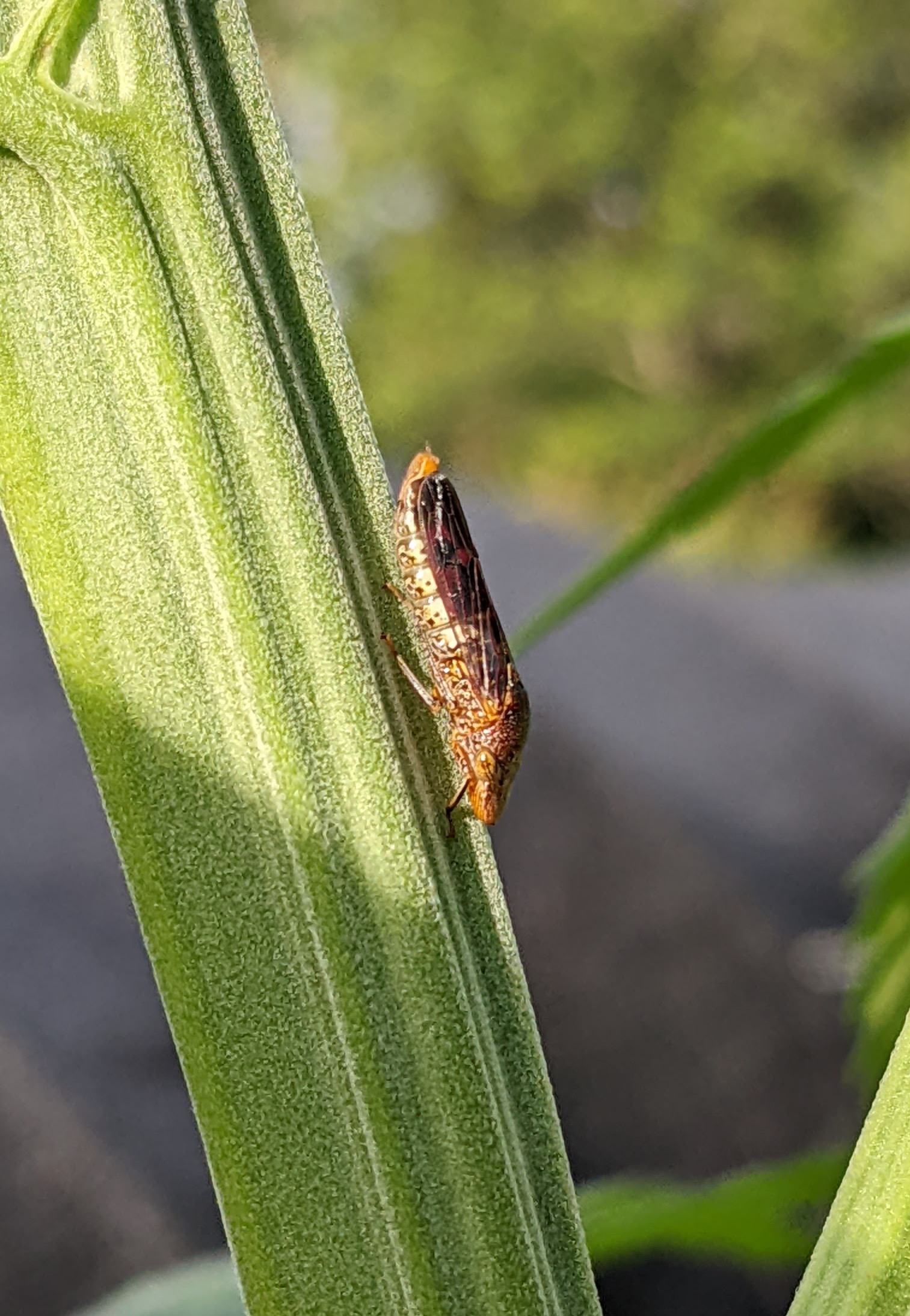
Glassy Winged Sharpshooter on the stem of one of our hemp plants

When we first began growing hemp I would sometimes mistake the whitewashed appearance of hemp leaves as white mold. However what we learned was that the leaves' white coating was actually defecation material from the glassy winged sharpshooters.

Glassy Winged Sharpshooter 'Whitewash' on one of our hemp plant leaflet

Glassy winged sharpshooters require copious amounts of liquid to grow and reproduce. Much of this liquid is excreted out in the form of a white paste, hence the whitewash effect across our hemp leaves.

Across Florida and throughout much of North America, the glassy-winged sharpshooter is a serious agricultural pest known for its potential to spread bacterial diseases to a variety of plants, including agricultural hemp. It feeds on a wide range of host plants and can spread the bacterium Xylella fastidiosa, the causal agent of diseases such as Pierce's disease in grapes and leaf scorch in a variety of other plants.

The glassy-winged sharpshooter, like other members of the leafhopper family, has specialized mouthparts adapted for piercing plant tissues and sucking out fluids. These mouthparts, known as stylets, function much like a straw. However, unlike a typical straw, the process involves more than just applying suction.

When feeding, the sharpshooter pushes its stylets into the plant tissues, navigating past cells until it reaches the plant's xylem - the system of tiny tubes that transport water and dissolved nutrients from the roots to the rest of the plant. Xylem fluid is under negative pressure, or tension, due to the process of transpiration (water evaporation) at the plant's leaves.

Once the sharpshooter's stylets are in the xylem vessels, the tension within these vessels causes the fluid to move into and up the insect's food canal (formed by its stylets), similar to how water will rise in a thin tube or straw. Thus, the sharpshooter doesn't need to actively suck up the fluid. In fact, the sharpshooter has to work to prevent the xylem fluid from flooding its alimentary canal and has a special filter chamber to help manage the volume and pressure of the ingested fluid.

It's worth noting that feeding on xylem fluid presents nutritional challenges, as this fluid is low in nutrients compared to the sugary sap in the plant's phloem (which many other sucking insects, like aphids, prefer). Sharpshooters have adapted to this diet in part through symbiotic relationships with bacteria that help them metabolize and extract nutrients from their food.

When it feeds, it can also introduce the Xylella fastidiosa bacterium into the plant, leading to blockages that can cause leaf scorch, wilting, and even death of the plant. Glassy winged sharpshooters also may be a host for Xylella fastidiosa, another significant plant pathogen.

As for the Integrated Pest Management (IPM) of the glassy-winged sharpshooter, here are some strategies that could be used:

Monitoring: Regular inspections of the hemp fields to catch any sharpshooter infestations early before they become a significant problem.

Biological control: There are several natural predators and parasites of the glassy-winged sharpshooter that could potentially be used for control. For instance, egg parasitoid wasps, such as Gonatocerus spp., lay their eggs inside the eggs of the sharpshooter, preventing them from hatching.

Cultural control: Changing farming practices to make the environment less conducive to the sharpshooter. This could include altering irrigation practices (since sharpshooters are attracted to water), removing potential host plants around the hemp field, or adjusting the timing of planting and harvesting to avoid peak sharpshooter activity.

Chemical control: If necessary, organic-approved insecticides could be used to control sharpshooter populations. These should be used judiciously to avoid killing beneficial insects and to prevent the development of resistance in the sharpshooter population.

As always, the specific IPM strategies used would need to be tailored to the individual farm and its unique conditions. Always consider local laws and regulations when implementing pest management strategies.

Thursday, June 1, 2023

IPM: Growing Hemp on the Green Roof Panels Has Proven Successful

It is time to install this year's FAMU Pilot Project Florida x Hepius variety of hemp plants.

Shallow, extensive green roof panels ready for x Hepius hemp plants

Last year the x Hepius thrived in the shallow planting trays. Rainfall and irrigation water are collected and recycled. We use a special, non-organic planting medium designed by the University of Central Florida's engineering department. Organic nutrients are mixed with irrigation water and delivered via drip irrigation.

Growing hemp on the green roof panels last year proved to be a successful experiment. The x Hepius variety growing in the green roof panels were shorter and exhibited a significantly more compact growth habit than the x Hepius plants growing in the ground level garden soil.

One huge advantage of growing hemp on a roof is that there are significantly fewer caterpillars and other pest insects who crawl up the support walls to reach the hemp. Additionally, any aggressive bugs that make it up to the roof are prime targets for hungry birds.

The x Hepius variety produces significant amounts of aromatic terpenes on flower buds without any detectable level of THC. Last year I noticed the living roof x Hepius plants filled the garden air with a complex scent of citrus and spice.

I prefer shallow green roof systems because I prefer creating shallow but wide root architecture patterns so that our Florida hemp plants can better survive tropical storm wind patterns. Shallow root architecture is not necessarily better than deep, intensive planting systems but they are my preference having worked with coastal and hurricane resilient green roofs over the decades.

As mentioned above, not all green roof systems are shallow such as these.

Green roof systems can be classified based on their depth into extensive, semi-intensive, and intensive systems. Shallow or extensive green roofs, often referred to as "eco-roofs," are the simplest and lightest type. They are typically used on residential, commercial, and small-scale buildings for their ease of implementation and maintenance. Here are some key points to understand about shallow green roof systems:

  1. Depth and Weight: Extensive green roofs have a shallow growing medium, typically ranging from 1/2 to 6 inches in depth. The shallow depth makes them relatively lightweight, adding approximately 15-50 pounds per square foot, including plants and saturated growing medium. This makes them suitable for a variety of building structures without requiring significant structural reinforcement.

  2. Plant Selection: Due to the shallow depth, the types of plants used in extensive green roofs are those that are drought-tolerant, wind-resistant, and can thrive in shallow soil. These often include succulents (like sedums), herbs, grasses, and some types of wildflowers.

  3. Water and Nutrient Requirements: The plants used in shallow green roof systems are typically adapted to harsh conditions and require minimal irrigation and nutrients. This is ideal for conserving water resources and reducing maintenance requirements.

  4. Installation and Maintenance: Extensive green roofs are typically easier and less expensive to install compared to their intensive counterparts. They also require minimal maintenance, primarily in the form of periodic weeding and checks to ensure the roof's waterproof membrane is intact.

  5. Environmental Benefits: Like all green roofs, shallow systems provide many environmental benefits. They can help reduce the heat island effect, improve air quality, manage stormwater runoff, provide habitat for wildlife, and enhance a building's thermal performance, potentially saving on heating and cooling costs.

  6. Aesthetic Value: Extensive green roofs can improve the visual appeal of a building, providing a lush, green space in urban environments that are often dominated by concrete and other hard surfaces.

Despite their many benefits, extensive green roofs aren't suitable for all situations. They require a waterproof and root-resistant roof membrane to protect the building, and while their maintenance needs are relatively low, they still require some care to stay healthy and attractive. Lastly, not all plant species will thrive in the shallow growing medium, limiting the plant diversity compared to intensive green roofs.

Saturday, May 28, 2022

Florida Hemp, Luna Moth & IPM


Luna Moth & Hemp Entourage Effect #biodiversity

Luna, the moon moth is a member of Actias genus in the Saturniid family. We love caterpillars & moths in our #Hemp cultivation area as they contribute to our amazing hemp #entourage effect & actually are an important matrix member of our #nativeplant & #biodiversity based #IPM efforts. #ArendellHillNursery #CBD #FreshFromFlorida #Permaculture #Organic

Florida Hemp, Leaf Miner Damage & IPM

Florida Hemp exhibiting leaf miner damage

 Leaf miner damage in #hemp leaves. Leaf miners are collectively a group of insects whose larvae 'mine' interior of leaves where minimal cellulose is encountered & where larvae are protected from predators. Many leaf miner species we see in our #hemp cultivation area are members of the moth, Lepidoptera, order. Leaf miner damage to hemp occurs via reduced overall plant photosynthesis & also from fungal & viral infections introduced into the plant through the leaf miner tunnels inside leaves. We use a combination of #IPM methods to control leaf miners including; bird feeding stations, yellow sticky cards with solar night lights, native plant companion plantings, lure plantings and occasional Neem or Spinosad spray applications (both organic approved). #integratedpestmanagement absolutely works best for our #FloridaHemp growing. #ArendellHillNursery #CBD #CBG #Fiber #FreshFromFlorida #Permaculture #Organic


Friday, May 13, 2022

Florida Hemp BMPs, Black Soldier Flies

Happy to see Black Soldier Flies! Hermetia illucens, #stratiomyidae These insects work the soil as larvae as good as earthworms do & help decompose organic matter, making our soils even more productive. They make great chicken feed too!  #freshfromflorida #floridahemp #ipm https://t.co/VYa3mSl5wX

Wednesday, April 20, 2022

Florida Hemp, Controlling Moth Caterpillars

So many moths everywhere. Can’t kill them all nor do we want to. Looks like hungry Spodoptera sp. moth caterpillars. We don’t get too concerned when they begin eating plants. First caterpillars trigger unique photochemical responses in our #hemp & then neem oil keeps them under control https://t.co/LyDxS1YYm2

Wednesday, April 6, 2022

Florida Hemp IPM, Beautyberry Organic Pest Control

Callicarpa americana cuttings after one month. Beautyberry is an extremely important integrated pest management #ipm #nativeplants team member here. Mosquitoes & pests flee BB. #floridahemp #hemp #850hemp #arendellhillnursery #freshfromflorida https://t.co/WN08aq6tCB

Thursday, March 10, 2022

Earwigs (Dermaptera) and Florida Organic Hemp Cultivation

Are earwigs friend or foe in the hemp cultivation area?
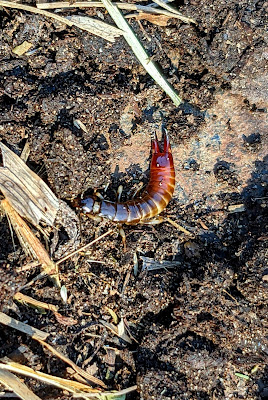
Florida Organic Hemp Pest Management, Earwigs belong to the insect order Dermaptera

The answer may be both!  Earwigs can be a friend but also a foe to the organic hemp farmer and crop.

Florida Organic Hemp Pest Management, Earwigs have 'pinchers' also called 'cerci' attached to the rear of their abdomen
Earwigs are omnivores, and they are usually hungry.  From my observations across Arendell Hill Nursery, earwigs prefer aphids and other small insects.

However earwigs will also eat young, tender plant shoots, buds and leaves if there are not enough aphids, mites, insect eggs or small prey to satisfy their voracious appetites.

There are a number of earwig species and importantly, many are primarily carnivores.  The earwig preference for pest insects can be beneficial to the hemp farmer and as long as there are adequate numbers of small insects for forage. 

The key to integrating Dermaptera successfully into an organic hemp integrated pest management program lies in developing an understanding of earwig life cycle requirements.  The hemp farmer should know what environmental conditions favor earwig population growth. 

Once the hemp farmer recognizes favorable earwig growth conditions, the grower can adjust many of those factors to maintain earwig population stability, effectively avoiding population explosions while ensuring an adequate number of earwigs exist to help manage aphid issues.

Interestingly, the insect's common name 'earwig' is rumored to have been derived from a fear this bug could crawl into a sleeping person's ear at night resulting in all sorts of painful pinching.  This rumor is unfounded though and earwigs generally do not bite or pinch humans.

So are earwigs desirable as an integrated pest control partner for hemp cultivation?  I'd have to say a definitive yes.  

As with all partnerships, successful relationships require active management of interactions and the same holds true with earwigs.  An overpopulation of earwigs with not enough aphids for food will result in hemp plant bud and new growth damage as the earwigs seek out alternative food sources.

Earwig population numbers can be managed with straight forward mechanical and environmental pest control measures such as moisture control, good housekeeping and sanitary practices and regular surveillance.

The key is to have just enough earwig pest control partners.

Smart hemp cultivation site pest management can employ earwigs to hunt down and eat pesky aphids and mites.  

Employing native insects and native plants as partners in organic farming can be the safest, most effective and sustainable growing approach for Florida hemp and most all organically farmed crops.


Saturday, January 1, 2022

Assassin Bugs, An Organic Hemp Cultivator's Helper

 Assassin bugs are a great pest control partner to have when growing hemp organically.  

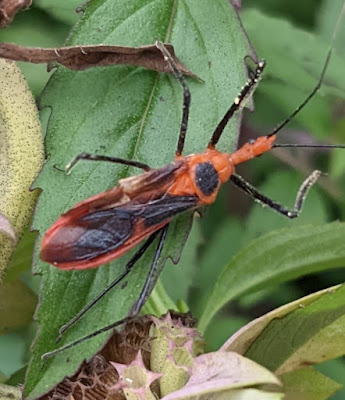
Milkweed assassin bug, Zelus longipes, is an important part of an organic hemp pest management program

Members of the Reduviidae insect family, assassin bugs are the perfect hemp (or for that matter any organically grown garden plant) pest predator. They inject a digestive secretion into their prey and then suck out their prey's body fluids through a straw-like snout.  Assassin bugs favorite hunt includes; aphids, beetles, caterpillars, leafhoppers and even bees and flies.

Included with the Assassin bugs in the Reduviidae family are the closely related ambush bugs (subfamily Phymatinae), wheel bugs (Harpactorinae) and kissing bugs (Triatoma spp.).  Some Reduviidae can and will bite humans.  As with any insect bite,  a bite from these insects may be painful and proper first aid should be administered.

Foraging across the garden, the assassin bug's appetite is voracious and non-discriminatory, devouring both bad and beneficial insects.  But on the whole, the assassin bug is welcomed as an eat all pesty pest bug control partner. 

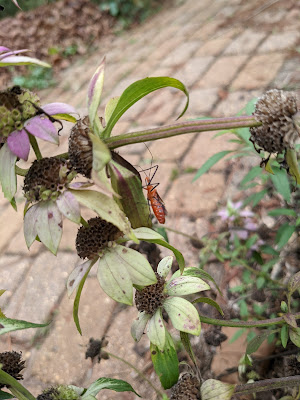
Milkweed assassin bug, Zelus longipes, foraging on Monarda punctata

The key to managing the assassin bug in the hemp growing area includes the use of nectar producing native plants the bug is naturally attracted to.  Strategic plantings of spotted bee balm, milkweed, goldenrod, mountain mint and other wildflowers can direct assassin bug's attention into those areas needing urgent pest control attention.

There are about one hundred fifty species of assassin bugs.  One of the most common assassin bugs seen in the garden is the Milkweed assassin bug, Zelus longipes.  

Milkweed assassin bug, Zelus longipes, have a never ending appetite for hemp cultivation pests

 The photos above are of a Milkweed assassin bug foraging across one of Arendell Hill's spotted bee balm, Monarda punctata, plants.

Though assassin bugs may look wicked, they can help the organic hemp grower keep pest insects to a minimum.

The native plants mentioned are known to attract assassin bugs looking for high-energy packed nectar.  Organic hemp integrated pest management will always use assassin bug attracting native plants around growing areas, either as permanent plantings or in movable growing containers for spot pest control.

The organic hemp nursery is a dynamic site, rich in complex ecosystematic matrices.  The relationships between native wildflowers, the Reduviidae family of insects and the hemp farm are important for the grower to understand.

Welcoming these colorful but alien looking bugs is another key component in a successful organic hemp growing program. 


Thursday, December 23, 2021

Organic Hemp Pest Control, a Native Plants & Songbird Partnership

 Last post we discussed the important roles wild birds have in organic based pest control for hemp cultivation.  

Ruby throated hummingbird, Archilochus colubris attracted to the many native plants of Arendell Hill Nursery, feeds on nectar & tiny insects
Today's post will consider what the hemp grower can do using native plant species to attract and manage birds interactions with the cannabis farm.

As we previously read, a wild songbird partnership begins with native plant landscaping.  Birds have always sought out native plant species for foraging, communal and safe harbor habitat.  Native plant species are their first choice when they are deciding to take up residence on a site.  This also holds true for raptors and migratory birds.  The connection with native plants lies deep within all birds DNA, a quid pro quo arrangement formed during earth's deep time.

Certainly non-native horticultural type plants may be popular and even attractive, however they do not offer the level of wild bird provisions afforded by native plant species.  This is a proven fact.  Moreover, non-native horticultural plants may also provide unwanted hemp pests a place to proliferate and do harm to native plant species through hybridization and even DNA alteration.  

Many non-native plants can quickly spread across the landscape, their seeds dispersed by winds, wildlife and human activity.  An organic hemp farmer will need to be able recognize invasive plants, such as Coral Ardisia, Ardisia crenata, or air potato vine, Dioscorea buldifera  and implement control actions to stop the non-native's spread throughout the hemp agriculture site.

Importantly, one of the keys to high terpene content in flower buds of any variety is a high level of biodiversity and complexity in the surrounding ecosystem matrix.  Non-native species reduce biodiversity, sometimes drastically.  The coral ardisia and air potato vines mentioned above are one particular threat to hemp farms because invasive plants can quickly displace hundreds of native plant species that previously existed within the hemp ecosystem matrix depleting biodiversity and throttling production of complex terpene expression in hemp flowers.

Complexity of terpenes in hemp due to biodiversity is what makes a flower special.  When a flower is desirable to the consumer, demand and sales increase.  High quality hemp is the goal of most growers.  By attracting cultivation site songbirds and planting a diverse landscape of native plants the grower gains more control over unwanted pests and also increases the quality of the hemp product by keeping cultivation site biodiversity high.  The songbird-ecosystem matrix complexity-terpene-hemp plant relationship is a very important grow optimization concept for the farmer to explore. 

History is full of examples of plants providing humans with amazing phytochemicals, substances rich in healing properties.  For instance, yaupon holly, Ilex vomitoria contains caffeine and many terpenes too.  Songbirds love to eat holly berries.  Yaupon also provides a home across its bark for countless different species of lichens and mosses.  Older yaupon plants support a complexity of fungi and mushrooms.  All of these ecosystem variables; the fungi, the lichens, mosses, birds, plant and wildlife litter interact together to help form a web of ecosystem matrix diversity that is essential to comprehensive terpene creation in hemp and other plants.

Native plants have evolved over the ages alongside soil formation, fungi & lichens, plants, weather trends, insects, birds, fish, lake, river and stream creation and flow, climate changes and other biological and geophysical factors. The ecosystems we are a part of today were fashioned and shaped through millennia, a result of 'trial and error' over vast expanses of time.

Native ecosystems are the product of natures long term refinement processes.  In fact the time factor nature has invested into forming the ecosystems around us is so vast that it is practically impossible for us to comprehend what has taken really place.

The result of these evolutionary process can be witnessed in the precisely balanced interactions associated with native ecosystems.  Natural checks and balances keep seasonal life cycles functioning smoothly.  This way no one or two life types becomes over abundant or out of control. 

So for the hemp farmer, outdoor growing can expose hemp plants to geophysical and biological variables that may activate both biological and epigenetic process resulting in increased terpene production and diversity. Many terpenes important to humans for cosmetic, pharmaceutical, agricultural and food purposes are synthesized by plants as responses to outside influences, or ecosystem variables.  Some of these may be related to the ecosystematic complexities surrounding presence of native plants, insects, fungi, birds and wildlife.

A strategically designed native plant filled landscape not only provides the basis for increased terpene development but also serves as the foundation for organic integrated pest management purposes.

Once native flora is established, birds will make themselves at home and begin to assist in managing insect populations.

I've found the following native plant species to be especially helpful in recruiting songbirds, raptors and other wild birds.

Shrubs and small trees:

  • Wax myrtle, Morella cerifera
  • Yaupon holly, Ilex vomitoria
  • American holly, Ilex opaca
  • Gallberry, Ilex glabra
  • Elderberry, Sambucus nigra
  • Firebush, Hamelia patens
  • Beautyberry, Callicarpa americana
  • Hoptree, Ptelea trifoliata
  • Coontie, Zamia integrifolia
  • Red mulberry, Morus rubra
  • Seagrape, Coccoloba uvifera & Pigeon plum, C. diversifolia (cold tender)
  • Groundsel tree, Baccharis halimifolia
  • Paurotis palm, Acoelorraphe wrightii (cold tender)
  • Coco plum, Chrysobalanus icaco (cold tender)
  • and many more.
Native tree species to plant for birds are:

  • Oaks, such as;
    • Live oak, Quercus virginiana
    • White oak, Quercus alba
    • Myrtle oak, Quercus myrtifolia
    • Shumard oak, Quercus shumardii
    • Swamp chesnut oak, Quercus michauxii
    • and many more
  • Red maple, Acer rubrum
  • Hickory, including
    • Mockernut hickory, Carya tomentosa
    • Pignut hickory, Carya glabra
    • Black walnut, Juglans nigra
    • and others
  • Magnolia, Magnolia grandiflora
  • Black gum, Nyssa aquatica
  • Cypress, Taxodium distichum & T. ascendens
  • Pines species:
    • Sand pine, Pinus clausa
    • Slash pine, Pinus elliottii
    • Spruce pine, Pinus glabra
    • Longleaf pine, Pinus palustris
    • Loblolly pine, Pinus taeda
  • Sabal palm, Sabal palmetto
  • Sycamore, Platanus occidentalis
  • Tulip popular, Liriodendron tulipifera
  • Silver buttonwood, Conocarpus erectus
  • Mangroves;
    • Black mangrove, Avicennis germinans
    • Red mangrove, Rhizophora mangle (cold tender)
    • White mangrove, Laguncularia racemosa (cold tender)
  • and so many others
Native plant societies, wildflower associations, local agricultural extension agencies and native nursery business associations are all excellent information resources on what species to use and how to plant and care for native plants.

Here in Florida, the following entities can provide important growing info about native plants;
Hemp farm landscaping should always be included during initial hemp growing planning considerations. Native plant focused landscapes should be installed concurrent with any hemp cultivation efforts.

The organic hemp farmer needs all available help with pest control.  Hemp agriculture will demand significant amounts of time from the grower.  Native plants can serve as hosts to nature's own great pest control specialists.

Wednesday, November 24, 2021

Organic Hemp Cultivation, Integrated Pest Management (IPM) & Birds

 We encourage birds to make themselves home here in the Arendell Hill nursery gardens.

Wild birds, song birds, raptors and more.  Winged creatures serve an important part of our Organic IPM

I consider birds to be better than 'human help' at picking caterpillars and other potential pest insects out of our gardens.  Songbirds can keep the ground and shrubbery around a hemp cultivation area significantly free of larvae that are crawling around looking for leaves or flower buds to chew on.  Larger birds also, like red shouldered hawks here are vigilant in keeping the nursery free of disease vectoring rodent populations. 

Winged creatures have a definite advantage over crawling pests.  Winged predators can conduct reconnaissance across a ground area much quicker than most crawly pests can escape.  It is true that many insects can fly and are beneficial in their own ways, such as for pollination.  The advantage however lies with birds though due to their size, advanced development of senses and ability to quickly forage across large areas of garden.

Maintaining quality bird habitat for hemp farms should include practices that ensure ample bird forage provisions exist.  Feeders are one obvious way to attract birds and work well in creating a basic Integrated Pest Management program.  Yet bird feeders are just a start.  Native landscape plants that flower, fruit and produce seed are another worthwhile addition to bird feeders in hemp cultivation areas.

Importantly, once the grower begins to attract birds to their hemp growing area and the birds begin their caterpillar and pest insect control duty, the grower must also ensure that the farm provides a place for the birds to 'stay' and nest.  Communal habitat is best established by planting native landscape and wildlife value shrubs.  

American holly, Ilex opaca, provides forage and evergreen communal habitat to wild songbirds and as such can be an important part of an Organic Hemp IPM program. 

Native shrubs, rather than horticultural imported shrubs, will always be a wild songbird's and raptor's preference, for the native shrub's habit and familiarity are transcribed by countless previous generations into a bird's DNA.  Simply put, the wild songbirds are attracted to those native shrubs they and their ancestors have always lived in and around.   

It is true that some non-native horticultural shrubs and plants will also be utilized by wild birds.   However the net benefit to the hemp farm efficiency matrix will be reduced when using non-native landscape species.  In fact, it is possible non-native landscape plants can cause significant ecological systems damage.  When the growing ecosystem matrix becomes unbalanced pest pressure will increase.

As we will see in other posts, not only do native plant species support all important bird populations across the hemp farm, but native plant species also provide a number of other important pest control and nursery management functions.

We will also discuss in future posts, how to visualize the hemp farm bio-geophysical ecosystem matrix.  Though the name 'bio-geophysical ecosystem matrix' may sound complex, the concept is a simple one.  Everything affecting the hemp farm makes up the matrix.  There are many variables, such as birds, wildlife, rain, wind, temperatures, pests, soil, water and others.  The way these variables act upon and influence hemp plant growth in the garden is what the matrix is all about.

Another term I like to use when thinking about the ecosystem matrix is the phrase 'Languages of Nature'.  Each variable asserts an influence, good or bad, on the hemp plants.  Each good or bad influence can be known through interaction with our senses.  Ecosystems communicate the effects of most impacts they experience through measurable responses. An expert hemp farmer 'reads' and understands these ecosystem responses and utilizes the information to maximize crop efficiencies.

Importantly, songbirds and raptors are not the only winged creatures employed by organic hemp and plant nursery growers as part of an organic IPM program.  Chickens, bats and other critters have been successfully integrated into hemp farm pest control programs.  We will discuss these too in future posts.

Finally, it must be understood that birds can be vectors of plant diseases.  However when weighing the risks of potential bird vectored plant diseases versus the insect control benefit, the pest control benefit is usually greater than the disease risk.  

IPM risk benefit analysis can be established through trial and error on the farm, through research of peer reviewed literature and also through coordination with experts working with a local agricultural extension service.

Birds are just one part of a hemp farm ecosystem matrix complex, yet they are a beneficial part.  

Now it is time for me to go add bird food to the feeders!


.


Thursday, November 11, 2021

Hemp Organic Integrated Pest Management (IPM); Thistles, Painted Lady Butterflies and Larvae

 Almost nothing can do as much damage to hemp plants and flower buds as caterpillars can. 

Painted Lady butterflies are attracted to aster-like wildflowers for use as host plants.

Most larvae go through a number of developmental changes (instars) during their transition from egg into butterfly form.  While in the caterpillar stages these larvae consume as much plant matter as they can and store the foraged protein for future use in egg production as mature butterflies.

There are quite a few caterpillars attracted to and often found on hemp plants.  Today I'd like to briefly talk about the Painted Lady Butterfly, Vanessa spp, butterflies and caterpillars.

Painted Lady caterpillars are often found growing and foraging in hemp leaves and hemp flower buds.  

Painted Lady butterflies will typically lay a single egg on a hemp leaf.  Once the egg hatches and the larvae begins to develop, a thread-like silky mesh will appear wrapped around two or more leaves as the caterpillar builds protective shelter.

Circular chew marks may appear of the edges of leaves as the larvae begin to feed.  In their early stages, the Painted Lady larvae may be light brown colored and spiny.  

During outbreak periods, a large number of Painted Lady caterpillars can significantly damage hemp plants with their voracious plant matter diets.  Not only can the Painted Lady caterpillars eat hemp plant biomass, but they can also (as with any other caterpillar and larvae) leave significant amounts of feces in hemp plant flower buds.  Hemp plant flower buds destined for edible product consumption may be seriously damaged or may even become a total loss.

Painted Lady butterflies and caterpillars serve an important role in our ecosystems however.  Even though they may be considered a pest to hemp cultivation efforts, Painted Lady butterflies should be accepted as a vital component of the ecosystem surrounding hemp cultivation operations.

The key to controlling Painted Lady crop damage lies not in eradication, but in supporting a balanced matrix of insect role within the overall surrounding ecosystem.  Painted Lady butterflies as well as other species are important pollinators for native plants.  Their long proboscis can be more effective at pollination for certain native wildflowers than bees for example.  Native plants are likewise essential for maintaining homeostasis with natural population balances, keeping fungi, bacteria and insects numbers relative to proper balances.

As Painted Lady larvae mature they may develop yellow and black stripes.  One important facet of organic based Integrated Pest Management is an understanding of where pests come from, or pest vector recognition.  Although native insect eradication is not a good idea, and actually a practice that may further aggravate invasive pest problems, it is important to understand where and under what conditions insects thrive.

Painted Lady butterfly host plants include thistles, wild asters and plants in the Boraginaceae and Malvaceae (okra, cotton and mallow) families. 

Large populations of thistle or aster plants may become breeding grounds that create out of balance, excessive population numbers of Painted Lady butterflies.  In natural systems fire among other events control host plant populations thereby keeping insect population numbers in balance.

Within today's agricultural systems many natural events, like fires and deep biodiversity, are suppressed.

Once the hemp grower recognizes host plants for their importance and limiting roles they serve then overall ecosystem and pest balancing is easier to achieve.

Bird feeders around thistle or sunflower patches are one potential approach.  Birds utilize caterpillars as food.  Several bird feeders set up just inside your fence adjacent to a roadside thistle patch can serve to keep Painted Lady butterfly and caterpillar populations from becoming destructive and overwhelming.

Painted Lady caterpillars and butterflies are just one type of many native yet potential destructive 'bugs'.

Learning to recognize the 'bug' and understanding their lifecycles and host plants are all necessary components of an organic IPM program designed to maximize hemp production.  Rather than approach organic IPM from the perspective of 'how do we keep nature out of our hemp populations', we must figure out how to effectively integrate hemp cultivation into a balanced ecosystem in which we live.

Hemp cultivation operations existing 'in-sync' with a balanced surrounding ecosystem will be highly productive and efficient.  Organic IPM programs can be one of the hemp farmer's best grow partners.