Showing posts with label organic hemp cultivation. Show all posts

Sunday, February 27, 2022

Florida Organic Hemp Cultivation and Fungi Based Integrated Pest Management

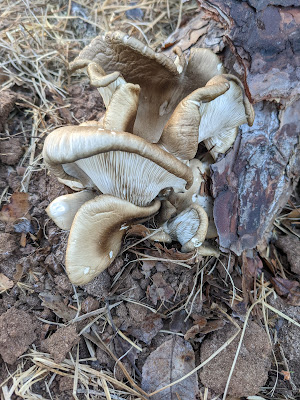
 Blue oyster mushrooms, Pleurotus sp., are an important part of our Integrated Pest Management program here across Arendell Hill nursery.

Oyster mushrooms are an integral part of Organic Hemp IPM program here at Arendell Hill


Oyster mushrooms help clean stormwater and detoxify any contaminants that find their way via wind, rain or drift into the garden. 

Interestingly, many fungi are capable of absorbing complex carbon chains found in the environment and converting them into carbohydrates for their own growth.  

Mycoremediation, as the mushroom's decon process is commonly referred to, has been shown to be an effective way to support hemp cultivation area cleanliness while helping to ensure pure surface water. 

Additionally, mycobooms, which are a mixture of hay and fungal spores can be used to contain and cleanup most types of contamination spills and can be an effective pollution control management tool.

Because our cultivation areas are organically managed and free of pesticides and herbicides, the oysters in our garden are usually free of contamination and may also end up in our kitchen for dinnertime sauteing.

For decades, fungi have been successfully used in many organic-focused integrated pest management programs.  Additionally, mushrooms are fun to grow.  Cultivating oyster mushrooms as a companion species to hemp is just one, but an important part, of Arendell Hill's organic hemp integrated pest management program.


Friday, February 4, 2022

Asian Lady Beetles and Organic Hemp (Cannabis) Cultivation

 I've been seeing Asian lady beetles, Harmonia axyridis, almost everywhere lately (early February 2022).

Asian Lady Beeetle, Harmonia axyridis, exotic insect and Organic Hemp Cultivation

Though they do little direct harm to cultivation (they do eat aphids) these exotics can cause serious nuisance issues around plants and especially in buildings. They certainly are not my preference for natural IPM across the hemp farm as they compete with native lady beetles.

Asian Lady Beetles on pepper plants at a local Tallahassee Nursery

Mostly, I tend to ignore them because they do not rise to the nuisance level of a 'key pest'. Beware though the Asian lady beetles can bite humans and they do leave a yellowish staining, foul smelling excretion when congregating in and around building windows.

Asian Lady Beetles should be monitored however across the hemp farm for potential damage

All in all, I'd rank them as a low species of concern, one worth notation (I certainly would not want too many of these insects foraging in plant flowers and buds) but not worth immediate worry over, across the hemp farm.

Monday, January 31, 2022

January Fungi, Florida Hemp Cultivation Integrated Pest Management

 Fungi play an important part in our integrated pest management program. Tracking fungi appearance and location is an important part of the organic matrix at Arendell Hill. January fungi under live oaks, coral fungi, Ramaria sp. considering R. formosa. Leon County

Tracking fungi across Hemp Cultivation area helps us understand the role fungi play in pest control 


Friday, January 21, 2022

Organic Hemp Cultivation, Pests in the Leaf Litter

 Caterpillars, when their population numbers grow unchecked, can devastate a hemp or cannabis crop in a matter of hours.

Organic Hemp Cultivation Pest Control, Managing Eastern Tent Caterpillar Web Masses

Last year there was a significant population bloom of the Eastern Tent Caterpillars, Malacosoma americanum in east Leon County.  The thick, web masses began to appear during spring and continued to grow in size through summer into autumn, finally falling to the ground with winter winds and rainstorms.

Here across Arendell Hill we counted thousands of the Eastern Tent Caterpillars over the course of the growing season.  They would crawl down from the safety of their web nests, across the ground and find any number of plants, including trees, to feed on, devouring blossoms, buds and leaves alike.

Our Myers lemons were hit especially hard from hungry caterpillar appetites.

Arendell Hill Nursery was not the only place infested with an over-population of the M. americanum, I encountered significant numbers of these caterpillars all across the city.  Park benches placed around our local library green space were often covered in masses of M. americanum.

As autumn leaves fall, so often do Eastern Tent Caterpillar eggs.  Their eggs are usually laid en masse around twigs, at the base of leaves. Winter storms often blow these egg masses to the ground where they become mixed with leaf litter and await warmer weather before hatching.

An important part of any organic based integrated pest management program is prevention.  One way to control on-site Eastern Tent Caterpillar populations is through daily ground surveillance.  Make it a habit to be on the lookout for fallen egg or web masses.  When you come across the eggs or webs on the ground, pick them up, place in a trash bag, tie securely then drop the bag into the garbage can for landfill destination pick up.

Chances are the web masses may not actually contain eggs but chances are also they may.

Eastern Tent Caterpillar egg and web masses blend in well with fallen leaf litter.  With a little practice one can soon find these well camouflaged potential future pest masses and begin disposing of in a convenient refuse container.

Much of the time the most successful organic pest control practices spring forth from common sense practices and an understanding of pest insect and bug life cycles.

Controlling Eastern Tent Caterpillars before they hatch is much easier than battling hoards of hungry pests. 


Monday, January 3, 2022

Leaf Footed Bugs, Friend or Foe to Organic Hemp Cultivation?

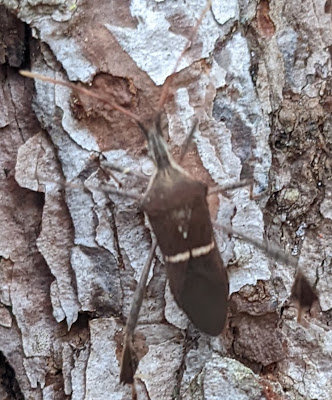
Leaf footed bugs, Leptoglossus spp., are larger size, primarily vegetarian insects, that feed on seeds, vegetables, plant matter and fruit with their cutting and sucking proboscis-like mouth.


Adult leaf footed bug, Leptoglossus spp. on a pine

Named for their leaf-like feet appendages, Leaf footed bugs are polyphagous and will feed on hemp plants, tomatoes, fruit, squashes and other garden crops when available.  During months when crops are not readily available they will feed on plants and seeds, seeking out 'weedy' areas across the hemp cultivation site. These insects may be often seen on hemp and cannabis plant stems, buds and leaves.


Leaf footed bugs can damage hemp and vegetable crops


Adult leaf footed bugs can fly long distances.  I usually see them hiding, over-wintering, in wood piles during cooler months.  They lay their eggs during spring and summer and may produce several generations in a year.

Birds, spiders and predatory wasps, possibly the sand wasp, are all natural enemies of leaf footed bugs and help keep their population numbers managed.

Though not the worst pest insect to the organic hemp or vegetable grower, they can inflict damage to both plant and flower.  In a well balanced horticultural ecosystem they can provide forage to other insects and wildlife and as such provide a certain level of food chain importance.

Certain species of thistles seem to attract leaf footed bugs as well as citrus.  Thistles are also quite beneficial in their supporting relationship to useful pollinators, birds and other natural pest predators. Native plant species such as milkweeds and mints are an important tool as they attract leaf footed bug enemies, such as predatory wasps.

A organic based integrated pest management approach to managing leaf footed bugs on the hemp farm should include;

  • native plants that attract predatory wasps
  • plenty of bird feeding opportunities
  • removal of unnecessary wood and debris piles
  • spider habitat
  • sighting notations in daily grow journal.

As long as the leaf footed bug population numbers are not out of control, their occasional presence should not be a priority concern to the hemp grower.  They can be however, a dynamic variable in the hemp garden's ecosystematic matrix and as such their presence should be recognized by the grower in the daily journal.


Saturday, January 1, 2022

Assassin Bugs, An Organic Hemp Cultivator's Helper

 Assassin bugs are a great pest control partner to have when growing hemp organically.  

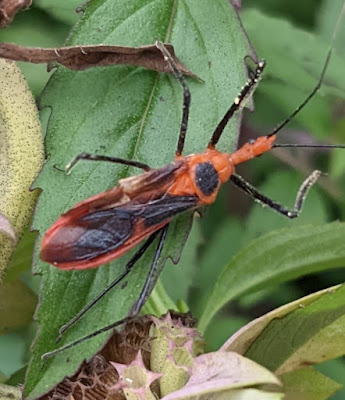
Milkweed assassin bug, Zelus longipes, is an important part of an organic hemp pest management program

Members of the Reduviidae insect family, assassin bugs are the perfect hemp (or for that matter any organically grown garden plant) pest predator. They inject a digestive secretion into their prey and then suck out their prey's body fluids through a straw-like snout.  Assassin bugs favorite hunt includes; aphids, beetles, caterpillars, leafhoppers and even bees and flies.

Included with the Assassin bugs in the Reduviidae family are the closely related ambush bugs (subfamily Phymatinae), wheel bugs (Harpactorinae) and kissing bugs (Triatoma spp.).  Some Reduviidae can and will bite humans.  As with any insect bite,  a bite from these insects may be painful and proper first aid should be administered.

Foraging across the garden, the assassin bug's appetite is voracious and non-discriminatory, devouring both bad and beneficial insects.  But on the whole, the assassin bug is welcomed as an eat all pesty pest bug control partner. 

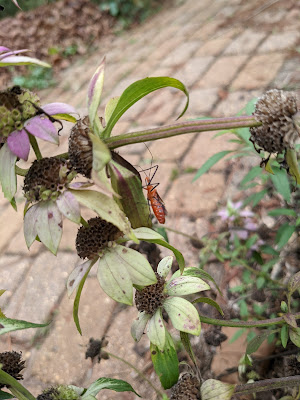
Milkweed assassin bug, Zelus longipes, foraging on Monarda punctata

The key to managing the assassin bug in the hemp growing area includes the use of nectar producing native plants the bug is naturally attracted to.  Strategic plantings of spotted bee balm, milkweed, goldenrod, mountain mint and other wildflowers can direct assassin bug's attention into those areas needing urgent pest control attention.

There are about one hundred fifty species of assassin bugs.  One of the most common assassin bugs seen in the garden is the Milkweed assassin bug, Zelus longipes.  

Milkweed assassin bug, Zelus longipes, have a never ending appetite for hemp cultivation pests

 The photos above are of a Milkweed assassin bug foraging across one of Arendell Hill's spotted bee balm, Monarda punctata, plants.

Though assassin bugs may look wicked, they can help the organic hemp grower keep pest insects to a minimum.

The native plants mentioned are known to attract assassin bugs looking for high-energy packed nectar.  Organic hemp integrated pest management will always use assassin bug attracting native plants around growing areas, either as permanent plantings or in movable growing containers for spot pest control.

The organic hemp nursery is a dynamic site, rich in complex ecosystematic matrices.  The relationships between native wildflowers, the Reduviidae family of insects and the hemp farm are important for the grower to understand.

Welcoming these colorful but alien looking bugs is another key component in a successful organic hemp growing program. 


Thursday, December 30, 2021

Raptor Perches for Organic Integrated Pest Management

 Arendell Hill has two new raptor perches now and we hope the birds of prey make themselves at home on the fourteen feet tall bird stands. These raptor perches are inexpensive and easy to build, and can be moved as necessary to different locations in the future.

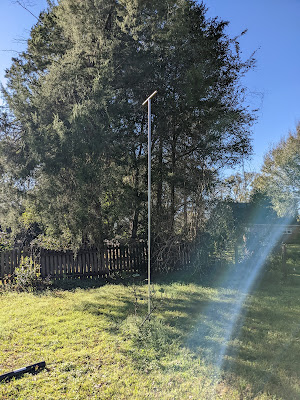
Organic Hemp Cultivation incorporates birds as pest control partners.  Here is one of two raptor perches at Arendell Hill.

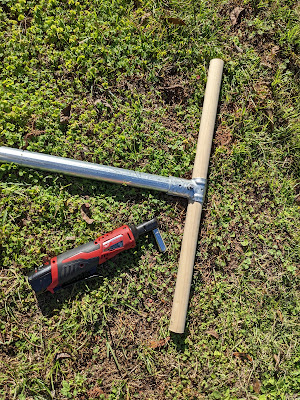
The horizontal perch section is a 1 1/4" diameter wooden dowel and is fastened to the vertical support pole.

Raptor perch, horizontal wooden dowel attached to vertical metal support pole

The materials list is for two perches:

  • Three 10' galvanized chain link fence top rail posts for vertical support
  • One 4' in length 1 1/4" diameter wooden dowel for horizontal perch
  • two galvanized chain link fence 1 3/8" T connectors 
Raptor Perch materials, IPM for Organic Hemp Cultivation

The tools I used to construct the raptor perches included; a fence post hammer (so much easier than a sledge hammer), level, portable ratchet, metal screws and portable screwdriver.

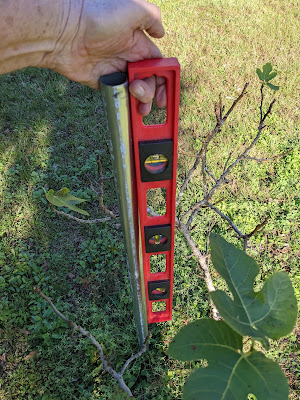
Raptor perch support pole should be plumb vertical

I cut one of the three ten foot top rail posts in half and drove the smaller diameter end into the ground using the pipe hammer approximately three feet or depending on the soil composition deep enough to keep the five foot pipe section sturdy.

Using the level I made sure the support pipe I was driving into the ground was vertically plumb, straight up and not skewed or leaning to the side.

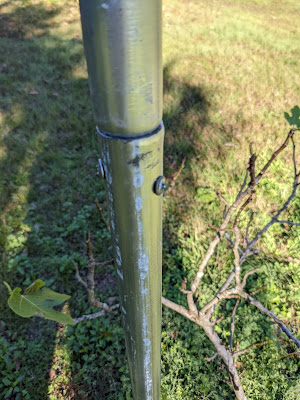
Raptor perch support poles are fastened together and secured with metal screws

Once the support pipe is hammered into the ground then the small diameter end of the uncut ten foot six inch top rail pipe with the wooden dowel attached are placed into the support pipe. The two vertical pipes are fastened together with two metal screws.  A pilot hole can be drilled for the two metal screws.

Because the raptor perch support post is not permanently anchored in concrete, it can be moved depending upon hawk or other raptor flight patterns.  Disassembly is easy; unscrew the two metal screws, remove the longer top rail with perch attached then pull up the support pipe hammered into the ground.

Birds of prey such as both the red-shoulder and red-tail hawks, swallow tail kites, sharp-shinned hawks, Cooper's hawks, broad-winged hawk, Swainson's hawk, Screech owls, Barred owls, Great horned owls, Barn owls, Peregrine falcons, Kestrels and even vultures scour hemp cultivation areas for rodents and other vermin.

Rats, mice and other vermin will eat hemp and cannabis plants and flower buds for food and also for the phytochemical action upon their bodies. Once a vermin devours enough cannabis flower they make an easy target for a nearby bird of prey.

Raptor perches afford the birds of prey a reason to stop and check out the hemp farm.  For the grower, hawks and owls are an important part of the beneficial organic pest control team.


Thursday, December 23, 2021

Organic Hemp Pest Control, a Native Plants & Songbird Partnership

 Last post we discussed the important roles wild birds have in organic based pest control for hemp cultivation.  

Ruby throated hummingbird, Archilochus colubris attracted to the many native plants of Arendell Hill Nursery, feeds on nectar & tiny insects
Today's post will consider what the hemp grower can do using native plant species to attract and manage birds interactions with the cannabis farm.

As we previously read, a wild songbird partnership begins with native plant landscaping.  Birds have always sought out native plant species for foraging, communal and safe harbor habitat.  Native plant species are their first choice when they are deciding to take up residence on a site.  This also holds true for raptors and migratory birds.  The connection with native plants lies deep within all birds DNA, a quid pro quo arrangement formed during earth's deep time.

Certainly non-native horticultural type plants may be popular and even attractive, however they do not offer the level of wild bird provisions afforded by native plant species.  This is a proven fact.  Moreover, non-native horticultural plants may also provide unwanted hemp pests a place to proliferate and do harm to native plant species through hybridization and even DNA alteration.  

Many non-native plants can quickly spread across the landscape, their seeds dispersed by winds, wildlife and human activity.  An organic hemp farmer will need to be able recognize invasive plants, such as Coral Ardisia, Ardisia crenata, or air potato vine, Dioscorea buldifera  and implement control actions to stop the non-native's spread throughout the hemp agriculture site.

Importantly, one of the keys to high terpene content in flower buds of any variety is a high level of biodiversity and complexity in the surrounding ecosystem matrix.  Non-native species reduce biodiversity, sometimes drastically.  The coral ardisia and air potato vines mentioned above are one particular threat to hemp farms because invasive plants can quickly displace hundreds of native plant species that previously existed within the hemp ecosystem matrix depleting biodiversity and throttling production of complex terpene expression in hemp flowers.

Complexity of terpenes in hemp due to biodiversity is what makes a flower special.  When a flower is desirable to the consumer, demand and sales increase.  High quality hemp is the goal of most growers.  By attracting cultivation site songbirds and planting a diverse landscape of native plants the grower gains more control over unwanted pests and also increases the quality of the hemp product by keeping cultivation site biodiversity high.  The songbird-ecosystem matrix complexity-terpene-hemp plant relationship is a very important grow optimization concept for the farmer to explore. 

History is full of examples of plants providing humans with amazing phytochemicals, substances rich in healing properties.  For instance, yaupon holly, Ilex vomitoria contains caffeine and many terpenes too.  Songbirds love to eat holly berries.  Yaupon also provides a home across its bark for countless different species of lichens and mosses.  Older yaupon plants support a complexity of fungi and mushrooms.  All of these ecosystem variables; the fungi, the lichens, mosses, birds, plant and wildlife litter interact together to help form a web of ecosystem matrix diversity that is essential to comprehensive terpene creation in hemp and other plants.

Native plants have evolved over the ages alongside soil formation, fungi & lichens, plants, weather trends, insects, birds, fish, lake, river and stream creation and flow, climate changes and other biological and geophysical factors. The ecosystems we are a part of today were fashioned and shaped through millennia, a result of 'trial and error' over vast expanses of time.

Native ecosystems are the product of natures long term refinement processes.  In fact the time factor nature has invested into forming the ecosystems around us is so vast that it is practically impossible for us to comprehend what has taken really place.

The result of these evolutionary process can be witnessed in the precisely balanced interactions associated with native ecosystems.  Natural checks and balances keep seasonal life cycles functioning smoothly.  This way no one or two life types becomes over abundant or out of control. 

So for the hemp farmer, outdoor growing can expose hemp plants to geophysical and biological variables that may activate both biological and epigenetic process resulting in increased terpene production and diversity. Many terpenes important to humans for cosmetic, pharmaceutical, agricultural and food purposes are synthesized by plants as responses to outside influences, or ecosystem variables.  Some of these may be related to the ecosystematic complexities surrounding presence of native plants, insects, fungi, birds and wildlife.

A strategically designed native plant filled landscape not only provides the basis for increased terpene development but also serves as the foundation for organic integrated pest management purposes.

Once native flora is established, birds will make themselves at home and begin to assist in managing insect populations.

I've found the following native plant species to be especially helpful in recruiting songbirds, raptors and other wild birds.

Shrubs and small trees:

  • Wax myrtle, Morella cerifera
  • Yaupon holly, Ilex vomitoria
  • American holly, Ilex opaca
  • Gallberry, Ilex glabra
  • Elderberry, Sambucus nigra
  • Firebush, Hamelia patens
  • Beautyberry, Callicarpa americana
  • Hoptree, Ptelea trifoliata
  • Coontie, Zamia integrifolia
  • Red mulberry, Morus rubra
  • Seagrape, Coccoloba uvifera & Pigeon plum, C. diversifolia (cold tender)
  • Groundsel tree, Baccharis halimifolia
  • Paurotis palm, Acoelorraphe wrightii (cold tender)
  • Coco plum, Chrysobalanus icaco (cold tender)
  • and many more.
Native tree species to plant for birds are:

  • Oaks, such as;
    • Live oak, Quercus virginiana
    • White oak, Quercus alba
    • Myrtle oak, Quercus myrtifolia
    • Shumard oak, Quercus shumardii
    • Swamp chesnut oak, Quercus michauxii
    • and many more
  • Red maple, Acer rubrum
  • Hickory, including
    • Mockernut hickory, Carya tomentosa
    • Pignut hickory, Carya glabra
    • Black walnut, Juglans nigra
    • and others
  • Magnolia, Magnolia grandiflora
  • Black gum, Nyssa aquatica
  • Cypress, Taxodium distichum & T. ascendens
  • Pines species:
    • Sand pine, Pinus clausa
    • Slash pine, Pinus elliottii
    • Spruce pine, Pinus glabra
    • Longleaf pine, Pinus palustris
    • Loblolly pine, Pinus taeda
  • Sabal palm, Sabal palmetto
  • Sycamore, Platanus occidentalis
  • Tulip popular, Liriodendron tulipifera
  • Silver buttonwood, Conocarpus erectus
  • Mangroves;
    • Black mangrove, Avicennis germinans
    • Red mangrove, Rhizophora mangle (cold tender)
    • White mangrove, Laguncularia racemosa (cold tender)
  • and so many others
Native plant societies, wildflower associations, local agricultural extension agencies and native nursery business associations are all excellent information resources on what species to use and how to plant and care for native plants.

Here in Florida, the following entities can provide important growing info about native plants;
Hemp farm landscaping should always be included during initial hemp growing planning considerations. Native plant focused landscapes should be installed concurrent with any hemp cultivation efforts.

The organic hemp farmer needs all available help with pest control.  Hemp agriculture will demand significant amounts of time from the grower.  Native plants can serve as hosts to nature's own great pest control specialists.
Wednesday, December 15, 2021

Birds and Hemp Cultivation Organic Pest Control

 Guarded greenhouse cultivation of hemp and cannabis is the best way to avoid birds when growing hemp. Yet, the grower might ask, 'why would I want to exclude a great organic pest control partnership from my grow operation?'

We make sure the bluebirds have plenty of nesting boxes ready to use each year.  Bluebirds consume a significant amount of pest insects across the Arendell Hill Nursery.

Birds are practically ubiquitous.  Fences don't prevent their presence, neither does hunting.  Birds always come back to the garden. 

The smart organic hemp farmer understands that though birds will always be around and may present some negative issues (such as potential vectors of disease and damage to crops), they also provide a number of significant benefits, including;

  • good control of caterpillar populations
  • mitigation of excess squirrel numbers
  • reduction in rodent infestations 
  • removal of unwanted seed fall from adjacent landscape plants
  • aphid and bug control
  • cricket and grasshopper management
  • and more
Disadvantages brought on by the birds can include;
  • feces and droppings
  • seeded bud damage
  • broken branches
Because many hemp and cannabis growers prefer to purchase seed from seed supply companies, the issue of seed interference by birds comes down to 'are the birds damaging flowers and buds in search of seeds' or did 'the birds take my seeds'.

One approach many growers take is installing bird feeders at strategic locations around the hemp or cannabis growing areas.  Organic black oil sunflower seed and organic wild bird seed can be placed on trays or in dispensers.  Not only will this strategy attract pest eating birds to the area but also direct the birds away from crops and towards the feeders.

I hang the feeding platform about five feet above ground level on a piece of 1/2 galvanized pipe with a tee at the top hammered into the dirt.  We always have squirrels around Arendell Hill Nursery so our feeders must also be squirrel resistant too.  Audubon type squirrel guards work well.

Hawks and other raptors, while perfect for managing squirrel and rodent numbers, will also hunt the garden's songbirds.  Proper bird feeder placement requires sufficient native plant cover nearby.  

Evergreen natives, such as wax myrtle, Morella cerifera or southern magnolia, Magnolia grandiflora and American holly, Ilex opaca each offer good forage and cover for smaller songbirds.  Either place bird feeders close to the evergreen native shrub or plant a good size native close to the hemp garden's bird feeders.  The tightly shaped limb arrangement on the native shrubs allow songbirds a place to safely perch, away from the much larger raptors.

Raptor perches and owl boxes should also be placed around the garden perimeter to attract hawks and night hunters.  Owls are highly proficient when it comes to thinning gophers, moles and rodents. 

Owls being nocturnal do not usually prey upon songbirds so placing roosting boxes around the hemp garden should not significantly impact wild bird presence.

Next post we will begin discussing the specific types of wild songbirds useful to partner with in an organic pest management approach for hemp and cannabis cultivation.


Tuesday, December 14, 2021

Organic Hemp Pest Control and Anolis carolinensis (Florida's Green Anole)


Lately we've focused on discussing some of the many ecosystem variables associated with hemp (Cannabis sativa) cultivation in an effort to understand how to grow hemp organically, without the need for chemical pesticides and herbicides that may be implicated in toxic or carcinogenic potential.

The green anole is an important member of organic IPM efforts for hemp crops

Today we will briefly discuss one particular lizard, Anolis carolinensis, the common green anole.  The green anole is an insectivore and a native lizard here in the southeastern US.  But what is the difference between lizards and anoles?  Are anoles lizards or are lizards anoles?  

The green anole is a member of the Dactyloidae family, a group sometimes classified as a subgroup of the Iguanidae family (Iguanas).  Anoles and Iguanas are both considered to be 'lizards'.  Anoles range in size from small to large.  

Though native to North America the small green anole is also recognized as an invasive species in eastern countries such as Japan.  But here in Florida Anolis carolinensis is considered a beneficial native lizard.

Importantly to the hemp grower, the green anole is a highly beneficial ecosystem component to include when developing an organic integrated pest management plan.  Although any wildlife, insect or bird can be a vector for diseases that may affect hemp, Anolis carolinensis offers more benefits than risks to the grower.  With their big appetite for pest bugs green anoles can be a beneficial partner, on duty twenty four seven (I've seen them feeding at night), always looking to devour smaller pest organisms.


Organic Hemp Cultivation,  Anolis carolinesis's throat fan

Unfortunately for the hemp farmer and for the native green anole, a larger anole has appeared in Florida.  This also hungry, larger, invasive anole is known as the Cuban brown anole, Anolis sagrei.  Though native to Cuba and the Bahamas, the Cuban brown anole has spread through the Southeastern US by laying eggs in horticultural potted plant soil.

Unfortunately for the native green anole, the larger Cuban brown anole is a predator who loves to dine on green anoles.  But because the Cuban brown anole is significantly larger and heavier, the Cuban brown anole generally avoids heights.
Green anole quickly eats the pest housefly; Organic IPM in action!

Heights however are a preferred foraging and communal area for the native green anole.  The more plant matter growing above, say one meter, the better for the green anole.  Vertical green, especially in the form of native vines such as: Carolina jessamine, Gelsemium sempervirens; Coral honeysuckle, Lonicera sempervirens; and Virginia creeper, Parthenocissus quinquefolia grow above the larger Cuban anole's normal roaming territory and provide a safe-haven of vertical green to the hemp farm's green anoles.

So by adding what we call 'Vertical or Volumetric Green' to the hemp garden, the grower is providing the Florida green anole with a place to escape predators and contribute to organic hemp cultivation IPM by devouring flies, aphids, caterpillars and more.

The photo sequence here starts with a green anole resting on the palmetto frond siding of a chickee attracting flies (and female anoles) with his 'dew lap' or 'throat fan'.

Green anoles play an important role in organic integrated pest management programs.

The fly, Musca domestica, soon lands and the always searching for bug anole grabs and eats the first fly of many for the day.  This seemingly insignificant act of predation is so important to hemp IPM.  Common house flies are a significant vector of diseases that may affect hemp.  Flies frequently regurgitate their stomach contents and leave fecal matter after landing on a hemp bud.  Salmonella, aspergillus and other noxious organisms can be spread through hemp crops by house flies. Because the green anole eats copious numbers of house flies daily, they contribute to positive hemp crop ecosystem criteria.

Nature is constantly providing examples of how ecosystem matrices and integrated pest management function. 

The Florida green anole and native plant species that provide communal habitat for the anoles are two very important components of a successful organic hemp integrated pest management system.  Ultimately, both the grower and consumer benefit from organically grown hemp.  First, the consumer benefits from the organically grown hemp because the product is free from pesticides and industrial type chemicals that may be toxic or carcinogenic.  Second, the grower can command higher prices for their crops due to the demand for healthier organic products.

Learning to understand the variables in a hemp farm's ecosystem matrices can be a complex undertaking yet the efforts will pay big dividends in sustainability, quality product, health and biodiversity. 

Shout out to Anolis carolinensis! 

Saturday, December 11, 2021

Organic Hemp Cultivation and Pest Control, Documenting Weather Patterns

 Some of the most important variables the organic hemp farmer can record and analyze are weather patterns impacting the growing area.

Weather patterns are often predictive of pest outbreaks.  Droughts, floods, excess heat or cold, humidity levels, solar radiation, geomagnetism and barometric pressure fluctuations can trigger pest population explosions and also initiate certain pest activities.

Temperature changes, such as prolonged heat waves may cause insects to become much more active.  Insects are cold-blooded (poikilotherms) organisms, meaning their body temperatures fluctuate with outside temperature variations and heat is not generated internally through biological processes.  Prolonged heat waves can fuel insect activity due to increased body temperatures.

Some have estimated that for each two degrees Fahrenheit rise in temperatures over normal ranges, pest insects may inflict ten to twenty percent more damage as their metabolism and body temperatures increase.  These observations suggest climate change could have serious impacts on hemp organic integrated pest management as well as for other agriculture product pest management systems.

Droughts too may trigger prolonged insect feeding activities as bugs search for water sources within plant buds, stems and leaves.  During droughts, hemp and cannabis pest insects may be driven to eat plant matter in search of moisture.  Regular precipitation measurements may provide the hemp farmer with patterns that help predict pest activity.

Organic Hemp Pest Control, Ambient Weather wifi enabled rain gauge

Climate and weather patterns can also be helpful in determining which beneficial insects, or pest predators are most productive in an organic pest control role under certain climate conditions.  Abnormal weather patterns such as drought, extreme temperatures, winds and humidity levels may actually work against beneficial insects and favor hemp pests.

There are many low cost, reliable weather stations available today that monitor, record and summarize growing area weather variables.  Ambient Weather, La Crosse Technology and Davis Instruments are a few of more popular retail available weather instruments.

Organic Hemp Cultivation, IPM methods, Ambient Weather Station

I use an Ambient Weather ultrasonic unit that measures temperature, relative humidity, wind speed, barometric pressure, sunrise and sunset hours and other important ecosystem geophysical variables.  The Ambient Weather station was inexpensive, easy to set up and summarizes weather trends over time.

Most of the small personal weather stations also provide the capabilities to connect to the internet, allowing for participation in crowd sourced weather data sites.

Weather and climate data are an important but small part of a hemp cultivation site's ecosystem variable population.   

Our agrarian ancestors understood the importance of understanding weather patterns.  Their food growing efforts depended on weather systems knowledge.  They watched and listened to the clouds, birds, animals and other tell-tale signs of impending climatic events.

Organic Hemp Pest Control, Ambient Weather data display

Today, the hemp farmer must also be able to comprehend meteorological impacts on crops.  A daily log of cultivation site weather data provides so much important information.

A thorough understanding of geophysical weather variables driving much of the hemp farm's growing parameters will support successful organic cultivation efforts.

The successful hemp cultivator will use all available organic-based integrated pest management tools.  Weather recording systems are a critical part of any organic IPM program on hemp farms.


Thursday, December 9, 2021

Organic Hemp Farming, Pest Control and Annual Ecosystem Matrix Data

 Last post we discussed the importance of codifying the hemp cultivation area's biological and geophysical characteristics into a chart or graph.  We call this site summary the ecosystem matrix.

Four season data provides the most accurate ecosystem matrix data to the hemp grower for pest control efforts.

Smaller sites may possess a single ecosystem matrix while large sites, spread across acres of land may involve many different existing ecosystem types.

There are many variables interacting with each other in a functioning ecosystem.  The whole of these variables comprises the ecosystem matrix.  Documenting hemp farm ecosystem matrix biological and geophysical variables in a summary table or graph can provide the grower with valuable tools for best growing results and pest control.

Importantly, many of these variables act differently according to seasonal variations.  Recording the growing site's variables during one month may provide valuable growing information for that month but may be irrelevant for different months or other seasons.

The ideal ecosystem matrix analysis will contain site data from one or more complete annual growing cycles, including data from spring, summer, fall and winter.

With respect to hemp plant pest control, the knowledge of when certain pests appear and when they inflict their respective damage is a vital part of the organic integrated pest management program.

It is a given that there are quite a number of pest insects that can harm hemp crops.  Importantly, these pests not only appear at different times of the year, during different seasons but they also have their own set of biotic and abiotic ecosystem variable requirements for growth and survival.

A few of the seasonal variables that should be noted when developing an organic pest control program include; day length (photoperiod), wind speed and directions, rainfall amounts, leaf litter amounts, air quality, temperature, bloom types, mushroom growth, relative humidity, barometric pressure and others.

The goal for the hemp grower should be to avoid surprise with respect to pest organism emergence.  By collecting hemp growing area ecosystem matrix observations and measurements throughout the year, predictive patterns will begin to emerge with respect to fly, caterpillar, fungus and insect population growth.

All pests have specific requirements for successful growth.  When the ecosystem is favorable to their needs, pests will flourish.

The ability to recognize patterns in seasonal occurrences affords the hemp farmer warning that certain pests may be expected, and then also the opportunity to manage variables in order to prevent pest outbreaks.

Though it requires time and effort, an on-going, annual ecosystem variable analysis effort is truly the backbone of any organic integrated pest management program.  The hemp farmer must understand what they are dealing with and when they will be facing specific pests.  It can't be overstated enough, the hemp farmer must intimately know their growing site ecosystem(s) through all the seasons.

The benefits of ecosystem matrix tools for organic pest control are many, not the least of which is a healthy agricultural product free of toxic sprays and powders.  Organic integrated pest management focused hemp growing operations will always produce the very best hemp products.


Saturday, November 20, 2021

Organic Hemp Pest Control (IPM) Prescribed and Simulated Burning Importance

 Last post we discussed how Eastern Tent Caterpillars, Malacosoma spp., lay their eggs on the branches, twigs and leaves of hardwood trees.  Once deciduous leaves fall and autumn winds blow twigs to the ground, caterpillar eggs can overwinter in accumulated biomass, groundcover vegetation and the dirt.


Insect, probably caterpillar larve hatched and beginning to weave silken web for protection

Until humans began the suppression of seasonal lightning fires, heat generated by combustion of dry biomass served to control population numbers of many pest organisms including caterpillars.

Natural seasonal fires served to cap population numbers of many pest insects.

Many farming operations today have reintroduced the practice of land fire management with prescribed burning.  Prescribed burning involves the intentional application of fire to plots for the purpose of weed and invasive plant control, pest management, biomass fuel reduction (safety), hunting plantation management and many other purposes.

Often times though, prescribed fire may not be practical for safety sake and sometimes burning is simply impossible, say in a greenhouse for example.  In the event a hemp cultivation area is located in an area where burning is not practical then leaf litter and grounds cleaning becomes a pest management tool of utmost importance.

Pest organisms take advantage of many transportation mechanisms referred to as vectors, to increase, sustain and spread their population numbers.

Leaves and twigs are subject to seasonal winds.  Once deciduous leaves fall from a branch they may be blown hundreds of feet from the tree from which they grew.  Over time these leaves can be carried significant distances via strong breezes.  

Moth laid caterpillar eggs attached to wind blown leaves and twigs can stay viable through winter months and hatch when appropriate weather conditions develop during spring months, increasing hemp pest population numbers.

Leaf litter management will not cause moths or caterpillars to go extinct.  On the contrary, managing tree leaf and twig drop can benefit the moth and caterpillar populations.  Excess caterpillar population numbers and overgrowth may lead to weakened individuals, spread diseases and lead to larval food shortages.  Good leaf management mimics nature's own way of managing insect populations.

As mentioned above, wildfires and lightning fires historically served as a limiting control on caterpillars and other insect egg spread.  As fire frequency diminished, pest pressure increased.  It is not really a big surprise that as the natural complexities of ecology change, a result of human actions, caterpillar and pest overpopulation occurrences are becoming more commonplace.

Today, because of the lack of seasonal wildfires it is important to 'simulate' fire's pest destruction effects by mechanically removing leaves that fall across the hemp cultivation areas.  Importantly, the grower should not only remove tree, leaf and twig litter from active cultivation areas but also from adjacent areas of the cultivation plot or greenhouse area.  Caterpillars and other leaf borne pests can crawl long distances.

Backpack blowers, rakes, lawn mower debris collection bags and other equipment can be employed to collect tree drop biomass (litter).

Once the twigs and leaves are gathered it is necessary to burn, compost or mechanically degrade the biomass to actually destroy pest eggs.  A big pile of leaves in the corner of the property can serve as a giant pest incubator.

Today, understanding and managing the leaf-twig-wind vector complex is just one of many important factors comprising an organic hemp growing ecosystem.

Seasonal fire is always helpful, but not always practical.  Therefore an organic hemp growing IPM program is benefited from simulated fire practices.

Predictable management of pest occurrences is a goal of organic pest IPM.  Keeping leaf litter under control can help keep hemp crops pesticide and toxicity free, and avoid diseases, leaf destruction or bud feces damage.