Showing posts with label florida stormwater. Show all posts

Thursday, February 2, 2017

Plants with Exfiltration - Answer to Urban Stormwater Runoff Treatment

Here is a quick eco-smart urban green stormwater treatment thought for the day.
Urban Green and Stormwater Treatment Integration

Take the massive amount of research conducted on how effective plants are with nutrient removal (P and N) along with their amazing capacity to fix carbon and combine with underground, permeable yet structural drainage filtration systems and you have the perfect combination of stormwater treatment, attenuation and landscaping all in a compact system.

The process may sound complicated yet in reality is very simple.

Use permeable pavers or a permeable surface in conjunction with a curb or gutter collection system to capture stormwater.

The stormwater is then routed horizontally through a permeable underground structural system.

Plants are installed in a larger, vertically oriented stormwater catchment system that can be connected in series to other units or to a central collection system.

The vertical collection tank is also a structural yet permeable unit where the plant grows in a removable top container.

Stormwater is then allowed to filter through the permeable structural system while watering the plants and recharging groundwater.

Exploring urban greening system integrated with stormwater treatment will become the future for design soon.

Thursday, October 3, 2013

Sustainable, Creative and Beautiful Stormwater Solutions

Stormwater drainage swales can be Eco-friendly and beautiful. 
Stormwater Swales can add stunning vertical green to the Urban Core

Much of the time they are just mowed weedy areas devoid of vegetation.  However, here is a very successful example of a stormwater swale in sandy soil with mature vegetation planted along the sides and even in the basin.

Trees observed include: Atlantic red cedar, Juniperus virginiana; live oak, Quercus virginiana and long leaf pine, Pinus palustris.

Notice the guard rail to the south of the swale to keep traffic from hitting the trees.  This swale is located at the western end of the bridge on Highway 100 crossing the Intercoastal Water Way heading east into Flagler Beach, Florida.

Kudos to the forward thinking designers!

Friday, May 31, 2013

Healthy Cities Need Healthy Stormwater Ponds - Urban Green, Habitat and Herbicides

Feels like I am stuck in the movie, Groundhog Day starring Bill Murry.  You know, the one where he wakes up in the same room to the same song and everything repeats itself!

Same way with our local governments spraying herbicides into those otherwise healthy stormwater ponds.
Stormwater habitat destroyed with aquatic herbicides


For years we've discussed the concept of 'nutrients in, nutrients out' here in this blog and in other forumsSimply put, once plants take up and sequester nitrogen, phosphorous and heavy metals they should be harvested out of the stormwater pond and composted, rather than conveniently killed with herbicides and left to decompose in the pond, releasing all the once removed nutrients and toxins right back into the water once more.

Native plant species, Typha sp. killed and left to return sequestered nutrients and toxins back into the water
The concept is so simple I really do not understand why most of our local governments still want to apply herbicides to stormwater ponds instead of simply taking a gas powered hedge trimmer and removing the upper biomass, then composting the collected vegetation.

Well, I can probably guess that the herbicide industry has spent untold dollars in lobby money, lunches out, small gifts, sponsorships of conventions, parties and the like.  After all the good-old-boy network is still alive and well and smoothly functioning!

I am really disappointed in the baby-boomer generation.  Though my hope has always been that the non-conformist ideas of the 60's would change the world, in reality there was little if any change and never will be much change.  As baby-boomers got older and fatter we fell prey to the corporate ideal of 'falling in line' and listening to not having enough energy to do anything that was out of the ordinary. 

So today I am hoping, younger generations, those in their twenties and thirties will actually implement change for the better across our world.

Local governmental decision makers are obviously still taking the easy way out with respect to urban green and habitat.  Poisoning stormwater ponds with mechanized spray is so much easier than harvesting and recomposting.  With spraying herbicides the bureaucratic bunch does not really even have to think!  All they have to do is buy the Roundup or other similar herbicide.  The more herbicide purchased the bigger the holiday parties the regional poison distributor throws, right?

Does anyone in your local public works depart even care that studies may exist showing a correlation between Monsanto's Roundup and Cancer, specifically non-Hodgkin's lymphoma.

So in the meantime, while all the migratory birds and other local wildlife are drinking and otherwise using stormwater ponds for habitat (well they once were - until all the vegetation was killed), foraging and communal. local city and county officials are still jumping on the 25,000,000 pounds per year purchasing program of the poison.

No wonder our once healthy cities are becoming unhealthy.

No wonder wildlife, migratory birds, insects and pollinators are fleeing the urban core.

What is  it going to take to get it?

Are we finally ever going to vote into office those who want to be good land stewards instead of good corporate supporters?

Hello young folk!  What are you going to do to fix the mess we baby boomers have created?


Wednesday, August 1, 2012

Native Plants for Urban Green, Permaculture & Green Roofs

The bioswale is looking great!
LaSalle Bioswale Project - Native Plants for the Urban Core
We were out on errands day before yesterday and Judy had library books due, so the San Marco library was a stop on the list, and I was thrilled.  You see, Riverkeeper and Coca Cola funded a stormwater project I've mentioned before called a bioswale in front of the city facility.

Of course there were engineers involved (Doug Skiles) and plant people like Bob Chabot and Chris Dailey from the Jacksonville Zoo and Gardens, and others.
The Bioswale takes the place of the old right-of-way landscape
Though a stormwater ditch may not sound much like an Urban Green project, nor may it be as glamorous as a green roof or front yard filled with food plants, it is important to all the above.

I have to keep reminding the botanist in me about the importance of native plants.

San Marco's library bioswale is filled with ethnobotanically important native plants.
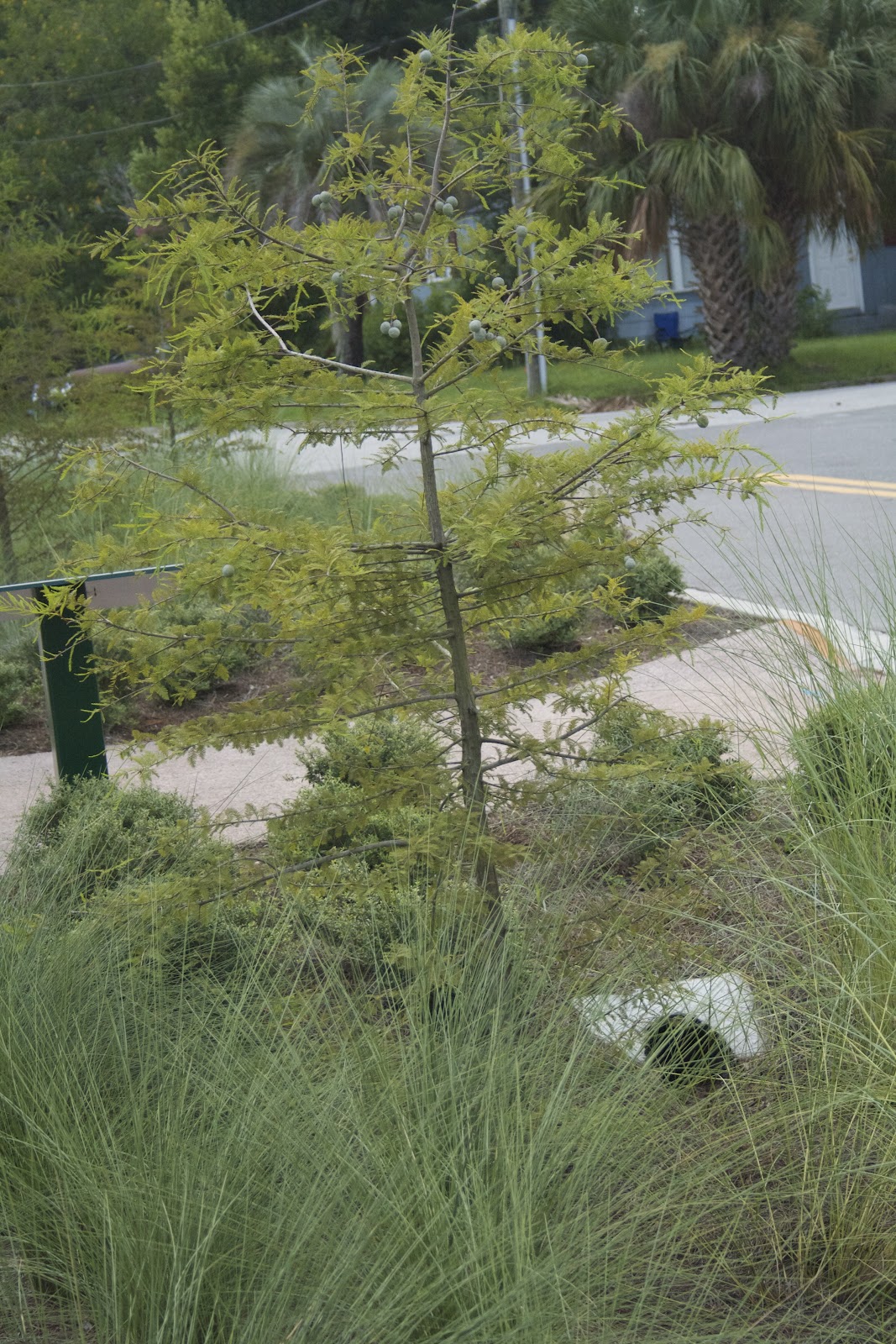
Cordgrass, Muhly grass, Cypress, Ilex and curbcuts gather and treat stormwater

However, many times these native plants are looked down on by, yes, even those involved in Urban Green, Green Roofs and Permaculture efforts.

Maybe due to their 'commonness', or lack of pretty, patented fluorescent flowers (though many native species are stunning in their own right), or minimal fruiting-food production, natives are out-of-vogue with a large component of the Urban Green movement.  In fact, in the Urban Farm movement, little if any thought is given to the impact of planting food plants that may themselves be another eventually invasive or monoculture problem.
Native plants provide habitat for native pollinators
Sometimes this may be due to the fact that urban farmers, green roof designers and permaculturists are used to thinking along the lines of only one mindset (including myself).

Yet the plants here are just as rich in ethnobotanical value as any exotic plant such as moringa, without the dangers of becoming invasive.  Though preached and loved as the ultimate plant, moringa has been classified as a potential dangerous plant for native habitats (see Michigan Technological University's website).
Existing utilities were worked around during design and installation
Other times it may be because of a lack of education and information about the true value of native plants to Urban Green, Green Roofs and City Permaculture projects.

But the San Marco bioswale brings all that back to mind very quickly.

The native plants growing in the San Marco bioswale not only clean standing and flowing stormwater, they are able to withstand long periods of drought without additional irrigation.  This is important because of our present water supply crises.  The plants can adapt to either floods or dry periods, without having to turn on the hose.
Native plants provide the transition beauty from street to building
Urban landscape, green roof and farming irrigation add up to be a significant amount of water use in our cities.  Hopefully, projects like the San Marco bioswale can educate us all to the fact that native plants can provide landscape beauty without added irrigation.

Yet there is more.  As I was walking around the bioswale, I noticed hundreds, if not thousands of dragonflies, damselflies and other insects.
Because of low leaf litter rate and ability to survive drought or flood, Cypress is perfect for bioswales
The bioswale was acting as a virtual breeding nursery for pollinators, those same pollinators permaculturists pray for around their gardens.  The native plants provide habitat for native pollinators to breed, forage and live in.  Without native pollinators there can be no food gardens.  Without native pollinators there will be no flower pollination.  Without native pollinators there are no city farms.

Importantly, we must recognize mistakes we as a culture have made in the past bringing in exotic plants for food, erosion control and landscape beauty that eventually have turned into nightmare plants.  Kudzu, wisteria, Mexican petunia and potato vine are just a few of many.  Unleashing plant monocultures that choke out native grasses and other plants has been a process that once we start has been difficult to rehabilitate.

The disappearance of many native pollinators and beneficial insects, amphibians and reptiles can be directly related to the use of food and landscape plants from foreign ecosystems that having once arrived, take over and preclude habitat for the native species.

Once our native species are gone we are left with a hodgepodge of alien plants.

Unfortunately, though gaining in popularity, native plant landscape are still under-appreciated for their biodiversity, pollinator support and habitat providing value.

Permaculture, green roofs and Urban Green have come a long way.  They still have a long way to go with respect to incorporating native plants.

Hopefully, projects like the San Marco bioswale will teach us about why we need a majority of native plant species on our green roofs, permaculture gardens and Urban Core Green.


Wednesday, December 1, 2010

Florida Green Roofs...Cold Weather Impacts on Florida Extensive Green Roof Plants

Add to Google Reader or Homepage

Here in Jacksonville we are supposed to experience our first frost-freeze of the year tonight - so I am posting a previous post about green roof plants in Florida and frosts. Enjoy and Happy Green Roofing!

The past week, January 5th through January 12th, 2010 has been one of the coldest weeks on record here in Jacksonville, Florida.  Hard freeze warnings have been issued every day.  Temperatures have dipped into the mid to upper teens many nights - - I even had an outside water line burst - my main supply line.

So how did the green roofs fare?  As expected, some of the plants weathered the cold just fine while others sustained slight to severe damage.

In addition to the freeze damage to the leaves and tender stem parts, there appears to be frost damage - due to epiphytic bacteria growth of Pseudomonas bacteria, a gram negative bacteria that also acts as an ice nucelator. From the available literature it seems that the presence of ice-positive Pseudomonas can actually cause ice/frost to form on the plant surface. Frost damages the epithelial layer, in many instances killing the plant.  See the Monday, December 22, 2008 blog about Pseudomonas and green roofs by clicking here.

The plants sustaining the most damage were the Sedums and Aptenias.  Aptenia cordifolia, a South African native is one of the most reliable spring, summer and fall plants for Green Roofs in Florida.  Between the freeze and the Pseudomonas the plants have repeatedly died over the past years on our trials.  A wonderful, thick and glossy low grower, Aptenia shrivels and turns brown in the severe cold, the stems separating from the roots.  I have not seen Aptenia reappear during the spring fresh growth spurts as I have with other species - especially the cacti.


So our data gathering continues and our knowledge of what works and what does not work in Florida's unique environment, grows with time and experience.

One of the surprising victims of the cold were many of the Sedums.  Sedum pachyphytumappears to have sustained significant freeze damage to the leaf structure.  I'll report back on what happens over the next couple weeks.


Happy Green Roofing!


Add to Google Reader or Homepage

Tuesday, September 14, 2010

Florida Stormwater Applicant's Handbook - Green Roof Rules pages 83 - 108

Posted here on the above link are the new rules proposed under the Florida Stormwater Rule.

We'll be discussing the rules and how they affect our Green Roof Industry.

Issues in the rule we will be exploring include:

* Irrigation is required on Florida Green Roofs,
* Fertilization is expected on Florida Green Roofs,
* Florida Green Roofs are to serve as a retention mechanism for stormwater treatment trains
* Florida Green Roofs and Cisterns are treated equally in the same section - shouldn't they be considered separate entities and systems?
* Recommended plant list includes those species that may represent a fire hazard under dought conditions.
* and other issues.

The stormwater rule is written from a stormwater perspective, calling some pioneer native plant species 'weeds'.

How do these issues potentially affect the Florida Green Roof Business?  Find out - stay tuned for a series of exploratory posts.

Email me with your questions and comments here.

Kevin

Wednesday, August 18, 2010

Allium - MV's Bonsai-ed Variety - Green Roof Plants Florida

I'm sold on Allium species for both green roof and living wall plants.  Hardy, evergreen, tolerant of inundation and tolerant of drought, these hardy plants form the backbone of many non-irrigated green roofs.  MetroVerde's bonsai-ed variety is an especially hardy variety - grown in a greenhouse with limited watering - typically les than 1/4 inch per month for over a year.  This picture I took today at University of Florida - we have a panel there - as we've written about before - and the system is non-irrigated, been in a harsh test area for over a year now - and the Allium species are growing strong!  Call Kevin with your low weight, extensive, non-irrigated green roof questions. 904-294-2656.

Monday, August 16, 2010

Another Green Roof in Hot Florida with No Irrigation - Green Roofs for Florida

This a small green roof we did in 2008 at Rob Overly's house in Jacksonville.  It is small (4' x 4') but in a very hot, harsh spot with on shade.

Rob, being the sustainable architect with a flair for clean water - being the water guru for Rotary International and traveling the globe on a mission of Sustainability - approached me and asked if we could do a pilot green roof on his front porch.  Using TPO over shingles and our mat and soil we planted the green roof using garlic chives, yuccas and bulbines.   Much to my surprise - two years later, the bulbines are the survivor champs.  Now birds, pollinators, tree frogs and anoles use the green.

I would have thought the winter cold would have killed them.  I would have guessed the garlic chives would be the surviving species.  However since this was to be a prelude to inexpensive technology in rural mother earth, one of the design criteria was a engineered soil layer of 3/4 inches of less.  This is probably why the garlic chives did not survive.  The TPO serves as the root barrier, and doing an excellent job at keeping roots out of the shingles.

This is an non-irrigated green roof that has survived temps ranges of 10 degrees F to  150 degrees F (measured on leaf surfaces with ExTech InfraRed).  Periods of no rain up 9 weeks and periods of intense inundation.

One of the reasons the section of roof shown was chosen is because it receives runoff from a long valley on the above roof and during a serious rain event there is a flood coming across the vegetation.

Call us with your green roof requirements.

Sunday, August 1, 2010

What Plants Should I Use For My Green Roof?

What plants should I use on my green roof?  I hear this question often.  The answer depends on your site orientation, sun exposure, rainfall amount, location, temperature zone, exposure and a host of other variables.

However I strongly suggest you take a tour around town as a first step in selecting green roof plants.  You will be surprised at what you find.  Look up at the top of buildings, old churches, in roof gutters - especially in older downtown areas.

Some of the most successful low maintenance, extensive and non-irrigated (other than natural rainfall) green roofs have been those pioneer and volunteer native plant species established and growing in gutters and along roof parapets.

If you are serious about understanding green roofs you will take the time to go, look, find, and identify the plant species growing without any additional assistance on the roof of your downtown buildings.

Though these plants may not ultimately be those you use, they will provide a solid understanding of the plant morphology and structure that does well under the influence of the 5 H’s.

Tuesday, June 22, 2010

Watching Green Roofs in Florida Evolve Over the Years...

It is amazing to watch the plants on a green roof move, find their perfect niche and grow over the years.  The photo here is of a sedum growing down across the roof and into the gutter, then overflowing the gutter and cascading down vertically.  Adding volumetric green to the urban core with Florida Green Roofs! For more information on green roofs, call Kevin Songer at 904-294-2656.

Saturday, December 5, 2009

Atlantis Living Walls - Living Walls for Florida, Vertical Green


Here is an interesting video of Atlantis Water Management System's Living Wall Concept. The design is solid, especially as the frame is made from 95% Post-Consumer recycled material - good LEED Compliant stats.

I'd make a few changes - such as setting the living wall frame off from the stucco wall by at least 4 - 6 inches and seal any penetrations for anchors with a good low VOC sealant.

Irrigation concept is good too, however I'd certainly capture the water as it exits the bottom of the system to prevent Slip and Fall litigation - you know how prone us American's are to lawsuits...look at the puddle at the end of the clip - Res Ipsa Loquitur.

The extra width will serve to provide stability - especially on free standing walls.

Any ideas how they could be used to treat stormwater?