Showing posts with label sustainability. Show all posts

Sunday, November 15, 2020

Super Easy DIY Living Wall on the Cheap

Included here are several photos of a one year old living wall planted with native coral honeysuckle, Lonicera sempervirens and wild muscadine grapes, Vitis spp.

DIY Living Wall with Coral Honeysuckle and Muscadine grapes

This living wall approach was super simple to construct and importantly, inexpensive.

DIY Living Walls can be Inexpensive and Beautiful with Native Plants

I would say this wall has been one of the best living wall designs that I've put together.

I've been trying different living wall approach approaches for over twenty years now.  I like both the trellis approach and the vertical planter approach.

Trellis Grid Panels are Held Together with Hose Clamps

However the trellis approach has delivered solid screening results with faster coverage and much less maintenance.  Since the vines are installed in the ground they tend to require less additional irrigation than walls designed around vertical planters.

The Vines Also Hold the Grid Panels Together

This system contains about a half dozen retail store merchandising wall grids and another six aluminum porch columns that I attached to concrete bases in the ground via 1/4" anchor bolts.

I sealed the grid panels with an exterior epoxy then attached them to each other and the aluminum columns with stainless hose clamps.

The entire wall cost less than one hundred dollars and covers 25' in length x 8' in height.  We just went through strong category two Hurricane Sally and the wall was unhurt.

We rooted the coral honeysuckle from cuttings so the plants were 'free'.  The muscadine grapes were volunteer sprouts from around the yard.

Because the living wall is adjacent our previous chicken yard, the soil is extra fertile.  Fertile soil is just what the vines want and they have really grown up the grids.

I am always amazed with the structural cohesiveness twinning vines impart to the grids they weave themselves into.

Coral Honeysuckle is a Favorite Among Hummingbirds

Hummingbirds love coral honeysuckle.

So consider finding some retail store wall grid on the internet marketplaces and allowing native plants like grapes, coral honeysuckle, Carolina jessamine, trumpet vine and others to provide you with beautiful screening flora.  No need to buy expensive living wall systems when you can easily build your own.

Wednesday, July 29, 2020

Fallen Logs are Alive with Ecosystem Benefits

Florida Permaculture, Fallen logs and Snag Trees play an important part in maintaining ecosystem health

Fallen logs are one of the forest’s most valuable assets.  Unfortunately deadfall is often thought of as natural ‘trash’ that needs to be cleaned up.  From an ecological perspective, old logs provide a bounty of needed benefits to the next generation of forest life.  Granted there can be peripheral yet important issues associated with allowing logs to decay naturally on site, but in terms of ecosystematics, decaying trees form an important basis for ensuring a continued thriving and diverse forest.


Should I allow a fallen log to remain on my property?  


There are many reasons from a permaculture and ecological perspective that point to a ‘yes’ answer.  These include:

  • Fallen logs provide communal and foraging habitat,

  • Dead fall slows the flow of stormwater,

  • Decaying trees may be considered a carbon sink,

  • Snags are full of nutrients and food for the forest and forest creatures,

  • Decomposing trees replenish soil lost through erosion,

  • Log fall supports full spectrum life biodiversity,

  • And much more.


Field observations have long proven the value of standings and fallen dead trees.  All types of wildlife use snag trees and hollow logs for shelter.  From bears, raccoons, snakes and opossums, to woodpeckers, kestrels, owls and osprey to ants, beetles, salamanders and lizards, decaying trees are sought out by refuge and food seeking wildlife.  A forest can be truly alive  through the presence of decaying, fallen logs.


Deadfall also serves to slow stormwater flow across the land, redirecting rainfall sheet flow back into the ground and reducing erosion.  A forest with fallen logs possesses effective methods of dispersing, managing and retaining important water resources.  Snag trees and logs play an important role in proper forest stormwater management.


Decaying logs also lock up carbon and mitigate carbon flow back into the atmosphere, ultimately returning most of the carbon back into the soil.  Preventing excess carbon release into the atmosphere is a significant part of addressing climate change challenges.


Old logs too, are full of nutrients for both plants and animals.  I am always amazed with the expansive amount of biodiversity I see inside a fallen log.  These forest logs are full of vibrant, functioning communities each seeking food, shelter and community and contributing back to the integrated health of the ecosystem. 


Decaying trees, full of compost from the wood and also full of excrement from life inside the log, are a rich source of fertile matter for new forest soil production.


Additionally, old fallen logs play a mostly unobvious but highly important role in maintaining the health of an ecosystem.  Intensive land use practices such as agriculture and subdivision construction have conditioned many of us to think of fallen logs as ‘trash that needs to be cleaned up’, and there are some issues associated with allowing deadfalls to remain on the property.


Land owners should be aware of trip hazard liability, injury from wildlife in the logs (bees, snakes and other critters), termite infestations and even land use restrictions.  I have actually seen local governmental entities designate parcels with snag trees serving as home for migratory birds (American kestrels) as ‘conservation parcels’, restricting land use options without compensation to the land owner.


However humans must balance their reasonable needs from the land with all important good earth stewardship.  Awareness and education can help us achieve a sustainable equilibrium between land use and sustainability.  Oppressive land use restrictions by governmental agencies can do more harm than good by disenfranchising land owners.  But burning fallen logs or haphazardly bulldozing snag trees also disrupts local native ecology and can significantly damage ecosystems for generations to come.


Sharing the importance of fallen logs with others will help communities understand how our ecosystems can properly function and ultimately add value to the planet.


Next time I step over a fallen log on one of my adventure hikes I’ll not only keep an eye out for pit vipers but also thank the log for the richness it adds to life.  Fallen logs are friends, and food too for the critters.


Friday, July 10, 2020

Designing Coastal Green Roofs Two, Native Plant Permaculature Tips


Part Two: Native plants and wildflowers can contribute to the design of a permaculture garden, green roof or container garden on an apartment balcony.  This video shares many of my design hacks and tips for plant selection.  Though the video was made to be an aid to green roof designers, the fundamental design principles are important for any garden or landscape design.  Hope you enjoy and learn from the video. Many thanks to greenroofs.com for hosting this video on their website!

Tuesday, September 24, 2019

Florida Green Roof and Living Wall Plants, Salt Tolerance Lessons from Mother Nature Ferns

One of the greatest learning centers of #greenroof and #livingwall knowledge can be found on and across the buildings in any local downtown, urban core area.

Ferns growing unattended on old brick adjacent downtown ocean pier, Kevin Songer 
Every living wall and green roof designer, as well as landscape designers and botanists should carry a 'found plant' journal to record information when they come across such resilient plants as those growing in the cracks and crevices of building walls and roofs, without soil media or added irrigation.


Ferns growing unattended on old brick adjacent downtown ocean pier, Kevin Songer 
Looking back across the decades, this is how I learned what I did concerning shallow root growing systems, nature irrigation and plants suitable for hot, windy, salty environs.


Ferns growing unattended on old brick adjacent downtown ocean pier, Kevin Songer 
These ferns are growing on a wall adjacent the downtown pier in Pensacola, exposed to desiccating winds and a barrage of salty mist.  And they seem to be thriving.

Always keep an eye out for those free lessons from Mother Nature about living wall and green roof plants!

Sunday, September 1, 2019

Florida Living Walls and Green Roofs, Nature Designed

Florida Living Walls, Vertical Urban Core Green by Mother Nature, Daytona Beach Church
For most my adult life I've been fascinated with understanding how plants colonize, live and proliferate on urban core structure roofs and walls.

Florida Living Walls, Vertical Urban Core Green by Mother Nature, Daytona Beach Church
Here are a few pictures of ferns finding a home on a church in Daytona Beach.  The benefits of urban green are many, including; carbon sequestration, urban heat island effect mitigation, habitat and pest control, rainwater attenuation and purification, oxygen production, sense of place and beauty and much more.

Florida Living Walls, Vertical Urban Core Green by Mother Nature, Daytona Beach Church
Examining how nature adapts plants to masonry provides insight into successful living wall design.

Next time you see a building with plants adorning the walls, stop and take a look.  Think about porosity, surface texture, locale, sun exposure and other variables contributing to the successful vertical green.
Florida Living Walls, Vertical Urban Core Green by Mother Nature, Daytona Beach Church

So much to learn and so many walls to plant!


Saturday, February 11, 2017

Living Walls, Celtic Cross Fabricated Using DIY Recycled Material

Here is a green wall I easily and inexpensively constructed from recycled materials.

The wall is four feet wide by five feet tall and fashioned out of rigid recycled plastic milk jug crates for the rear and side structural support.

The growing media is mineral wool and the celtic cross cut from old copper gutter sheet.

The Florida Green Anoles absolutely love it, providing them with habitat to escape the larger exotic predators here, the Cuban anoles.

Bringing Urban Green back to the cities doesn't have to be complicated and require high tech materials engineering or mechanical systems.

Recycled material technology is a sustainable approach to take when implementing Urban Green.

Thursday, February 9, 2017

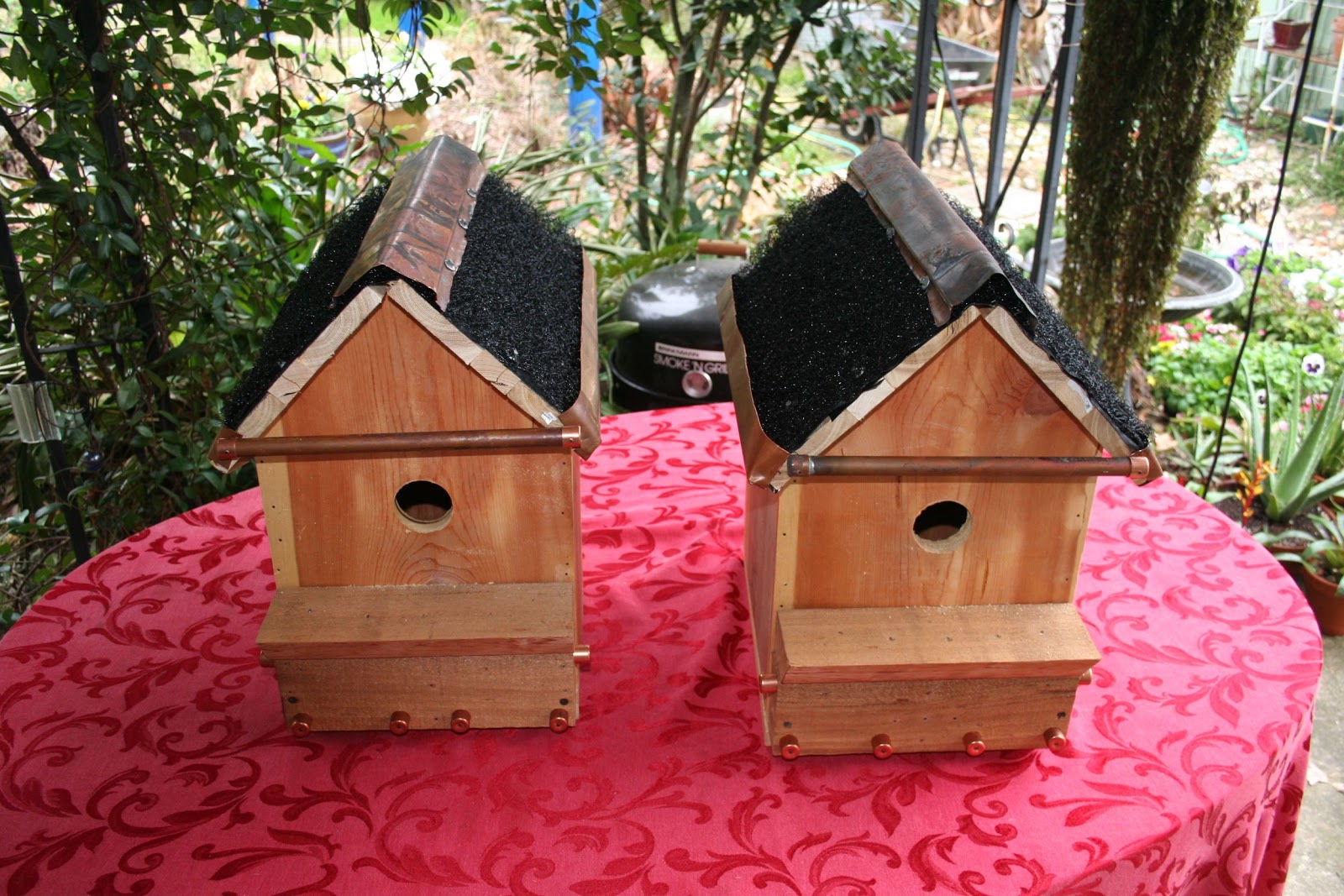
Green roofs for Birdhouses too! Urban Greening for all.

Green roofs are found on a wide variety of structures and not just commercial, institutional or residential buildings.
Green Roof Birdhouse - Plants and seed added...


Cedar Roof Decking - Birdhouse Green Roof
Included are several DIY photos of how to put a green roof on a birdhouse.

Birdhouse Green Roof - Double Sided Roofing Tape


First photo is of the birdhouse roof decking.

Green Roof Birdhouse - Membrane Installation


Next photos is the double sided tape allied to the cedar decking.

Third is the waterproofing membrance serving also as a root barrier.

Green Roof Birdhouse - Grow Weave Mat


Fourth is the grow weave mat, then the ridge cap (made from recycled copper flashing) and trim work.

Green ROof Birdhouse - Copper Ridge Cap


Agaves and succulents are added, along with a mixture of drought resilient wildflower seed.


The concept here is exactly the same process we use on large, large green roofs.  This type of system is called an extensive green roof and on the sloped birdhouse roof the soil is stabilized with a natural stabilizer such as agar (you can use flour also if you cannot find agar)...

Sunday, January 29, 2017

Urban Green With Simple Living Walls and Green Roofs

As I deal with a chronic cardiovascular disability that could end my life at any moment I have lots of time to reflect on Urban Green.
Simple Florida livingwall with plants grown into base fabric & attached to wire frame.

With a 24% heart output function I tire easily and so am either in a chair or bed most of the time.

Fortunately my mind whirls around Urban Green Concepts.  Especially after midnight when my mechanical heart parts end up making such a loud racket!

So I am going to try and push out these ideas for others to take and run with.

I've tried this before and usually fatigue gets the best of me.  Considering fatigue and long, detailed posts I am going to shift gears and go to shorter, frequent posts.  We shall see.

Firstly I recommend understanding of immediate environment, simplicity and use of native plants.

You must know the immediate environment if you expect to create an ongoing ecosystem capable of surviving in the environment.

Second forget the bells and whistles.  Simplicity is best.  Mimic nature if you can.

Finally though exotic landscape plants make great temptations for green roof and living wall use, your best bet is to use local native species.

OK.  Thats a start.  More #greenroof and #livingwall notes tomorrow.

Sunday, September 18, 2011

Future Green Roof Designers - UF Students studying on the Green Roof

Students, Pervious Pavement and a Green Roof

Rehabilitated BGC Office, Example of Florida Green Construction
Dr. Kathleen Carlton Ruppert's students taking her Practicum in Sustainability in the Built Environment class visited the Breaking Ground Green Roof last week.

Questions poised by the students were very on point and I was pleasantly surprised their queries focused on many important issues with green roofs and sustainability.

UF has a broad-based sustainability effort across the campus.

Check out the UF Program for Resource Efficient Communities website here for some great Sustainability info.

Saturday, February 12, 2011

Rooftop Garden Trials - Green Roof Garlic Board Update

Kevin's Florida Green Roof Garlic Board
As we stated in the  January 12th post,  - its not the highest tech approach to trying out new systems on a green roof.

Place a small 'pilot-plant' or 'test-unit' on the roof and see if the plants thrive or if the plants die.

Here is the sustainable Garlic board.

Sustainable because though this example is cedar, the board can be made of pine (potentially sustainable) or of bamboo (even more sustainable).

What does this really have to do with green roof?  Sure, it may be small scale permaculture on the roof but it doesn't have a water proofing system or root barrier system and one can imagine what kind of missile the contraption may become during 130 mph winds of a tropical cyclone here in Jacksonville.

Garlic Board After 3 Weeks


We'd take the board off the roof if a hurricane was approaching.  Thankfully, hurricanes or tropical cyclones give at least a couple hours notice or more now thanks to NOAA and other weather watch services.

However hurricanes are not the focus of this post.

The board is a statement of sustainability.

The garlic board is a first step in a process.  A process of moving away from synthetic materials to more natural materials for green roofs.  Surely there will be hundreds, if not thousands of other trial materials in our search for green roof sustainability.

Maybe we use an approach similar to this in areas where the ground soil is contaminated with pollution, or infested with pest organisms.  Maybe we provide simple shelter roofs while growing food.  Maybe, instead of a pine or cedar board, we grow the food in the thick stem of a palm frond.

Its all about feeding the people.

Our collective intelligence as humans across the globe is so great that maybe if we throw out an idea, the idea will catch hold somewhere and grow.

The idea of developing a natural materials based green roof is growing in my mind and the garlic board is just one small step towards the idea becoming reality.

And the garlic board is working.  The cloves are sprouting now and hopefully will grow and fill out the deep wide holes drilled into the board under the trough filled with soil visible in the photograph.  Certainly the garlic is up high enough in the air to enjoy the bright sun's rays and the system is soaked with morning's dew on some mornings.

So we will watch the garlic cloves and learn something about cellulose as a platform for growing plants on roofs.

Having worked hands on with plants for over thirty years I believe there are approaches to take in developing and growing large mats of root interwoven plants that would hold themselves together on a green roof.  Though wood and burlap and other natural materials may disintegrate over time, they may provide enough of a structural system to allow the plant roots to develop into a sustainable structural system themselves.

Coir may be another sustainable material for green roof system establishment.  Potassium, salt and other limiting issues with coir can be resolved with pre-treament and maintenance procedures.

The approach we are discussing here would be relevant to green roofs with a primary function of habitat creation, food production, O2 production, carbon sequestration, urban heat island effect yet may present problems with green roofs constructed primarily for stormwater issue resolution.

Though a topic for another blog post, green roofs created for stormwater attenuation will probably need to be constructed out of a long term stable material.

True sustainability is what we all strive for.

I may never stop using woven plastics such as polypropylene or polyethylene, especially if they are made from post-consumer recycled plastics - might as well use up the scrap and they do hold the roof plant material together quite effectively.

However we are in peak oil, plastics are petro-based and I am a dreaming product of the post- plastic inundation era.

I do want to make a long term difference.

And maybe the start lies with what I will learn from a cedar board on a roof with allium plants.

Plastic?

As always, email your comments and questions.

Happy Green Roofing!

Kevin

Thursday, September 30, 2010

Solar Powered Truck - General Works, Sanford

Today I'd like to share something new with you ( and a little different from Green Roofs ) - a solar powered truck!

General Works in Sanford, Florida (a Tecta America company) built this incredible solar powered truck - actually it is battery powered - but can be charged from solar panels.  Steve, the man who built the truck gave us the tour and it was really impressive.

Nichole says the truck can do 60 MPH.

Sustainability!

Kevin

Electric Truck, General Works, Sanford, Florida