Monday, July 20, 2020

Florida Green Roofs & Survival Garden Permaculture Plant, Seminole Pumpkin, Cucurbita Moschata

Seminole Pumpkin should always be considered for tropical permaculture plantings, survival gardens, and green roofs or living walls due to its bountiful food production, amazing leaf color and extensive summer heat island cooling biomass production.  

Our harvested Seminole Pumpkins have kept in the pantry for well over a year and still taste just as delicious as fresh when prepared as a dish.


So it is easy for me to say, one of my favorite vines this year is the Seminole Pumpkin, Cucurbita moschata

Florida Green Roof and Living Wall plant, Seminole Pumpkin (Permaculture Food)

An adapted garden wonder to Florida, the Caribbean and Latin American, this variety of pumpkin or squash is acclimated to the harsh, humid climate of the region, and grows wickedly fast in one growing season.
Unripe Seminole Pumpkin, resistant to pests

As a vine that provides ample shade, Seminole Pumpkin makes a great end of summer living wall and green roof plant and loves wide open, hot, sunny growing areas.  This year our Seminole Pumpkin has decided to cover a side yard trellis.  Last year it spread out across our entire driveway so much so the packages delivery person actually stopped coming up to the house until we trimmed the vine back.
Florida Living Wall plant, Cucurbita moschata

Thriving on neglect and drought, Cucurbita moschata, is ultra resilient to squash vine borers and other pests.  Here Seminole Pumpkin is used as a cover to our geese pen, providing a wall of privacy, security, shade and food.  We cook Seminole Pumpkin the same way we prepare butternut squash; boiled, baked, sliced and sauteed or grilled.
Seminole Pumpkin creates a living wall and green roof for the Urban Farm fowl
When thinking of drought tolerant plants for tropical green roofs and living walls, consider annual vines.  Green roof plants can include more than just wildflowers or groundcovers.  Green roof agriculture is always an option to be considered.

Seminole Pumpkin not only affords shade but also provides us with a significant amount of food.  Picked green on the vine the pumpkin will ripen and turn a yellow orange hue when stored in the pantry.
Seminole Pumpkin is a heavy food producing plant

 Nature has provided us with some awesome food and cooling shade plants that will thrive, prosper and provide.

Wednesday, July 15, 2020

Florida Permaculture, Ginko Walk Ecosystem Design Theory

Florida Permaculture, Ginko Walk Schedule for Survival Garden Design

‘Year round function and sense of place” are some of our primary objectives when designing a survival garden landscape.  Choosing the right plants; those that will thrive, provide color, texture, fruits, berries and ensure nourishment for pollinators and wildlife, is crucial to successful year round function and sense of place planning.

There are many readily available pulp planting guides to help choose plants but most are overly simplified and way too generic.  Many I read, group bloom and fruiting time into an oversimplified broad seasonal format; Spring, Summer, Fall and Winter.

Plants usually bloom when they want to bloom though due to varying microclimate conditions. Fruits and vegetables often respond to locality influences, especially the presence of lack thereof of pollinators, air and water quality and other variables. 

Because local site conditions can fluctuate widely in the same apartment complex, neighborhood, townhome community or rural zip code, good landscape and garden design should be based on an intimate knowledge of site specific bio-geo-climatologic systematics.  Simply put, local bio-geo-climatologic systematics is 'local ecology - what is actually there on the land, patio or balcony'.

One can generally follow the pulp planting guides and expect a moderately average result but ultimately, for the most productive and visually pleasing garden a designer must tailor final plans based on first hand understanding of the location.

In technical terns, when developing a landscape design input variables must be valid.  The designer must understand sites are complex systems.  The complex ecosystem concept applies to condo balconies just as much as it applies to large land tracts.  This is where a designer using generic planting information can miss important plant selection and infrastructure criteria.

As with any model, the Garbage In Garbage Out (GIGO) concept applies also to permaculture and survival garden planning.  Using ready made pulp landscape lists during the planning stages will provide you with plant choices that may work.  But over time, regular walks through your neighborhood will best contribute to an in-depth, first hand knowledge of those plants growing well in your locality and ultimately ensure a productive and pleasing garden.

I learn something new or see plants behaving in a manner never witnessed before on a regular basis. This is another reason for the garden designer to take ongoing, regular outdoor walkabouts.  An insightful landscape designer will want to know a site and understand how plants will behave on the site over long periods of time, usually for a minimum of one complete year – ( i.e. at least 365 days, preferably longer).  For instance, I know much about the elderberry plant, Sambucus nigra, from propagating to harvesting and using all parts of the plant.  But without my daily ginko walk photos and notes on my iphone it is easy for me to forget just how fast and tall elderberry can grow.

What is a ginko walk?  Isn't ginko really spelled 'ginkgo'?  We'll discuss those questions shortly.

We all are familiar with the adage, 'right tree right place'.  Yet many people install plants in a spot based on acquisition size in the nursery pot.  I see this happening all the time with parking lot landscapes.  Evergreen live oaks are beautiful fifteen foot tall trees in fifty gallons pots yet in a matter of a decade these trees can be pushing up asphalt and cracking concrete in their search for adequate root space.

Right now some of our friends have a holly tree in their front yard that has grown so large the roots may be pushing into their foundation and concrete driveway.  But when it was planted it was probably no more than eight feet tall.

Back to the elderberry.  We love elderberry for many reasons.  Elderberry is the perfect urban heat island effect mitigation plant because it shades in the summer and allows solar gain in the winter.  Of course there are numerous other benefits to have elderberry growing in your spot too, such as; berries, pollinators, medicine, drink, flowers, wildlife and more.  Elderberry grows fast.  Sometimes I forget just how fast elderberry grows!

Here is a photo of an elderberry taken in April.  We've trimmed the shrub/tree back to the top of the four foot tall chain link fence.  The plant is obviously a bit weedy looking but we love weeds too.
Florida Permaculture, Pruned April elderberry

Next is a photo of the elderberry taken in June, just three months later.  Now the shrub is approaching twenty feet tall.
Florida Permaculture, June elderberry shrub is now twenty feet in height

This huge difference in height can seriously impact surrounding gardens and structures.  But because I see the elderberry on a daily basis I never really notice the incremental growth, even considering the speed with which the plant shoots up.

However referring back to my ginko walk notes and photos the changes become obvious.

Regular ginko walks are a useful and documentable way to verify your knowledge of plants you add to plans.

The most successful site landscape and permaculture garden designs will be developed over time; they will be those having plant selection and landscaping principles verified and validated by comparing design to those plants growing, blooming and thriving in proposed site vicinity.

Granted, a one year (full seasonal) site study is time consuming, unwieldy and expensive.  It is also possible that landscapes and permaculture gardens can be designed and installed using generic planting data that will turn out as planned.  So why not just go with the pulp planting guide?

I've seen some quite expensive landscape and garden projects go awry and even eventually demolished because time was of the essence and the pulp printed plant list was not actually field validated. Take the elderberry for instance.  I forgot at first how fast this plant grows, but after double checking (validation) I know from my ginko walk notes not to plant elderberry around plants that need plenty of sunshine for within a matter of months elderberry would shade out all surrounding species.

Regular ginko walks are a 'best' solution hack to plant selection questions, and prevent GIGO during landscape design and plant selection decisions.

But what really is a 'Ginko Walk?' First of all the term 'ginko' as in ginko walk is spelled differently than the ginkgo in ginkgo tree, Gingko biloba.  I find the coincidence charming and actually appropriate though.  'Ginko, 吟行 is a Japanese word translated often to mean 'poetry walk' or 'singing steps' ('gin',  and 'ko', ).  Japanese poetry tradition relies on walks in nature, or ginko walks, for inspiration in creating verse. A ginko walk is an outdoor hike where the walker forages for nature information to create poetry with.

I am a big short verse poetry fan. Haiku poetry originates around the themes of; nature, outdoors, seasons of the year, wildlife, plants and an array of natural elements.  Haiku is a brief snapshot of something in the surrounding ecosystem, a thoughtful analysis of an ecological event (with a twist of course).  In this sense haiku is nature documentation.

For inspiration, writers hike through the outdoors, foraging, observing what they sense is going on around them in the real world, in the preset time.  As a foraging activity ginko walks help accumulate knowledge about local nature.  Foraging for ideas to create poetry is quite similar to exploring your site for an understanding of what plants will grows best in your permaculture design.  Rather than learn about your surroundings from a planting brochure you can learn so much more from regular ginko walks. Ginko walks provide real time input about; plants that grow successfully in your vicinity, bloom seasons and duration, colors, hues and textures plants share, soil compositions, sunlight exposure and many other ecosystem variables potentially influencing your garden to be.

First hand experience of which plants work best, along with observations of where and when and other real time data, provide a solid basis on which you can build your garden design.  Ginko walks are an exercise in foraging for information, and most revealing when conducted over extended periods of time.

It is possible too you may even experience a 'ginko walk ginkgo tree' encounter, if ginkgo trees grow in your neighborhood.

Use your ginko walks to forage for valuable garden and landscape design variables.  Once your ginko walk inspired designs and installations are complete the final product will be much more successful than any plan derived from pamphlet planting lists.

Ginko walks benefit not only garden success but also the health of the participants.  We all know regular hikes and strolls through nature have been shown to benefit human health and reduce stress levels.  

Real time foraged data entails much more than just a recording of plant types.  Importantly, when one takes the time to get to know their plot, over the course of a year, documenting light levels, rainfall and wind impacts and other relevant factors, they are also rewarded with an intimate relationship between the end result garden and themselves.  This closeness to the garden's life pulse provides as much benefit to we humans as do the resulting plant fiber, food and medicine produce.
Florida Permaculture, Good Designs Based on Comprehensive Site Understanding


The human-plant bond building concept is much like creating a piece of art versus buying a piece of art.  The artwork you create is a heirloom worthy of pride because of the amount of time and energy spent creating the work.  The purchased piece, though it may be lovely is much more impersonal and not a true reflection of creative spirit.  A close relationship with the natural world, facilitated by regular amounts of time spent over the seasons outdoors, builds deep understandings between designer and garden.

It is interesting to note as an aside, many land development regulatory agencies will actually require a year long site survey when considering threatened and endangered species so as to ensure confirmation of the presence of a particular species.  Some endangered plants are difficult to recognize except when in bloom.  Often these endangered plants may bloom only for a few weeks during the year.  Year long ginko walks or field surveys can provide presence validation.

A one year site surveillance period does not mean cultivating and planting can't occur right away, but rather it is the significant infrastructure design that should be delayed until the designer or owner is thoroughly familiar with important seasonal fluctuations.  Go ahead with those yummy eggplant, pumpkins, cherry tomatoes and flowers in early stages of design; plant away.  In fact, a fresh flush of garden plants can be inspiring and get all outdoors even more. The more time we spend outdoors on our site the more we will learn about our landscape design requirements.

Unfortunately, with climate change, reduced water levels and unexpected hydrologic cycles, and increased CO2 levels possibly discriminating against C4 plants like many asters and landscape grasses, we cannot anymore blindly assume bloom times for any plants, even those we’ve used reliably for decades.

Flux conditions quickly outdate pulp informational lists.  Because everything in our universe is constantly changing, including the local ecosystem in which your yoyo garden exists, relying on generic bloom or fruiting charts is simply not the best way to ensure garden success.  Don't get me wrong, the cumulative experience of local gardeners can be invaluable.  You just can't beat hands on, personal experience when it comes to designing infrastructure and then selecting plants to grow in your garden.

But if you want to reliably hit the moving target with your plant design try this bit of advice:

Start going for Ginko walks.  Always carry camera journal and pencil, or your smart phone with a camera. Always carry a water bottle with filtered water.  Consider carrying a walking stick to beat away the mosquitoes and to avoid tripping.

Do three Ginko walks each week for an entire year across your proposed project site, be it a balcony, patio, yard, rooftop or farm.  Better yet, do a ginko walk a day and note what you see, hear, smell and feel.

Carry a local plant identification guide and identify every blooming plant you come across on each ginko walk. Record when blooming starts, the size of the plant, how long the bloom persists and when blooming ends.  Plant identification guides (or a recommendation for a good one) are usually available through your regional native plant society.  Many times native plant societies will also be a good source for invasive exotic plant identification literature too.
Florida Permaculture; Ginko Walk Checklist

Record as much secondary information about the site as possible, including hydrologic, climatic, wind, light and land use.  Jot down, sketch out or photograph blooms, blossoms, fruit, seed production, foliage and as much other information relating to how, what, why, when and where the plants you encounter on your ginko walks are interacting with their surround ecosystems.

Over time the data you gather while ginko walk foraging will begin to paint a picture of what plants will do best on your balcony, patio, yard or ranch. 

Sketch out and create your own personal diagrams of how you envision site using crayons, colored pencils or even a computer program.

I believe there are no truly constant permaculture principles.  We live in an ever-changing universe.  The great beauty of taking ginko walks is that they make me feel like I am staying abreast and learning new growing principles each day; CEUs in real time for free.  While books and blog posts like these quickly become outdated and dusty, walks through your outdoor spaces bring fresh air, fresh ideas, new discoveries and weave adaptable understanding into our relationship with nature.

Learning to look at plants and wildflowers in your surroundings, not in the sense of a regional list but in terms of ongoing ecological flux, has many benefits. I guarantee that if you approach the intricacies of hues, colors and textures in plant and permaculture ecosystem design from a ginkgo walk perspective, your garden will become a year round producing, functional work of stunning garden art.

Finally, I'd like to share on of my short verse poems:

cool beach morning fog
gooey round white splatters mark
osprey nest snag

Best, Kevin.

Tuesday, July 14, 2020

Tuesday Night Evolutionary Fun

What does this have to do with Urban Green, Permaculture and Sustainability?  Its an exercise in imagination.  Imagination is crucial for innovation.  So off on a side road we go tonight.

In addition to the older Sahelanthropus, Ardipithecus and Australopiths, there have been eight or so different Homo species existing on our planet that we are aware of over the past 300,000 years.  That is just plain science, real facts. 

I worked hard today, mentally and physically for me and now I wanted to play a little.

So for fun and more into the realm of Tuesday night science fiction, I jotted down what species Homo sapiens may evolve into in the next several centuries.  My imagined species are:

Homo expectus: H. expectus comprised most of the human population in the 21st and 22nd centuries.  Homo expectus had evolved to expect that all they needed came out of an ups box or off a retail aisle.  Homo expectus began evolving away from H. sapiens once they forgot how to make things with their own hands and tthose beginnigns generally coincided with the openings of the first mega grocery and merchandise stores. H. expectus rapidly disappeared from the planet once the SHTF. 

Homo adapteous var. communialeous: H. adapteous still exists scattered, apparently in growing numbers, across the earth, found in small groups, individual huts and in loosely organized communities.  H.adapteous seemed to survive the stressful SHTF periods by rolling with the punches, finding opportunity in adversity, studying and respecting nature, sharing, cooperating, partying with and working alongside other similar SHTF mutants.  Some of the more innovative post-apocalypse inventions have come out of this side branch of Homo evolution.

Homo pitchforkian: H. pitchforkian evolved out of desperate H. sapiens, groups with no where to live, nothing to eat (except cake) and those who had to watch their children whither away without medical care, education or sustenance.  This side branch of H. sapiens was almost completely destroyed by the authoritarian H. sapiens regimes who directed atomic fury at H. pitchforkian after hungry mobs began ravaging gated upscale communities.  H. pitchforkian retreated to the hinterland and still are considered an intermittent threat to post SHTF efforts to make the nations great again.

Homo digitalomous:  H. digitalomous is an anomaly species, one with little resemblance to their ancestor H. sapiens.  H. digitalomous are characterized by colossus size cranial cavities with hot, dense grey matter and multiple large glazed eyes randomly scattered across their faces.  H. digitalomous exhibits only short stubby limbs and strange metallic umbilical cords that plug into digital computer chips.  H. digitalomous are mainly farmed by other species for information system use.  H. digitalomous seem happiest when they are plugged in.

Homo nomaskous:  H. nomaskous was an overall angry species that quickly became extinct along with most H. fantasiaea after the big plague of 2020, unable to resist exposing themselves to the virus.

Homo prepperarian:  Mostly a solitary species at first H. prepperarian hybridized with H. adapteous var. communialeous to create a hybrid known for adaption, cooperation, sharing, wildcrafting, seed saving and especially for the art of the knife and bow.  This group of post H. sapiens evolutes continues to survive and in some communities, thrive.

Homo permaculturoux: H. permaculturoux is another side branch of Homo species who have focused on nature interactions.  Over time many developed features of the plants and animals they tended for generations, possibly a result of intertribe breeding.  H. permaculturoux holds much of the earth’s new wealth, a result of food, seed, produce and animal husbandry commerce.  H. permaculturoux has been recently forming allegiances with H. autocratoux, hiring them for protection from H. eatorbeeaten.  At one time many thought the answers to earth’s challenges would come from H. permaculturoux however this species obsession with the Myth of Scarcity and hoarding tendencies have put into doubt whether any Homo species is destined to survive in the long term.

Homo eatorbeeatenarian:  H. eatorbeeaten is another evolutionary branch off the H. sapiens line whom H. autocratoux used to exterminate H. pitchforkian. H. eatorbeeaten sustained significant losses in the conflicts and were ultimately shunned by most other Homo evolutes.  Though H. eatorbeeaten were a powerful group for decades during the SHTF they eventually suffered from mass cardiac infarctions.  They just could not chill enough to keep from having heart attacks.

Homo hippieoux:  H. hippieoux are a quiet species, astonishingly found amicably existing among most all other Homo species.  They are considered a smelly lower caste but tolerated for their beautiful art and music.

Homo autocratoux:  H. autocratoux are the new Homo species destined to hold power over other Homo species; they are ruthless, manipulative and the one species that has seen brain capacity actually shrink.  It is speculated that H.autocratoux are ruler figureheads funded and directed by the new rich and powerful class of successful H. permaculturoux.  H. permaculturoux affords an elevated lifestyle to H.autocratoux in exchange for political favors.

Homo fantasiaea: part of H. sapiens great downfall was that many believed reality did not exist in the present moment but in a fairy tale land after death.  Unfortunately this belief led to the trashing of the earth since it was the afterlife that was more important.  The resulting pollution resulted in mutations to H. sapiens that resulted in H. fantasiaea, a new species that rejected science in favor of one or more of hundreds of mythologies concerning everything from eclipses to strange bugs.  H. fantasiaea died out quickly following the great plague because they believed the mythman was going to protect them from the virus.

:)  

Saturday, July 11, 2020

Okra Coffee. Café Quimbombo.

Florida Permaculture Okra Seeds, ready to roast and grind for a great brew

I traded for a fat bag of okra seeds last week.  A foot rub for a bag of cleaned grey-brown kernels.

As we've mentioned here before, okra is a member of the hibiscus family.  The flowers, leaves, buds and seeds of hibiscus family plants are used in a variety of worldwide cuisines.  

Okra, like many of the other mallows, has a long-standing relationship with humans.  I've read where okra seeds have often been roasted, ground and used to make a coffee substitute throughout history.  For example, during the civil war coffee was often a scarce commodity.  The tradition of roasted okra seed brew had been passed down through the generations of plantation workers and with okra being a convenient crop, the plant was turned to when coffee beans were unavailable.

The strong brew is really tasty and I believe the aroma of roasting okra seeds is sweet, much like the scent of heated coffee beans.
Florida Permaculture, hot, rich cup of okra coffee

Our seeds had been harvested from longer sun dried pods, much too tough to eat.  Once the seeds were cleaned Judy stored them in a freezer bag and there they set until I traded for them.
Florida Permaculture, roasted okra seeds ready for grinding

Best roasting temperature I've found is about 375 F.  I spread the seeds across a sheet of parchment paper on a cookie tray and place in our convection oven.

The seeds are roasted and ready about five minutes after you begin to smell the aromatic, coffee like scent coming from the stove.

Remove the seeds from the oven and allow them to cool.  I process the seeds in a coffee grinder on an espresso type setting and store in an air tight glass jar in the refrigerator.
Florida Permaculture, roasted and ground, ready to make okra coffee

Use about the same amount of ground okra seeds as you would coffee.  You can use a drip pot, boil in a pan or use a French press.
Florida Permaculture, pot of okra coffee, smooth as Starbucks

Be sure and save any left over brew as it makes excellent cold tea.
Florida Permaculture, leftover okra coffee makes a delicious tea

The flavor to me is slightly bitter, like coffee and possesses many layers of fruit and wood flavors.

Here in Florida okra coffee is certainly much more sustainable than beans imported from far away countries.  Okra is easy to grow too, and the plant gives much more than just the seeds.

Okra coffee does not contain caffeine but a simple hack would be to add a bit of dried yaupon holly leaves to your okra java; that'd get your engine revved.  And tastes delicious too.


Yoyo Garden Chicken Morning


Yoyo survival garden chickens are always ready in the morning for their laying mash and a day of scratching for bugs in the Florida permaculture garden chicken yard.

We feed our three hens a combination of greens from the garden, worms and fly larvae from the worm bin, cracked corn and laying mash.

The third hen is in the laying box in a broody mood.

Chickens sure can vocalize and tell you what they are thinking.  

They give back in so many sustainable ways; eggs, fertilizer, pest control, fun and much more!

Friday, July 10, 2020

Expanding Permaculture Efficiency Design by Spending Time the Kitchen


Permaculture Garden Design Principles Found in the Kitchen

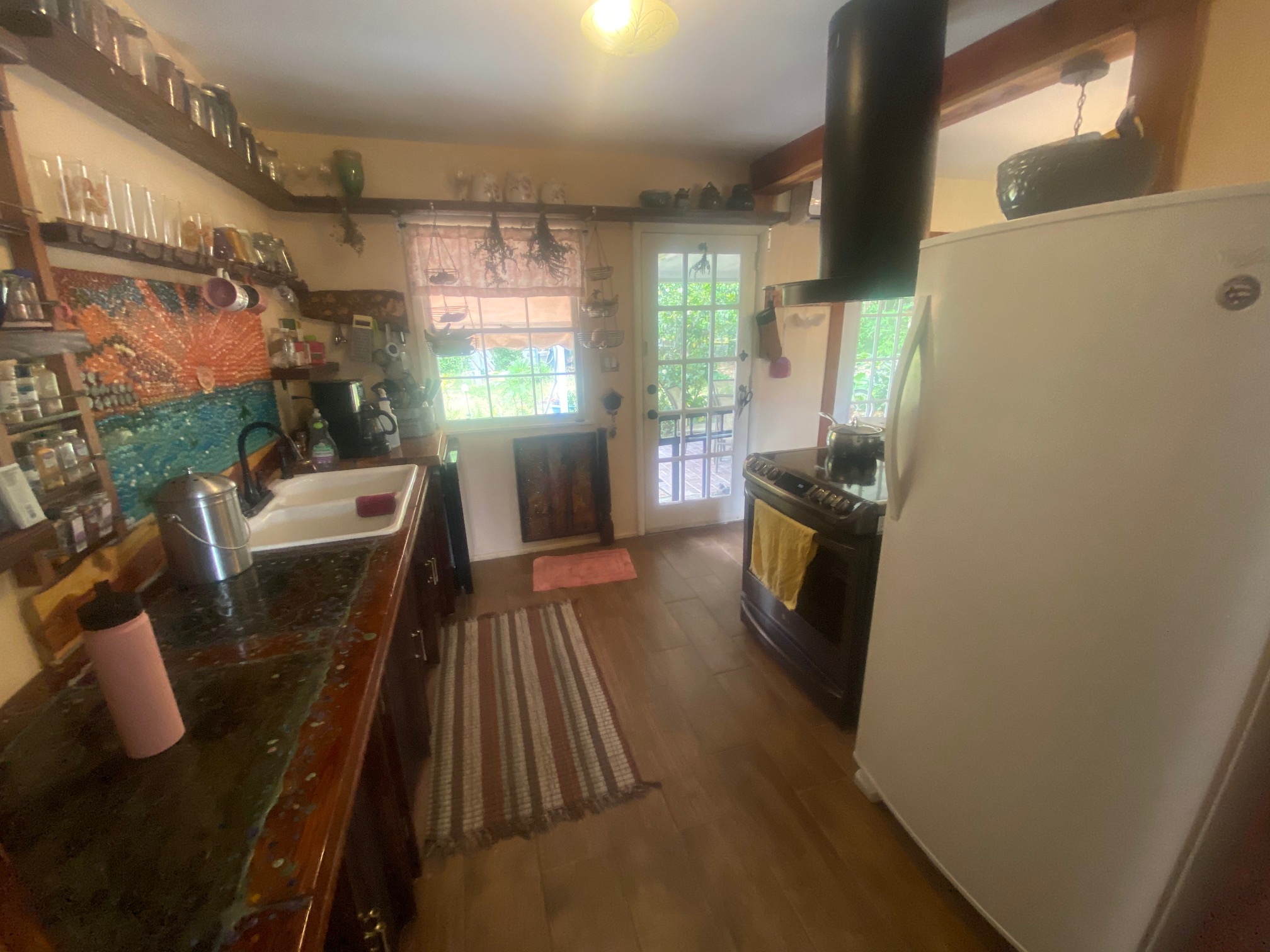
Cleaning our small kitchen used to be one of my least favorite activities.  Now I thoroughly enjoy the task for there is so much to learn about maximizing form and function design concepts.

Kitchens and gardens have several things in common but one trait in particular stands out.  Kitchens and gardens, be they ground level, balcony, patio or rooftop, have only so much available space.  With limited space comes potential clutter problems and negative energy flow.
Florida Permaculture, Vertical Edges in the Garden Offer Additional Growing Space

Finding enough room to add plants to the survival garden is just like finding space in the kitchen for that added cup, utensil, appliance, pot or pan.  As in a cluttered kitchen, a cluttered garden can be so overwhelming that we don't want to spend time tending to the plants.

We've found in our rather small kitchen two different approaches to maximizing function and sense of form; 1. go vertical along edges, and 2. leave plenty of open space in the middle.

Our kitchen and pantry areas are limited in size.  Originally the spaces were tightly enclosed with walls and most of the storage space could be found only on flat, horizontal surfaces like counters.

Likewise, yard space was mostly filled with randomly scattered plants and few defined edges or walking spaces or gardens.

After removing a few walls and opening walking areas and installing hooks, racks, hangers, shelves and baskets our kitchen and pantry evolved into a much more efficient and enjoyable food activity area.  Now I like to clean and cook because the space is much more enjoyable to spend time in. Granted, the pantry is not as packed as it could be.  Perhaps less packed is more efficient though as it is now easier to see and use those goods we do have stored. 
Florida Permaculture, Lessons From Kitchen Design

I've noticed that our garden, landscape and overall permaculture installations also benefit from the same open space and vertical edge design principles that we applied inside the kitchen. 

Maximization of walkable space increases a feeling of openness, zen and overall accessibility both in the kitchen and in the garden.  Being able to move without bumping into something or someone unexpectedly makes for a more pleasant sense of place than the claustrophobic clutter feeling of having to navigate spaces sideways.
Florida Permaculture, Finding Garden Edges for Vertical Green

Intense densities in plant communities do have their places in permaculture design.  I love jungles and swamps and they are some of the most diverse ecosystems on the earth and some of my favorite.  I am never more thrilled than to study the highly complex and productive ecosystems found in jungle-like plant communities.  I also try and incorporate areas of deep forest and swamp-like plant communities into our survival garden.  However, swamp and jungle garden areas are not those places where humans will willingly spend much of their time.

Same way with a claustrophobic kitchen or pantry.  Packed storage might be good for quantity but I probably won't be inclined to hang out for stretches of time in the strew.
Florida Permaculture, Pantry Space, Like Garden Space, Can Be Limited

Open, flowing garden spaces can welcome breezes, sunshine and pedestrian activities and provide a sense of place and belonging; this is important to both humans and plants.  Plants need sunshine. Light is a basic component of the photosynthetic process.   Too much jungle, and there will be not enough light to support bountiful produce harvest.  Plants also need to be tended by humans; neglected, overgrown survival gardens may not even survive themselves. In turn, humans benefit in countless ways from vibrant garden plants.

Many designers include feng shui, 風水, flow into both kitchen and garden plans.  The concept of feng shui maximizes good qi, or energy, flow through an area.  The number one guidance thought in feng shui is the importance of 'tidy and orderly' space.  Our kitchen and garden both may not always be clean but because of openness and vertical components both have positive energy pathways throughout.

Adding vertical growing space to a garden functions much the way hooks, racks and shelves create functional storage in the kitchen and pantry,  Vertical growing space such as; trellis, fencing, arches and walls in the garden add room for more plants, flowers, fruits and vegetables, and provide tidy form.
Florida Permaculture, Chicken Coop Fences Offer Growing Space

Vertical growing space in the garden can also be integrated with natural and created plant based edges to further bolster both form and function.  A permaculture survival garden alive with form and function possesses good, strong qi.

Just like a cluttered, disorganized kitchen, an overgrown weedy garden will want for the amount of time we spend in it.  An ignored garden will also lack in productivity and harvest.

Gardens and kitchens full of open space and vertical edges, even though small and compact, can flow with positive qi and invite us in to spend time in their lushness, while rewarding us with bountiful harvests.  

If you have a well laid out, lovely kitchen or perhaps a flowing, beautiful and productive garden, examine the vertical edges running through each along with the openness and inviting flow of the area.  A good garden read can help us with our kitchen energy.  A kitchen where we like to tarry may also hold answers to increasing form and function qualities in the garden.

Designing Coastal Green Roofs Two, Native Plant Permaculature Tips


Part Two: Native plants and wildflowers can contribute to the design of a permaculture garden, green roof or container garden on an apartment balcony.  This video shares many of my design hacks and tips for plant selection.  Though the video was made to be an aid to green roof designers, the fundamental design principles are important for any garden or landscape design.  Hope you enjoy and learn from the video. Many thanks to greenroofs.com for hosting this video on their website!

Wednesday, July 8, 2020

Native Plant Selection Modeling, Designing Coastal Green Roofs Part One


Native plants and wildflowers can contribute to the design of a permaculture garden, green roof or container garden on an apartment balcony.  This video shares many of my design hacks and tips for plant selection.  Though the video was made to be an aid to green roof designers, the fundamental design principles are important for any garden or landscape design.  Hope you enjoy and learn from the video.

Tuesday, July 7, 2020

Thistle & Swallowtails

Thistle & swallowtail butterflies, Florida roadside
tuesday wildflower & swallowtail short verse:
...
thistle dancing round,
a surprise bloom, florida
roadside attraction
...
#thistle #swallowtail #haiku #poetry #natureart #floridawildflowers #floridanativeplants #ethnobotany

Monday, July 6, 2020

Florida Green Roof Corn

Florida Green Roof Agriculture, Rooftop Corn

Here's a couple examples of rooftop agriculture in the urban core.  Green roof tomatoes and corn.  When space is at a premium one can be creative.
Florida Green Roof Agriculture, Rooftop Tomatoes


Living Wall Celtic Cross, Copper & Grass

Living Wall, Celtic Cross, copper & grass

Here is a small living wall I made with grass & copper.  Vertical green for the urban core.

Saturday, July 4, 2020

Quimbombo; Okra's History and The Florida Survival Garden

Florida Permaculture Garden Okra, also know as Quimbombo, is a member of the Mallow Family
Okra will always be an important member of the yoyo survival garden here.  Okra's is also known to botanists as Abelmoschus esculentus.

The history of any food, fiber or medicinal plant is just as important as the more procedural oriented gardening principles found in permaculture growing manuals.  Recalling our discussion of the existence of an infinite variety of edges and perimeters in the garden, the history of each garden plant is also an edge; one separating plant history and time.  An understanding of garden plant's paleoethnobotanical story adds layers of rich dimensions that in turn enrich our intelligence and appreciation of all we grow.  This increased appreciation for where our survival garden plants have come from and how they have arrived in our garden translates into more attention, greater care for and higher yields from these important plants.

Our garden plants are, in many ways, like close friends and family.  They have important stories we should listen to and they long to be appreciated.

Back to okra.  Throughout history okra has traveled far and wide, sometimes purposely hidden away and other times as openly traded in the market.

Florida Permaculture Garden Okra Pods Ready for Daily Harvest
And okra has had, like many plants, a variety of cultural names.  The name familiar to most of us, 'okra', has roots in the Nigerian Igbo language, where the plant is/was referred to as 'okuru'.  Another name we are all familiar with is Creole term 'gumbo'.  Gumbo's nomenclature derives from the Angolan term for the plant, 'ngombo'.  Other worldwide names have included; bamia (French), bhindi (Indian), quimbombo (West Indies Spanish), ochro (English derivation of the Igbo term 'okuru', and Lady's Fingers.

Today we view okra as a staple vegetable that has always been here in the grocery store produce section or perhaps in a jar of pickling vinegar and spices on the condiment isle.  However few realize the storied past tale of this member of the mallow family.

Okra's flowers, leaves and seed pods are a staple food source in many cultures
As a member of the mallow family along with hibiscus and cotton, okra is a plant with strong mucilaginous properties.  Most mallow leaves and seed pods when boiled in water release exopolysaccharide compounds that retain water with a thick, gooey consistency.  Okra will thicken soups and gumbos when their leaves and pods are added to the stewing pot of vegetables.

Paleoethnobotanists tell us from their studies of ancient village sites that okra originally grew along the upper banks of the Nile River in what is now Ethiopia.  From Ethiopia traders brought okra into Arabia and across the entire Mediterranean and West Africa.  I can easily imagine peoples living along the Nile 10,000 years ago foraging for and harvesting okra pods, flowers and leaves for gumbos and salads, just like we do today.

Okra made its way to the Americas during the slave trade of the seventeenth century where the plant is mentioned in Brazilian records around 1650.  I've read accounts where Africans chained in ships hulls would hide okra seeds on their bodies so as to have this important plant once they reached land.

Okra was soon established as a food, fiber and medicinal plant in the Caribbean, particularly in Cuba where it was commonly known as quimbombo.  Lydia Cabrera, the renown ethnobotanist who wrote one of my favorite tropical plant use books, El Monte, often associated quimbombo with the gods Chango and Oya, and noted the dislike witches had of okra because the plant's slippery mucilage kept spells from sticking to the intended target.  According to some, okra infused baths are one way to ward off bad spells. 

From the Caribbean, the plant moved up the Mississippi and U.S. east coast into North America.  Today okra is grown worldwide and the edible pod is a staple food for many cultures.

Okra pods, leaves and flowers can be fried, sauteed, boiled and stewed.  From Creole spice to Indian Bhindi Masala, okra dishes are becoming more popular as a favorite cuisine.  One of my favorite simple okra recipes involves sauteing sliced pods in ghee with turmeric powder, salt and ground black pepper.

Roasted and ground okra seeds are also used to make a popular decaffeinated coffee substitute beverage.  During the American civil war, roasted okra seed beverage was the norm with troops when South American coffee was unavailable.

Okra delivers daily food throughout the hot humid summer months here.  We pick the pods when they are about three or four inches long for tenderness.

We do make sure our okra plants receive regular adequate irrigation, especially in times of drought.

I find interesting the fact that okra flowers (they do look like a hibiscus) will close at night and reopen in the morning, a plant process known as nyctinasty.

Our okra likes some organic material for sure but will grow fairly well in our sandy soils as long as there is adequate water.  Once we add chicken yard compost around the base of the plant the okra will shoot up fast.

Okra has not always existed here in Florida.  The plant in human hands has journeyed from eastern Africa across the Mediterranean to the Americas.  Much of the paleoethnobotanical history of okra involves not only the pleasure of food but the suffering of a great number of peoples.

Our Florida permaculture survival garden is multidimensional in many ways.  Understanding the edges of plant history gives new meaning to that which grows here, for the DNA of our okra plants carries the winds and cries of countless past voices.

We add our voice of gratitude to the leaves, flowers and seeds of quimbombo; to the DNA of our okra and hope others now and in the future enjoy the storied and delicious nourishment found in this mallow.


Thursday, July 2, 2020

Florida Nature Art, Spiderwort, Tradescantia spp.

Florida wildflower, Spiderwort, Tradescantia spp.


Wildflower sketch for Thursday night, spiderwort, Tradescantia spp.

Transmission of Information Through Homo Sapiens Existence

Dune daisy, Helianthus debilis

When the surgeon disconnected my heart and lungs while icing my body to replace part of my aorta, varying structural changes occurred to my brain.  Today, my cerebral wiring can cause me to wonder about things I was never before curious about.  Earlier I was contemplating the transmission of information from one generation of plants to the next.  Then I became side tracked.

So here's my take of the transmission of information through generations of Homo sapiens.

300,000 years ago Homo sapiens appeared on earth. For the first 295,000 years DNA was the primary transmitter of human information from generation to generation (netbooks hadn't been invented yet). 

Then 10,000 years ago a second method of transmitting information through the ages appeared. Historians estimate Aboriginal groups began passing information from generation to next generations via oral traditions & story folklore.  

Recently, a third primary human route of transmitting of information appeared. 5,500 years ago cuneiform writing developed in Mesopotamia and soon thereafter hieroglyphs in Egypt as a means of transmitting information through time. 

Today, the information of humans is being passed on through to future generations via; DNA, oral histories and massive amounts of writing and written languages, including computer code, from which interestingly, scientists now estimate more data has been created over the past twenty years by humans than over the previous 280,000 years. 

Three routes of human information transmission; one very old (DNA, based on nature), one quite young (oral, based on traditional folklore) and one newbie (written word, based on our inquiring curiosity). 

Thursday night musings, fwiw….. that's a lot for me to think about. 

Wednesday, July 1, 2020

Florida Permaculture Design, Reading and Understanding Garden Edges

Florida Permaculture, Edges Are Everywhere

The task of trying to read edges edges has always been a significant part of my professional life.  Before aortic dissection put me on hold, I spent decades as a biologist tasked with documenting natural edges across the landscape for design purposes.  Subsequently, after law school, I continued learning the language of edges and natural perimeters as an advocate for sustainable conservation and land use. I have spent thousands of hours out in nature examining tracts of land searching for significant preservation edges, such as; mature successional or native forests; wetlands and uplands; perimeters of protected wildlife habitat; changes in soil types, and so much more.  The years of hands on natural feature delineation have proven important to my own understanding of how perimeters play such an important role in urban landscape and survival garden design.

And so I believe that prior to installing a survival garden the initial permaculture design process should include identification and integration of existing perimeters and edges, both natural ones and those constructed.  Perimeter and edge concepts are necessary central components to successful survival garden design.

Thoughtful edge use is a primary infrastructure design tool capable of maximizing survival garden production values. 

Flat or farm, the concept of edges applies just as much to the tiny apartment balcony as it does to a large acre homestead.  There are many edges on a balcony, those obvious and those not so obvious.

Edges exist almost everywhere.  Some edges are pronounced and other edges are more nuanced and difficult to discern, but all edges are important considerations in permaculture and survival garden design.

During your initial permaculture site survey you will come across those prominent and then those not so manifest edge lines and perimeters.

Obvious edges can include: ground level topography; vertical edges such as buildings, walls, cliffs or dunes; watercourses like ditches, streams, creeks, rivers, lakes and oceans; foot paths, trails, curbs, sidewalks, driveways, roads and highways; balcony railings, fencing and signage; roof contours; rows of plants such as containerized plants, mondo grass, crepe myrtle shrubs and lines of canopy trees; telephone poles and street lighting and more.

Not so obvious edges may include: tree canopy variations; rainwater flows including drip lines, gutter downspouts and water stains, swales; changes in soil types; plant community transitions; shadows from adjacent structures; allelopathic buffering; shadows and light lines; reflections; animal and critter trails; bird flight patterns; prevailing wind directions and others.

In fact upon a comprehensive examination of your survival garden, you will probably find edges and perimeters covering your entire site.  Complexity is the appropriate way to think of your integrated plot, be it balcony, yard or farm. Survival garden complexity and lots of edges go hand in hand.  An understanding of these edges will provide you with design guidance and ultimately with a secure, beautiful, sustainable and productive homestead.

Most edges and perimeters have signatures left by bio and geophysical interactions with the space in and around your homestead.  Birds may share the same flight pattern across your yard or land in the same spot on a apartment balcony rail.  Rainwater pours off, pools and then runs off with similar flow characteristics with each passing storm.  Squirrels, mice, raccoons and feral cats usually enter your parcel time again through the same ingress point and leave via the same egress location.  Tree lines vary with height, texture and color depending on grove species and light exposure, as do shrub and groundcover splays.  Natural windrows become illustrated through the habit and forms of sculpted plant canopies.  Nature and civilization both sign their perpetual works of art across balconies, patios, yards and homesteads with 'edge art'.

Larger tracts of land will usually contain more edges and perimeters than apartment balconies but even small balconies may develop numerous edge influences.  Learning to recognize these natural and man-made edges can be an enjoyable and enlightening venture.  With each additional recognition of newly discovered edges we can gain a greater understanding of how our homestead and garden efforts function in the natural world.

Once we recognize the edges that exist in our space we can then use proven permaculture approaches to increase overall homestead efficiencies.  For instance, if the cardinal lands on your apartment rail in the same place each time she visits, placing a pollinator attracting flower under her perch area can take advantage of her nitrogen rich droppings and spare you the effort of cleaning her plop off your balcony.  Similarly, recognizing stormwater flow across your patio or yard will give you a heads up about where to place those plants needing increased irrigation, and so forth and so on.  

I believe our agrarian and foraging ancestors intuitively developed a refined art of recognizing edges.  Perhaps through industrial commercialization and the electronic revolution we humans today have shifted focus away from our predecessor's edge tracking skills.  Nature has so much to offer once we learn to read her ways.

Finally, the decades of conducting ecosystem field analyses has provided me with many opportunities to learn first hand about patterns with edges in nature.  I want to share an interesting observation about the area where soil saturation ends and upland soils begin.  

Documenting agricultural tracts with large numbers of cows I noticed over the years a similarity between cow paths and wetland delineation lines.  After long discussions with farmers and others familiar with cows and their habits the correlation became clear.  Cows like to have access to water.  They often establish perimeter paths around ponds with varying access points.  When I would establish wetland delineation lines around the ponds, the wetland lines invariably corresponded almost exactly to the cow trails.  Turns out, according to the farmers, cows want to walk as close to water without walking through damp soils or muck.  Upland soils are easier to traverse for the heavy animals.  Now when I look from a distance across a cow field and see ponds I can almost immediately discern where the upland soils change into wetland soils.  The cows intuitively recognized the edges between upland soils and wetland soils and used this recognition to their advantage.

Although wetland and upland soil lines are just one part of integrated soil science a general understanding of edge forensics provides important insights for survival garden design.   It is so much more perceptive to look at plants, topography and animal tracks in the field than to have to pull out a soils map and translate the symbols.

We have just barely touched the surface of the practical importance associated with recognizing nature's edges.  Understanding what your plot is saying will help guide you in your survival garden ventures.

Always look for new edges, wherever you may be.  Even after years long familiarity with a plot you will find that nature changes previous perimeters into new edges.  Seek and search for changing edges.  A homesteader or bushmaster who is well read with the language of nature's edges has an advantage in creating a successful survival garden design over those who have not learned perimeter discernment.

You can start today conversing with edges simply by walking outside, wetting your finger, holding it up in the air and noticing the wind's direction and watch as leaves rustle in a breeze.

Once we begin discerning the language of edges around us, new and amazing permaculture worlds will manifest themselves  everywhere.