Monday, November 21, 2011

Green Roof Plant Design - Heliotropoism, Diaheliotropoism and Paraheliotroposim


Understanding photosynthesis processes in green roof plants is crucial to the green roof designer and we have discussed the difference between C3, C4 and CAM photosynthesis processes in prior notes, including;
Yet nature is complicated and does not limit herself in resisting environmental stressor conditions to just the above three types of photosynthesis processes.

Cowpeas and other plants for example possess the ability to adjust their leaves position to either increase or decrease the amount of leaf surface area receiving direct sunlight.
Under Intense Sunlight Leaves Fold to Prevent Desiccation


Under optimal Sunlight C3 Leaves Open Widely

Under Optimal Sunlight Conditions C3 Leaves Open Widely
Heliotropoism is the term used to describe a plant's actions when it orients leaves to receive more sunlight and thereby increasing photosynthesis capabilities, i.e. - more CO2 fixation.

Diaheliotropoism describes a plant whose leaves actually track the sun'd path, maximizing solar contact.

Paraheliotroposim denotes a plants actions similar to the above photographs.  During parahelioproposim, plants may fold or move their leaves to either;

  • Minimize solar contact, or
  • Minimize total leaf surface area,
either way reducing water loss and preventing desiccation.

Though C3 plants such as the beans - and most other of the world's food plants except the grasses, maize, and sorghum - do not possess as complicated a multi-cellular Calvin Cycle as C4 plants and are more susceptible to drought, they - through Heliotropism biomechanisms they do possess their own unique desiccation prevention mechanisms.

Green Roof Removal - Exploring Underneath Seven Year old #GreenRoof

We recently removed a living roof installed in 2005 over a sloped asphalt shingle roof here in Florida to accomodate a new project.  Of course I was very interested to see how the underlying shingles had fared for approximately seven years under a heavily used green roof supporting rooftop permaculture (tomatoes, allium and more).

Not surprisingly, the asphalt shingles looked as new as the day the living roof was installed in 2005.  Green roofs protect underlying roofs from ultraviolet rays and sun damage, effectively extending the roof life by years.

Green Roof plants removed in preparation for roof removal
Mat is lifted from the roof, exposing the roof barrier

Interesting root architecture, showing green roof plant root reach 

Roof is sloped with 5/12 drop

Root barrier is in excellent condition

Asphalt shingles appear like new, well preserved under the green roof

Green Roofs help preserve underlying roofs, extending functional life by years!

Friday, November 18, 2011

Rooftop Gardens in New York - RAD video!


New York Farm City from Petrina TV on Vimeo.

Living Walls, the work of Bob Chabot at the Jacksonville Zoo

Jacksonville, though certainly not a 'green' city, has a core group of individuals who want to see plants fill a concrete and asphalt void.

Bob Chabot who serves as Director of Horticulture and Facilities for the Jacksonville Zoo, as well as President of Greenscape of Jacksonville and Vice-President for the Association of Zoological Horticulture and I took a tour of his zoo gardens yesterday, focusing on several upcoming projects we are both involved in, the Lasalle Street native plant bioswale and living walls for the USGBC's North Florida Resource Center in downtown Jacksonville.

Bob Chabot & very healthy, flourishing lemongrass, Cymbopogon flexuosus
Of course, it helps to have all the mammal compost you ever need to grow great plants, however the design, combination and selection of native plants, Florida Friendly Plants and plants from around the world make the Jacksonville Zoo a virtual ethnobotanical and horticultural library.

Living Walls, Jacksonville Zoo,  Confederate Jasmine, Trachelosperum jasminoides
Living Walls, Jacksonville Zoo, Cross vine, Bignonia capreolata
Bignonia and Trachelosperum offer several great advantages for vertical urban greenscapes.  They are both evergreen, non-invasive, provide habitat for wildlife, offer a stunning array of scents and visuality and importantly are drought tolerant.

We'll post updates on the various projects as they 'grow'.  In the meanwhile, if ever in Jacksonville be sure to take the time and tour the Jacksonville Zoo and Gardens.


Thursday, November 17, 2011

Green roofs and rainfall, nature's best irrigation

Green Roofs love rain
Rain is always welcomed by Florida green roofs.  Problem is for years now we haven't been receiving as much rain from the sky as we historically used to receive.

In fact, the Jacksonville and other areas of Florida and the Southeastern US, such as Houston and others are experiencing long term serious drought.

So when rain visits here, the green roof systems and plants must take advantage of every precious drop of water.

Last night we received about 15mm of rainfall, a little over one half inch.  Since all of our green roof systems are shallow in depth, I was confident the plant roots had an opportunity to adsorb a good amount of water.

Curious though to just how much water some our potted plants received, I ventured out into the nursery and selected a plant potted up in a one gallon container and removed the plant, examining the rootball for moisture.

Green Roof plants, Florida's rainfall events do not allow for much water adsorption anymore
As the photo shows, the top ten to twenty millimeters was wet.  Beyond fifty millimeters or so the roots were bone dry.

Horizontal roof architecture for green roofs has advantages, particularly if the green roof lies in the hot and dry climates of the world.  Horizontal root architecture is discussed here.

So though shallow roofs may not be the answer for all green roof applications, they have established themselves as viable alternatives in hot and dry climates, providing lightweight potential, lower cost, beauty, habitat and stormwater attenuation.

Tuesday, November 15, 2011

Saturday, November 12, 2011

Green Roofs & Frost - We had frost in Jacksonville last night!

I think this climate change is kicking into high gear!  I can't remember a frost this early in the season - especially along the Atlantic Ocean but we have on this morning.

Frost on my #green roof heirba buena this am
So with frost comes a host of new green roof issues here in Florida.  Of course you can take the boring way out and just be happy with a dead roof for half of the year.

Or you can use those plants capable of surviving hard freezes and our torrent summers.

I prefer the later - year round green and color.  Costs the same.   Looks much better than brown mushy bah.

One of the issues we learned over the years centered around frost bacteria.  Certain bacteria can cause premature frosts on a roof at higher temperatures and then others can depress frost formation until significantly lower temperatures are reached.

Sounds like cool information for a gren roof designer.  So I'm cutting and pasting here an excerpt from a previous years Pseudomonas post (the thing about SnoMax is too cool!).

Green Roofs behave differently in the cold seasons here in Florida and the Southeastern U.S..  Because cold weather will be here soon, I am re-posting an article from two years ago (December 2008) about bacteria, green roof plants and frost.  Enjoy!.........   Also - Check out the follow-up Pseudomonas blog post here.

In general, plants used in exterior living walls appear to be more resilient to cold than those flat on the ground. Dismantling one of my oldest walls last night, I was amazed to see one of the cactus plants, Disocactus flagelliformis, not only survive the cold but thrive. Amazingly, most of the literature on the web specifies a minimum temperature of 50 degrees F and clearly warns against frost exposure. Last year we experienced several nights in the low twenties. However the cactus keeps on growing.

With my curiosity peaked, I researched frost, cold and plants on Google trying to sort through the thermodynamics of air movement, heat and cold transfer and the five different types of frost. It seems that as the ground layer of air cools, the warm air rises. So the vertical positioned plants on the wall could actually be several degrees warmer than those plants on the ground. There are several interesting stories of how orange grove owners use helicopters to keep warm air blown back down into orchards in California on occasional nights with freezing temperatures or where frost may become a threat.

Additionally and to my surprise I read where many plants on the ground support epiphytc bacteria growth of Pseudomonas bacteria, a gram negative bacteria that also acts as an ice nucelator. From the available literature it seems that the presence of ice-positive Pseudomonas can actually cause ice/frost to form on the plant surface. Frost damages the epithelial layer, in many instances killing the plant.

There is a ice-minus strain of Pseudomonas also, a mutant bacteria that also occurs naturally that does not possess the ice formation encouraging mechanism that its non-mutant sibling possesses.

Leave it to capitalism to go figure out how to profit on these two types of bacteria. SnoMax - made by Johnson Controls - see SnoMax's website, is a product made from the ice-plus variety and is used for making snow! On the other hand, FrostBan - see article - creates a crop resilient to frost. FrostBan was the subject of many GMO battles during the 1980's and early 1990's.

I don't have the testing equipment to see if my Disocactus cactus had the ice-minus Pseudomonas, or if the plant growing vertically with excellent air flow had just avoided the dispersal of common Pseudomonas.

But the fact that it survives the cold and continues to grow on the wall is another piece in the green roof and green wall plant database we are all developing.

Amazing stuff.

Friday, November 11, 2011

Friday's Residential #GreenRoof Photo - Genora's Nature Irrigated Living Roof

Quaint and strikingly beautiful, Genora Crain-Orth's is shown here in the photo my daughter, Jincy took with her Ipod day before yesterday.

Genora's nature irrigated living roof with native plants
The roof is lightweight, actually less than 50mm soil media, irrigated only with available precipitation, dew and water vapor.

Native species were used including Yucca filamentosa and Helianthus debilis.

The bees and butterflies love the roof!

Looking good after a long hot summer.

Thursday, November 10, 2011

Green Roof Plants - choosing between those plants that produce seed and those propagated vegetatively

When choosing plants for green roofs one is always faced with a decision to specify those species with a tendency to bloom and flower then set seed, or on the other hand go with those plants who normally are propagated primarily by vegetated cuttings.

Green Roof plants setting seed in Jacksonville, Florida
 Yet the decision is not a simple one and carries far reaching consequences.  Arguments for and against highlight the many benefits and disadvantages for selecting either approach.  I prefer to integrate in so many plants who reliably produce viable seed for the following reasons discussed below.

November seeds sprouting on a Florida Green Roof
Seed provide variability.  Like a roll of the dice, the many combinations of predictable but also unpredictable color, patterns and texture always provide a surprise waiting once plants set seed and those seed germinate into a new generation.  Because of inherent variability, seeds are generically difficult to remove from the open source system and patent.  Plants propagated via cuttings or asexual reproduction are much easier to protect under intellectual property rights laws and remove from public domain.  So by adding plants who reproduce by seed to your green roof design, you ensure for the time an ongoing, royalty-free plant source season after season.


Green Roof Salvia lyrata and green roof seeds sprouting
Longing for seasonal variability including color hue shifts, texture changes and other plant responses is a fundamental part of humankind's side by side relationship with the plant kingdom.  Plants who do  not rise and fall with nature's cycles seem almost 'plastic' to me.  Granted I use these 'plastic' plants to create central design structure and they serve faithfully providing green and form month in and month out.  But these structure plants are only a backbone.  The skins are the many hundreds of species, genus and families of flowering ephemeral and persistent native wildflowers, grasses and food plants.


Once established, seed producing green roof plants are an economic & ecological benefit

Familiarity with the signs of plant growth teases the senses like aroma from fresh baked bread.  The Salvia lyrata in the above photo for instance is preparing to cover certain areas of the green roof with her wonderful lavender spring flowers, one of the first sights across the roof as winter recedes.

Life is a complexity of changing interactions.  Green roof designers can tap into the interest of nature's spectacular array of surprising variability by using lots of plants who seed and reseed.

Wednesday, November 9, 2011

Nature Irrigated Green Roofs - how much water do you need!

Nature is amazing.  It has not rained for several days here and though we did recently have a little rain we are still far below our normal.  In fact Jacksonville is still classified as officially experiencing severe drought conditions.

National Weather Service Drought Index
Yet nature provides ample water, even in times of drought here in the form of water vapor.  Good green roof design takes advantage of all sources of water, including morning dew.

Nature's irrigation - morning water vapor

I am constantly amazed at just how much water rests on the green roof plants some mornings.

As though an irrigation sprinkler has been turned on across the roof, opportunities exist for the plant designer to use those species capable of condensing (those with fine leaves, hairs or waxy surfaces) to capture the water then direct the droplets to the green roof planting media below.

Working with an international hotel chain to improve their landscape vegetation I was asked to diagnose why a large collection of very big planters were doing so poorly.  A large roof overhang directly above prevented morning water vapor from reaching the plants.  However, only a few feet over and out from under the overhang other planters looked lush.

Fog and morning dew can contribute an important source of nature supplied irrigation.

I make it a regular habit to walk green roofs early, middle of the day and late.  Surprises abound always.  This morning I was amazed at just how much water was on the plants.  Who needs a sprinkler?

Tuesday, November 8, 2011

Green Roofs - many times the last line of defense for water quality

Green and living roofs are so very important to our water quality, sometimes being the last line of defense for removing pollutants before runoff enters our waterways.

Green roofs slow down stormwater, cleaning and sequestering pollutants 
Even small green roofs can provide a significant benefit to reducing peak runoff amounts and reducing loadings on creeks, rivers and ponds.
Blue Hole, Ichetucknee Springs
Once stormwater hits a roof and flows to the street below it may only be a matter of minutes before the water and any contaminants picked up as the volume flows across streets, drives and roads enters Florida's drinking water supply.

Floating wetlands, Gainesville, Florida - greenroof on a pond
Storm drain allows pollutants to enter waterways
Florida has a unique geology across many parts of the state called Karst.  Karst formations are typified by limerock with caves, tunnels and holes throughout the  formation.  Once stormwater runoff enters the limerock above drinking aquifers the flow to the pools of underground water can be very quick.

Many times storm drains are a direct connect to water supply aquifers
Green roofs, living walls, floating wetlands and other best management practices can help keep water clean by slowing the runoff and removing contaminants from the water.

Wekiwa Springs, Florida - higher in nitrogen and algae
 Wekiwa Springs, located just north of Orlando, Florida and shown above is surrounded by houses, streets, roads and commercial development.  Though many good best management practices are in place to contain nutrients and runoff, the springs still suffer from high nutrient contents such as nitrogen and phosphorous.
Salt Springs, Ocala National Forest, not as impacted by development
Salt Springs in the Ocala National Forest on the other hand, though threatened by development, does not have all the septic tanks, stormwater runoff and as you can see, the water is much clearer, contains less nitrogen and other nutrients and is so much more healthy.

Installing a green roof on your commercial or residential building is just one small contribution you can make int he Urban Core to help protect water supplies.

Wednesday, November 2, 2011

Green Roofs and Rooftop Gardens can help defeat Urban Core hunger


We can defeat hunger in the Urban Core - on the roofs, on balconies, in small yards and across patios! Food is so easy to grow in the harshest of places, with little of no soil and even when water supply is limited.  All it takes is a basic understanding of the important factors impacting growth, such as wind, light and available water vapor.

Though permaculture has always addressed simple food growing principles, most of the time this focus has been about ground level growing.

Growing food on walls, roofs, buildings, and shacks up off the ground is important in the crowded urban core, high rises and slums.  Ground level food production is many times impractical in cities because of the lack of open land.  But there are plenty of walls and roofs to grow food on!

We believe educating the young about how to grow 'rooftop gardens is a way to capture their interest, create economic opportunity for them, create habitat, restore ecology and bring peace to the world.

Harvesting Green Roof Seeds, Educating the children
It is really exciting to see students become interested in urban agriculture.

Young children's minds are so fresh and thinking so quickly!  They see opportunities to improve and enhance our green roofs, living walls and rooftop systems.

Offering the next generation hope through empowerment is what we need to be doing every day.  Placing control of their food and water supply into our children's hands is so important.

Making educational videos about rooftop permaculture to teach the children.
It is a path to world peace and freedom from those who may want to try and control other's lives through food and water.

And growing food and recycling water does not have to be expensive or difficult.  This is why education is so important.

But we have a fight ahead of us.  Large corporations see opportunity through control of food, water, seeds and the knowledge of how to grow food and collect water.

The 'I don't have a green thumb and can not grow food' storyline is often repeated and many of the world have come to believe they can't grow sufficient supplies of food in the urban core.

We must show our children the path to breaking reliance from those who would control our lives and souls in exchange for food and water.

A small living wall or rooftop garden can provide enough seeds in a growing season to grow five more gardens the same size the following year.  Seeds are free.

Systems can be designed to cheaply capture and store water and to grow food on even shacks made from rusty tin.

The students harvested a giant luffa sponge from the roof this week.  Organic luffa sponges cost five dollars or more in the store.  The enterprising young person growing luffa gourds across the roof of their inner-city barrio could earn hundreds of dollars each season.

Plants not only provide food but they provide security, shelter and medicine.

I love Lydia Cabrera's quote I use over and over, paraphrased "there are more spirits in the plants than in the sky".

Aloe growing out of walls and on roofs becomes the local doctor's office in many instances.
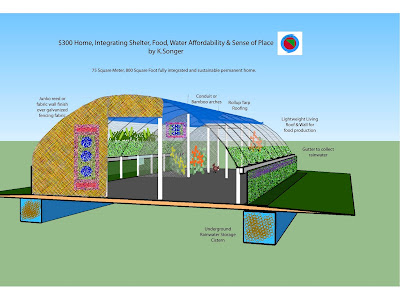
Low cost Barrio-type house with living walls, food roofs & water recycling
Structure walls made from wire with grapes abundantly growing provides fruit, sugar, vine and community opportunities.

Rooftop beans and peas can feed the masses, not only providing daily food but offering up the following years crop of seeds.
Reusing water and controlling flooding

Native wildflowers planted across window openings and on the roofs and walls bring in the pollinators, crucial for food production.  One must have native wildflowers growing side by side with food plants.

Collectively we have found a way to travel to the moon, harvest the atom and talk across the globe.

But this awesome generation has forgotten how to feed themselves.

Now is the time to relearn.  Now is the time to show our children how to break leashes and create freedom.

Give me one month and the seeds I can carry in my pocket, a few wiling youth from the urban core and  the plants of medicine, food, fiber and economy will be growing across the landscape.  It can be done in a desert or a wetland, hurricane or earthquake prone areas.
We've answered the critics who say it can't be done, designed systems withstanding cyclones, created highly productive food systems in 30mm of sand, implemented bee hives on roofs, built water storage systems for practically no cost and are working now on a rooftop chicken system.

Control of your food is the path to freedom and peace.  Reliance on the corporations for food is the path to bondage.