Sunday, August 12, 2012

Urban Greening, Creating Visual Screens with Plants

Many municipalities and urban governments require screening around infrastructure such as water and natural gas back-flow preventers and other pipe systems found adjacent commercial buildings.

Most insist the screens be constructed from wooden privacy fence panels, concrete or brick walls, chain link fencing with privacy slats or other man-made materials.

Ligustrum japonicum, Visual Screen for Site Infrastructure


Planners and site development reviewers rarely allow these screens to be created from plants.  

Wooden and chain link fence panels are understandably predictable in behavior and provide instant opacity.

Plants on the other hand take time to grow, and if not maintained properly can present a challenge.

Ultimately, many city permitting staff take the easy way out and reject proposals using plants for screening requirements to a site development plan.
Ligustrum vulgare, Visual Screen for Site Infrastructure.  Plants provide privacy,  clean stormwater, sequester carbon, pump out oxygen, offer wildlife habitat and more.

Yet there are some visionary site designers and municipal site plan reviewers, some who are willing to take a risk and allow plants to be used for infrastructure screening.

Plant screens can be highly effective, offering opacity and privacy.  Additionally, plant screens clean stormwater, sequester carbon, produce oxygen, prevent erosion, provide habitat for urban wildlife and mitigate urban heat island effect.

Ligustrum vulgare, Visual Screen for Site Infrastructure.  Though Ligustrum japonicum, Common Privet is not a native plant, she is a drought tolerant landscape species offering much more benefit to the Urban Core than fencing panels.
Here, once again Publix has shown visionary design approaches by specifying plants for infrastructure screens.  Ligustrum or Common Privet, Ligustrum japonicum is not a native plant species however it is considered to be a drought tolerant and reliable landscape plant.

Even more encouraging was the fact that the reviewing county agency approved the use of plants for a visual screen rather than wooden panels or galvanized chain link.

Kudos to the designers and to the permitting staff for allowing and even encouraging Urban Greening.

Hopefully we will see more native plant landscapes serve as site design elements in the Urban Core.

Sloped green roofs in Florida, 3-D Mats and Hurricanes

Extensive Green Roof Mat System Cutaway Section
Here is an interesting photo of a Florida extensive green roof - 2-4" thick on a 5/12 slope (built in 2005) with a HDPE root barrier.  A portion of the vegetated roof has been removed for root barrier inspection and root behavioral studies.  The plants are growing in a soil filled woven mat and the roots are thick into the mat.  Once the roots reach the liner they turn and grow parallel with the liner's surface.


Florida is subject to summer tropical storms and hurricanes.  Wind speeds of over one hundred miles per hour are typically seen across rooftop systems during these weather events.

Three dimensional mats serve multiple purposes in green roof systems.

First, the mat holds soil media in place on both flat and sloped roofs.


Second, the mat allows for green roof and living wall plant roots to anchor to a permanently attached roofing component, reducing the potential for blow-off during wind events.

There are many materials a mat may be fabricated from, both natural and synthetic substances.


Consider a growing mat on your next green roof or living wall project.

Friday, August 10, 2012

Green Roofs & Hurricane Winds - Reviewing UF Wind Tests

With two tropical depressions in the Atlantic and several cyclonical systems developing this August 2012 hurricane season, the October 2010 video of green roof hurricane tests in UF's Civil Engineering facility is reposted along with the original narrative.

As food becomes scarcer and more Urban Ag activities spring up across our cities, material science will play an important role in designing secure plant growing systems for patios, walls and roofs.


Though the video is quite long, Urban Green roof and hurricane design issues require comprehensive attention to potential safety issues, just as any other roofing material or system would demand.


October 2010:


We started off today referring to the Green Roof Wind Uplift Test duration as "until failure".


At least it looked as though the test would proceed until the mat failed.

After all, the MetroVerde Green Roof had been sitting in the hot Florida sun, non-irrigated, 1" thick layer of engineered soil for 18 months at the University of Florida.

We are going into our fifth week of zero precipitation (no rain).

The plants looked brown.

The panel was fixed at a 3/12 slope just feet away from the large hurricane simulator.

The plants appeared vulnerable, the engineered soil just waiting to be blown off the mat along with vegetation.

The large diesel engines fired up and the turbines spun.

50 MPH for one minute -  dust blew off the roof.

70 MPH for a minute plus - not much happened except the plants whipped back and forth.

90 MPH and the dust around the base of the testing platform flew and the plants bent backwards - almost parallel to the roof slope.  Shingles on a shed 300' away began flapping.

We were all amazed, having seen other green roofs under hurricane tests blow away, soil and plants...

We took a break and looked at the panel.  A small amount of the engineered soil had blown off the mat.

The 120 MPH for over three minutes.

The dead, brown material blew off the plants - like a good pruning.  Even the large, tender Echeveria was still there, albeit leaning a little.

The nodding garlic - Allium canadense was beautiful.

The plant roots were so intertwined in the mat that 80% of the engineered soil remained.

Successful.  The first Florida Designed Green Roof Panel to pass the 120 MPH wind uplift test.


Lots learned -

Will be working with UF more in the future!

Enjoy the video - I'll post the link as soon as YouTube finishes processing it - in the meantime here are a couple pics and happy Green Roofing!

MetroVerde Green Roof Passes 120 MPH Hurricane Testing

120 MPH Winds on Green Roof - Hurricane Testing

Thursday, August 9, 2012

Wildflower Green Roof photos from Breaking Ground Contracting, Jacksonville


Yesterday's blog note focused on the Green Tree Frog climbing the Breaking Ground Contracting office wall, Florida Friendly and drought tolerant species, native plants and the importance of Urban Green for habitat.

These photos from May of 2011 illustrate how Urban Green can be established to create habitat corridors through out the Urban Core.  Native plants, Florida Friendly species, vegetables, grasses and more live on the rooftop garden.

The Tappouni sisters' efforts with 'greening Jacksonville' are part of an important sustainability web being woven by the next generation.

"Here are some photos of the Breaking Ground Contracting food and wildflower green roof in Jacksonville.  Even though we've had a terrible drought, the green roof plants have grown very nicely.  This roof is irrigated with rain water and uses only HVAC condensate.  Right plant, right place with CAM species on the perimeter and C4 species inside the CAM belt.  Model your design for wind and sunlight!  Enjoy the photos!. 10-20-30 rule met so far!  We have approximately 150 plants species and counting!"

MetroVerde Green Roof for Hurricane Prone Areas, Breaking Ground Contracting

MetroVerde Green Roof for Hurricane Prone Areas, Breaking Ground Contracting

Corn, MetroVerde Green Roof for Hurricane Prone Areas, Breaking Ground Contracting

Day lily, MetroVerde Green Roof for Hurricane Prone Areas, Breaking Ground Contracting

Cathranthus, MetroVerde Green Roof for Hurricane Prone Areas, Breaking Ground Contracting

Gaillardia, Rudbeckia, Native Species, MetroVerde Green Roof

Mint, Herbs, Spices for Green Roof, MetroVerde

More wildflowers, MetroVerde Green Roof

MetroVerde Green Roof Biodiversity

Green Roof Wildflowers, Jacksonville, MetroVerde

Solar Panels and Wildflowers, MetroVerde Green Roofs

Wednesday, August 8, 2012

Green Contractor's Office Provides Habitat with Native Plants and a Green Roof

Jacksonville's Breaking Ground Contracting (BGC) office sports a green roof and landscape comprised of native plants and grasses.

Breaking Ground Contracting's front landscape utilizes Yucca filamentosa and the Hyla cinerrea (green tree frog) loves the habitat (photo by M. Tappouni)

The front bed is filled with Yucca filamentosa, one of Florida's native yuccas and a great habitat provider for wildlife.

Importantly, the BGC office incorporates volumetric green from the street to the roof.  Native grasses extend from the edge of the roadside right-of-way to the front door, around the building and up to the rooftop.

Interconnected corridors of green create animal habitat, providing foraging and communal opportunities for wildlife in the Urban Core.

These photos were taken my Mary Tappouni who owns Breaking Ground Contracting (I borrowed them from Twitter for this post).  The Florida green tree frog is a Hyla cinerea.  H. cinerea is under predator pressure from the larger, more agressive and invasive Cuban Tree Frog.  However the native plants across BGC's site provide refuge for the smaller native tree frog.

Soon after the BGC green roof was installed, H. cinerea appeared  on the rooftop vegetation.  I suspect several eggs came in on native plants.

Though small and almost unnoticeable, H. cinerea is a voracious eater and can consume a great amount of  otherwise pest bugs such as mosquitos and roaches.

Breaking Ground Contracting's front landscape utilizes Yucca filamentosa and the Hyla cinerrea (green tree frog) loves the habitat (photo by M. Tappouni)
Creating habitat for native wildlife is an important facet of Urban Greening.  Year after year, the Breaking Ground Contracting office's landscape is successfully providing foraging and communal refuge for Florida's native wildlife.

You can find out more of the BGC green roof and sustainability efforts here.  The Breaking Ground Contracting website is http://breakinggroundcontracting.com/

Tuesday, August 7, 2012

City Greening - A Wonderful Publix Landscape Screen

Most stores on main roadways want maximum exposure.  Driving up and down our city streets we are typically greeted with glaring neon lights, tall concrete structures, multi-colored signs and more of the industrial urban commercialism.

Seldom is the occasion when a major grocery store chain designs a thick screen of native plants between the store and a highway such as A1A her on the east coast of Florida.

A1A Highway & Native & Florida Friendly Landscape Screen, Publix Grocery, Hammock, Florida
A1A is one of the longest, scenic and most historic of highways in Florida and is frequently travelled by many motorists.

Live Oaks, Palms & Cedars, Landscape Screen, Publix Grocery, Hammock, Florida
So it stands to reason Publix would have wanted maximum exposure to automobiles driving past their store in Hammock, Florida.

Instead, even though the store is only a few feet from the edge of A1A's right-of-way, the designers installed a very dense hedge of native shrubs and trees, along with Florida Friendly landscape plants.
Live Oaks, Palms & Cedars, Landscape Screen, Publix Grocery, Hammock, Florida
And you can hardly see the building from the road.

Even though there is a large grocery store and big asphalt parking lot behind the native landscape, the man-made structures are practically invisible to those riding by.

Instead, one is greeted with the beauty of Florida live oaks, palms and cedars.

Unexpectedly, the native plant screen may actually attract more customers by hiding the store.  When I drive by I am aware there is a store there even though I cannot see most of the building.  My curiosity is aroused and I slow to look through native plants at the business.

Maybe Urban Greening actually attracts more customers.

Even so, the native plant hedge provides many benefits to the store and community.  The plants provide habitat for wildlife, sequester carbon, pump oxygen into the air, provide cooling shade, offer beauty and more.

My architect friend, Rob Overly says something to the extent that Urban Greening must start at the doorstep, connecting the roadways with the structures.

Live Oaks, Palms & Cedars, Landscape Screen, Publix Grocery, Hammock, Florida
 Publix has done just that, an excellent job with Urban Greening in the Hammock, Florida location.  To view the landscape and the store take A1A south from Marineland.  The grocery store is a couple miles south of Bings Landing on the east side of A1A.  You'll have to be looking for live oaks, palms and cedars to find the grocery store.

Green Roof and Urban Greening Plant, Monarda punctata, Spotted Bee Balm

Undoubtably, Spotted Bee Balm, Monarda punctata should 'bee' a required plant for most if not all North American green roofs, living walls, xeriscapes and urban greening projects.
Green Roof & Urban Greening  Plant, Spotted Bee Balm, Monarda punctata a native wildflower

This week's photos shown here are of the Lamiaceae's (mint family) hardy native growing only a couple hundred yards off Florida's Atlantic ocean shoreline.

Spotted Bee Balm is a pungent native wildflower with a natural range across most of the United States and much of eastern Canada, with a sub-species, M. punctata spp. immaculata endemic to parts of Texas.

Spotted Bee Balm is listed as a historical plant in Kentucky, and protected as endangered in Ohio and Pennsylvania.

Green Roof & Urban Greening  Plant, Spotted Bee Balm, Monarda punctata growing in sand dunes
Importantly, Spotted Bee Balm grows very without additional irrigation in the harshest of places, making her a wonderful landscape plant for xeriscape projects.

As a native wildflower, her nectar attracts many Lepidoptera and other pollinators.
Green Roof & Urban Greening  Plant, Spotted Bee Balm, Monarda punctata, Florida wildflower
Here in Florida, Spotted Bee Balm grows vigorously on the hot, dry beach dunes, across desert-like roadsides and just about anywhere you can find a sandhill or flatwoods.


Green Roof & Urban Greening  Plant, Spotted Bee Balm, Monarda punctata an important permaculture plant
Popular for use in teas, Spotted Bee Balm is high in thymol content and other phytochemicals.

Though often confused in use with Citrus bergamia, the bergamont orange and recognizable component of Earl Grey tea, Spotted Bee Balm tea is reported to possess a calmative effect due to the thymol derivatives found in leaves, terminal buds and flowers.

Green Roof & Urban Greening  Plant, Spotted Bee Balm, Monarda punctata 
For Urban Core greening and green roofs, Spotted Bee Balm is a natural choice.  As a native wildflower, the plant is already adapted to many climates across North America.  Numerous pollinators utilize M. punctata.  Ethnobotanically speaking, the plant has many culinary and medicinal uses.

Spotted Bee Balm can be used as an annual or perennial, depending on the climate's average winter temperatures, but can be counted on to reseed or come back from roots on a reliable basis.

Ideally suited for green roofs, Spotted Bee Balm will provide excellent late summer color and vegetation, long after the Gaillardia and Helianthus have dried and gone to seed.

Green Roof & Urban Greening  Plant, Spotted Bee Balm, Monarda punctata a native wildflower
Seeds are available through numerous internet resources, including Prairie Nursery and Sand Mountain Herbs.


Sunday, August 5, 2012

Florida Permaculture Garden's Hot & Spicy Basil Habanero & Banana Pepper Jelly

Florida Permaculture Garden is full of ripe habanero peppers.
Florida Permaculture Garden's habanero, chili, jalapeño & banana pepper's & spicy globe basil

Wondering what to do with the hot, hot, hot produce we took Rob Overly's Facebook suggestion and made hot and banana pepper jelly with the bountiful harvest.

Spicy globe basil leaves were added for a touch of summer taste.

The jelly batch turned out to be one of the tastiest, most delicious permaculture garden foods we've yet ended up with.

The hot and spicy globe basil - banana pepper jelly will go well with fish, turkey and any meat dish, be tasty on a bagel or with whole wheat crackers and cream cheese and as a salad accompaniment. 
Spicy globe basil adds summer taste to permaculture jelly!
And I thought the way too hot peppers would make the jelly inedible.  Instead, the spice level was just right, even for Judy who is ultra sensitive to hot foods.

Last night's first batch of the summer will definitely not be the last.

Here is the permaculture hot banana pepper & habanero jelly recipe:

Pick a colander full of bot hot and banana peppers - be sure to use gloves as these may be HOT!
Florida Permaculture Jelly:  Step One: Slice Open Hot Peppers

Deseed.

Florida Permaculture Jelly:  Step Two: Deseed hot peppers
Rinse three times in colander.

Florida Permaculture Jelly:  Step Three: Rinse hot peppers
Chop in food processor into small chunks.  Do not over process.  The pepper chunks should be about the size of a large grain of rice.
Florida Permaculture Jelly:  Step Four: Boil vinegar, peppers and sugar
Rinse chopped peppers again.

Place chopped peppers into a large sauce pan.  Add 1 cup of apple cider vinegar for every 3 half pint jars of the jelly you wish to make.

Bring slowly to a boil.

Just before the pepper and vinegar mixture reach boil, add 3 cups sugar for each 3 half pint jars of the jelly you wish to make.

Gently boil for three minutes, stirring constantly.

Turn heat off and immediately add one pouch pectin or Sure-Jell for each 3 half pint jars of the jelly you are making.

Stir until the pectin is dissolved.

Add several small basil leaves to each half pint jelly jar.

Spoon several large spoonfuls of the chopped peppers into each half pint jelly jar.
Florida Permaculture Jelly:  Step Five: Pour into Jelly Jars
Ladle the hot jelly liquid into cleaned and warm jelly jars.  Cap and let cool and seal.

Enjoy some of the best hot pepper and basil jelly you've ever put into your mouth!

Florida Permaculture Jelly:  Step Five: Pour into Jelly Jars

Note:  The combination of cider vinegar and hot peppers may cause a burning sensation in your eyes!  be sure to open your windows, provide adequate ventilation or wear a dust mask while cooking!

Saturday, August 4, 2012

Rabbit on a Stick, Green Roofs, Fresh Fertilizer & Florida Permaculture

My green roof friend in France, Pascale says to eat rabbit on a stick with mustard.  It sounds good, but I've never tried rabbit on a stick.
Florida Permaculture Garden's Jack Rabbit in his Green Roofed Pen
However in the Florida Permaculture Garden rabbits played an important permaculture role.  The bunnies provided us with some of the most potent, ready to use fertilizers.
Ruby the Rabbit, Florida Permaculture Garden
In the Permaculture Garden, rabbits are one of the easiest livestock animals to keep.  They are quiet (except when a predator is around), their poo is ready to use without the required cooling off period normally associated with chicken manure, they are tasty and reproduce at lightening speeds.
Permaculture Green Roof for Rabbit Pen under construction

Our rabbit hutch has a vegetated roof.  Simple permaculture concepts.  Rabbits eat clipped forage off their green roof, rabbits grow, rabbits poo, we use the rabbit poo to fertilize and grow more plants on the rabbit hutch green roof, rabbits produce more rabbits and green roof plants feed the babies.
Rabbit forage on the Pen's Green Roof
Perfect perpetual motion machine.  Almost.

Fortunately, the rabbit hutch green roof was not expensive.  In fact, the hutch was built with only recycled stormwater panels, used felt material, wood scraps, old tin sheets and some chicken wire left over from the hen coop.
Remember, for green roofs on the cheap - structure, soil media and proper plants!
The rabbits loved their 'green' coop and the living roof kept them cool during the hot summer months.

We had the very best permaculture fertilizer one could have, a gift from the rabbits in return for their 'green' digs.
Florida Permaculture Garden's Green Roof Rabbit Pen makes for happy & hoppy bunnies
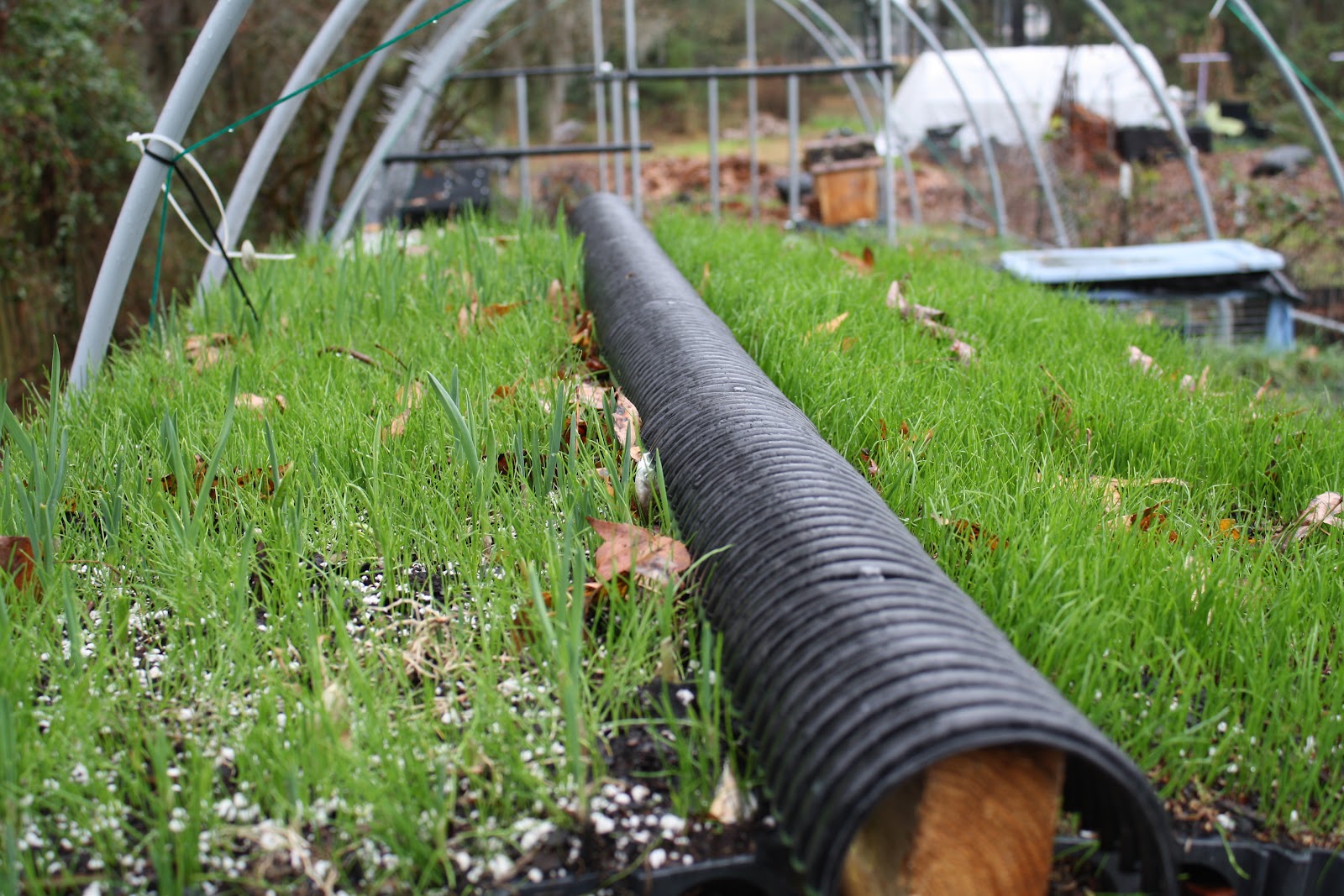
Much the way many living wall designers use felt or a non-woven geosynthetic, I rolled and inserted the felt fabric into the stormwater panels for a base growing platform.  The panels were placed atop a standard piece of roofing tin over wooden rafters above the rabbit cages.
Simple piece of tin covers the pen rafters under the DIY green roof system
The purpose for using the 50mm stormwater panels was to give the living roof a structural dimension, one that would place the weight of the green roof over the stronger outside pen supporting walls rather than on the rafters.
A reused gutter drain served as a green roof crown cap
Once the felt was embedded, rabbit poo, leaves and compost was added to the panels.  Garlic, rye and  other forage plant seed was added.  Soon the roof was green with tempting bunny forage.  The felt acted to wick water across the roof,  provided oxygen, drainage and a structural grid for roots to attach to.

Green roofs don't have to be expensive.  Think - support, innovative soil platform and proper plants.

As for the rabbits, try on a stick with mustard!


Wednesday, August 1, 2012

Native Plants for Urban Green, Permaculture & Green Roofs

The bioswale is looking great!
LaSalle Bioswale Project - Native Plants for the Urban Core
We were out on errands day before yesterday and Judy had library books due, so the San Marco library was a stop on the list, and I was thrilled.  You see, Riverkeeper and Coca Cola funded a stormwater project I've mentioned before called a bioswale in front of the city facility.

Of course there were engineers involved (Doug Skiles) and plant people like Bob Chabot and Chris Dailey from the Jacksonville Zoo and Gardens, and others.
The Bioswale takes the place of the old right-of-way landscape
Though a stormwater ditch may not sound much like an Urban Green project, nor may it be as glamorous as a green roof or front yard filled with food plants, it is important to all the above.

I have to keep reminding the botanist in me about the importance of native plants.

San Marco's library bioswale is filled with ethnobotanically important native plants.
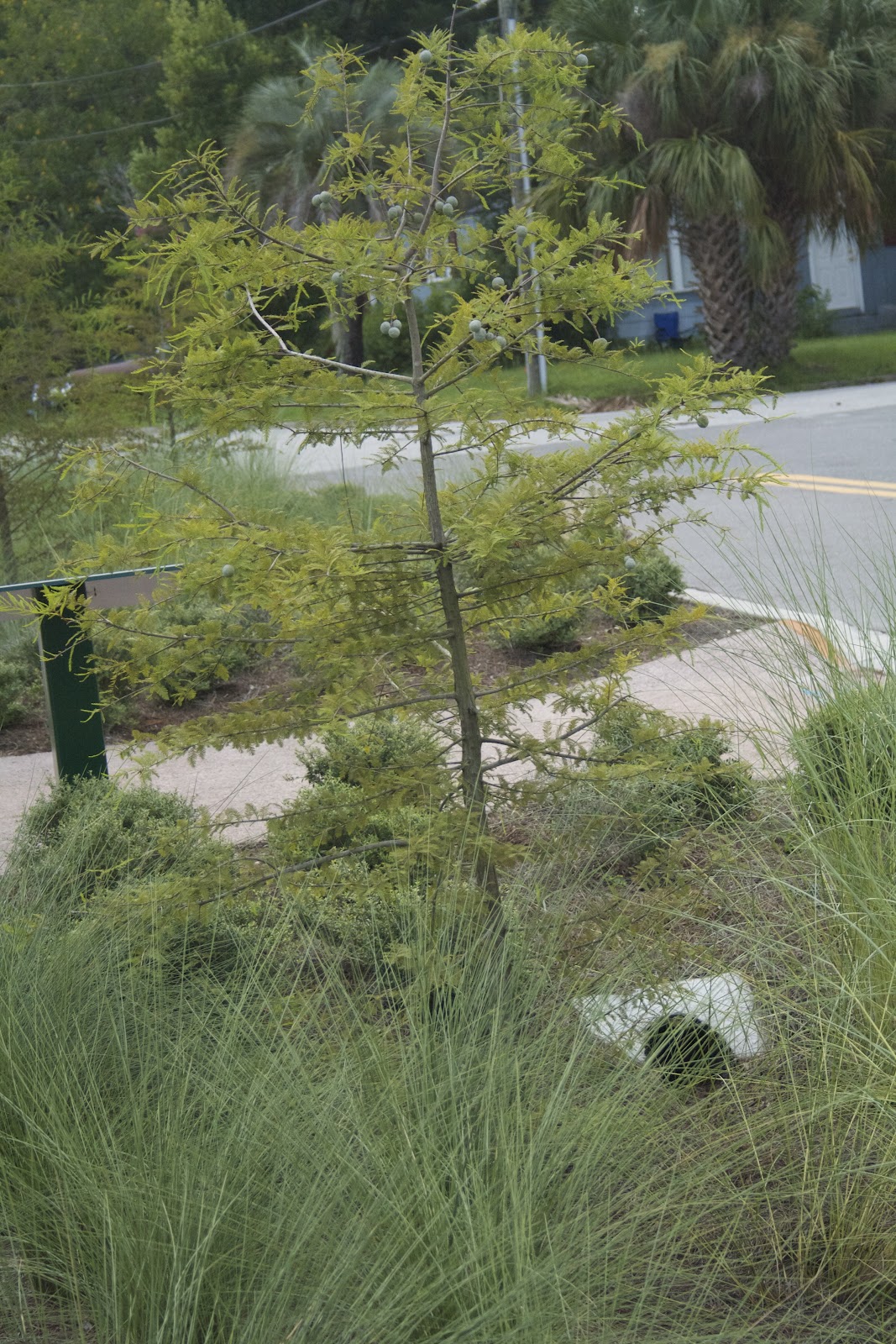
Cordgrass, Muhly grass, Cypress, Ilex and curbcuts gather and treat stormwater

However, many times these native plants are looked down on by, yes, even those involved in Urban Green, Green Roofs and Permaculture efforts.

Maybe due to their 'commonness', or lack of pretty, patented fluorescent flowers (though many native species are stunning in their own right), or minimal fruiting-food production, natives are out-of-vogue with a large component of the Urban Green movement.  In fact, in the Urban Farm movement, little if any thought is given to the impact of planting food plants that may themselves be another eventually invasive or monoculture problem.
Native plants provide habitat for native pollinators
Sometimes this may be due to the fact that urban farmers, green roof designers and permaculturists are used to thinking along the lines of only one mindset (including myself).

Yet the plants here are just as rich in ethnobotanical value as any exotic plant such as moringa, without the dangers of becoming invasive.  Though preached and loved as the ultimate plant, moringa has been classified as a potential dangerous plant for native habitats (see Michigan Technological University's website).
Existing utilities were worked around during design and installation
Other times it may be because of a lack of education and information about the true value of native plants to Urban Green, Green Roofs and City Permaculture projects.

But the San Marco bioswale brings all that back to mind very quickly.

The native plants growing in the San Marco bioswale not only clean standing and flowing stormwater, they are able to withstand long periods of drought without additional irrigation.  This is important because of our present water supply crises.  The plants can adapt to either floods or dry periods, without having to turn on the hose.
Native plants provide the transition beauty from street to building
Urban landscape, green roof and farming irrigation add up to be a significant amount of water use in our cities.  Hopefully, projects like the San Marco bioswale can educate us all to the fact that native plants can provide landscape beauty without added irrigation.

Yet there is more.  As I was walking around the bioswale, I noticed hundreds, if not thousands of dragonflies, damselflies and other insects.
Because of low leaf litter rate and ability to survive drought or flood, Cypress is perfect for bioswales
The bioswale was acting as a virtual breeding nursery for pollinators, those same pollinators permaculturists pray for around their gardens.  The native plants provide habitat for native pollinators to breed, forage and live in.  Without native pollinators there can be no food gardens.  Without native pollinators there will be no flower pollination.  Without native pollinators there are no city farms.

Importantly, we must recognize mistakes we as a culture have made in the past bringing in exotic plants for food, erosion control and landscape beauty that eventually have turned into nightmare plants.  Kudzu, wisteria, Mexican petunia and potato vine are just a few of many.  Unleashing plant monocultures that choke out native grasses and other plants has been a process that once we start has been difficult to rehabilitate.

The disappearance of many native pollinators and beneficial insects, amphibians and reptiles can be directly related to the use of food and landscape plants from foreign ecosystems that having once arrived, take over and preclude habitat for the native species.

Once our native species are gone we are left with a hodgepodge of alien plants.

Unfortunately, though gaining in popularity, native plant landscape are still under-appreciated for their biodiversity, pollinator support and habitat providing value.

Permaculture, green roofs and Urban Green have come a long way.  They still have a long way to go with respect to incorporating native plants.

Hopefully, projects like the San Marco bioswale will teach us about why we need a majority of native plant species on our green roofs, permaculture gardens and Urban Core Green.