Sunday, September 28, 2014

It's What They Don't Tell You That Matters Just As Much As What They Tell You; Uncertainty and Chronic Illness

When I know I am usually ok.  When I don't know I am all stressed out and usually not ok.  This applies to many life situations but especially to chronic illness challenges.
My Tweet About Not Being Afforded Access To My Prescription

For instance, the other day I went to the pharmacy to pick up my Coumdain (warfarin) and other prescription medication refills like I always do and have always done for the past three years.  When I arrived at the pharmacy counter the normally very communicative and courteous clerk was a little busier than normal.  I am a patient person so I waited.  When she handed me my medications, the warfarin was not included.

I methodically looked through the plastic bottles each filled with pills and repeated out loud what I was thinking. "Metoprolol, Losartan, Lipitor," and paused.  "What about the warfarin?" I asked.

The pharmacy technician was already back to her table working on another order.  She turned quickly and replied, "Oh, they won't allow me to refill the warfarin until the 30th, they won't let me do it."

Right then and there I should have taken the initiative and asked, "Who is 'they'?"  I should have made it very clear that I needed my warfarin to stay alive because of my artificial heart parts.

But in the moment, with lots of people standing around, her being so busy and my own most unuseful habit of having a 'compliant' attitude with authority figures like doctors, officials and pharmacists, well I just said 'OK', turned and left.  My stomach was becoming tightly knotted.  I wanted to hop on my bicycle and return quickly to the safety of my house and figure out a solution to this cluster mess of not having an important medication.

I hate stress and stress causes me lots of physical issues, especially those relating to my heart.  I was  stressed.  I did not get my warfarin like I should have.  Somewhere out there in America's health care complexity someone or some computer program algorithm said 'Kevin has to wait until the 30th for his warfarin refill'.  The 30th was seven days away.  I had three days of warfarin left.  That meant I would be out of the medication that keeps clots from forming on my heart valve.  I could stroke out.  I probably would stroke out.  I could or would die.  I did not know what was going to happen but I knew it was going to probably be bad.  More totally unnecessary stress.

So I tweeted out to the world my frustration.  After all I had a year's worth of refills and had never been denied before.  More importantly I had a family to care for and I was NOT going to roll over and die because some stupid clerk in a swivel chair in front of a computer somewhere out in health care space had decided to not issue approval for my medicine.

If I couldn't get the warfarin and a clot did form on my valve and I 'stroked' out then someone would pay.  I wanted to make this clear to the pharmacy.

Then a thought popped into my head.  Had I been my old, pre-dissection self I would have caught this right away.  Unfortunately, as I have blogged many times about before, my time during open-heart surgery on the heart-lung machine has given me 'pump head' syndrome.

Quickly, for those of you like me who can not remember a whole lot, 'pump head' is a condition where the heart-lung pump system allowed small air bubbles or particles to enter the brain blood vessels causing blockages and resulting in cognitive issues, like memory loss and confusion.

In pre-dissection days my lawyer training would have prompted me to right away ask, 'Who is 'they'?"  But it was only after coming home and stressfully pondering the entire medication situation thing that I realized I never was told who 'they' was.  I wanted a face or a name associated with the 'they' that was potentially going to decide if I lived or died.

I was going to take 'they' to task about my refill.

The 'they' issue has always been one of my OCD issues.  Ask my wife and teens.  I would always ask 'who is they?' when the family would use the word in a sentence.  A distaste for ambiguity is a common trait among lawyers.

Unfortunately, I am not as quick as I used to be - then again this slower purposefulness may be good too because it has made me less intense and aggressive. But I digress.

So a quick phone call to the pharmacy was made and I explained how I was very worried I might stroke out, yadadada…  "Tell me please, who is the 'they' that would not allow my warfarin refill?" I asked the just as now as me confused pharmacist.

Fingers taps on the computer keyboard dominated the momentary silence over the phone as she searched my records.

"The 'they' is your medicare insurance company, Humana," she replied.  "Humana won't pay for your refill until next week. But we can refill your prescription under our four dollar program as we did before your medicare began" she continued. "Would you like me go ahead and refill for four dollars?"

I breathed a huge sigh of relief.  I could get my warfarin.  I was not going to stroke out.  I would live!

Then the anger overwhelmed me.  I wanted to shout, "Hell, Yes! It is only four dollars versus two dollars!"  Pause.  Deep breath.  Instead I calmly thanked her so very much for solving the problem, and tweeted…
The 'Thank You For Refilling my Warfarin' tweet
If only the busy pharmacy tech had just told me what the busy pharmacy tech had not told me.  Instead of saying "they won't allow me to refill your warfarin', the busy pharmacy tech could have said "your present insurance carrier won't allow the warfarin refill for another week, but we can refill under your old method of buying warfarin since you have a valid, up to date prescription with refills."  Problem would have been solved.

Partial statements that are technically correct but offer incomplete information are extremely dangerous to patients in today's health care business.

Unfortunately the pharmacy debacle has not been the only recent 'it's not what they said but what they did not say' challenge.

As I have been blogging about recently, something inside my body tore and I really bled a whole, whole lot of blood which pooled about my waist.  The emergency room doctor informed me I had a 'hematoma' and she gave me some pre-printed literature with her comments added. "rest arms and shoulders.  Apply ice pack 4-5x daily for 20 minutes @ a time".  She said loud and clear "You have a hematoma.  I would like you to rest your arms and shoulders and apply an ice pack four to five times daily."

The literature was lengthy with lists of finer sized print.  I incorrectly assumed the most important information was what was highlight bold in large test - the "rest arms and shoulders.  Apply ice pack 4-5x daily for 20 minutes @ a time" statement.

So I came home and for a week applied cold ice packs to my grapefruit sized hematoma as instructed.  I did read the rest of the literature but as soon as I set the papers down I pretty much forgot what I had read (the pump head issue).

After a week of cold applications and no shrinkage in size of the hematoma I was worrying and stressed.  The bleeding had mostly stopped and the large bruise was going down in size slowly but the lump was still on my shoulder blade.

Then yesterday my home health care nurse came by for a surprise visit.  Ted and I became good friends after my initial dissection recovery and subsequent episode with endocarditis.  He is the one who made me go to the hospital when my chest began to swell with infection after the first open heart surgery.  I value Ted's practical experience based opinions.

We talked about yams and football and then I shared my recent hematoma experience.

"How are you treating the contusion?" he asked.

"With an ice pack," I replied and pulled out the cold blue sack of frozen liquid from between me and my recliner.

"Just ice?"

"Yes, that is what the emergency room doctor told me to do."

Ted sighed. "Kevin….never mind" he said and continued, shaking his head.  "Do what the doctor told you to do."

I could read his body language and knew he would never recommend anything contrary to a doctor's orders.  "OK Ted, you were right about my endocarditis when the physician's office was incorrect, so tell me what you think."

"Well, I usually like to treat a contusion with warmth and heat.  Cold alone will constrict the capillaries and prevent dispersion of built up fluid.  Cold also can damage the nerves."

I shook my head.  "That makes sense."

"Try alternating a hot pad and then cold.  Heat will improve circulation in the area, improve circulation and move the fluid build up."

Over the past twenty four hours I have applied both heat and cold, alternatively and the hematoma has
shrunk considerably.  Intrigued, I went back and looked at the discharge papers I'd received from the emergency room visit.  The "rest arms and shoulders.  Apply ice pack 4-5x daily for 20 minutes @ a time" was very visible.  I also clearly remembered the doctor telling me this.  She never mentioned heat.

Yet buried in the finer print was a few words about using heat too.  The doctor had never said this to me though.

And so it really is what 'they' don't tell you that matters just as much as what 'they' do tell you.

Sometimes I expect too much from others, especially being in the disabled condition I am in.

But in the future I am going to try to listen to all the words 'they' say.  And I am also going to listen to all the words 'they' don't say.

If I don't forget to.

Friday, September 26, 2014

Dissected Aorta and Hematomas, Keeping a Heart Valve Clicking also can Cause Bleedout

Hematoma is what the doctor at Florida Hospital in St. Augustine called the lump on my back.  It was very large.  I am not sure how it got there but after three days of pain I had my son drive me to the ER.
Bleeding from recent hematoma

I'd never really researched what a hematoma was before.  The ER doctor gave me a couple information sheets about the causes, symptoms and cures and sent me home with written instructions to rest and place an ice pack on the grapefruit size lump, four or five times a day.

Hematoma is generally defined as a collection or pooling of blood outside of normal blood vessels, due to an injury where internal bleeding has occurred.   My injury occurred around my right shoulder blade.  At the worst, I estimated that I bled about a half gallon of blood that eventually collected and pooled around my waist.

This was a big one.  I lost so much blood that I could only walk a few steps without having to sit down and rest.  However because of my warfarin (Coumadin) regime to keep my mechanical heart valve from clotting up, any trauma - large or small - could precipitate spontaneous internal bleeding and fluid collection.

Most of the time for me the hematomas are small to medium size and resolve themselves within several months.  This larger one is being persistent.  It has been two weeks yet is still bloody looking and quite swollen near the original injury site.

Importantly, though hematomas are collections of blood they do not have blood flowing through them.  This opens up the possibility of infection setting in where the blood is pooling.  Ugh.  After my six month episode of endocarditis and fungal growth on my Dacron aorta graft I really am in no mood for another bout with heart infection and peripherally inserted central catheter line with anti-everything treatment.

So I am taking lots of vitamin C and turmeric and supplements, staying well bathed and eating good foods and resting in my recliner without moving much at all.  I've seen the ER doctor and my cardiologist also.

My cardiologist says to watch the size of the hematoma closely and if it becomes hot or grows in size to seek medical attention immediately.

I want to stick a sewing needle in the lump and allow the fluid to drain but of course I would not because of the risk of infection.

To top all this off my connective tissue disorder (Marfan Syndrome) subjects me to daily situations where I can bend over, reach up or do any number of regular, normal body movements and I'll tear a muscle or ligament or something inside.

Then with another tear the bleeding starts again.  Another hematoma.  Double whammy.  Warfarin and Marfan.  Tear bleed, tear bleed, tear bleed.

And each time a tear occurs and bleeding starts I always foremost wonder it I am bleeding out from an aneurysm; or 'is this the big one?' as Fred Sanford eloquently said.  After all, my dissected descending aorta is... paper thin.

Life with connective tissue disorders and anti-coagulant medications is a challenge.  Yep, it is the new reality for me.  But I am also so very glad to be alive to experience it.

Tuesday, August 19, 2014

Life, Trauma, Bikes, Mosquitos and Marfan Syndrome

Not having a driver's license is difficult.
Yep not having a driver's license is traumatic.  Automobiles have made the world such an easier and more convenient place to live, especially when one runs out of medications late in the evening and Florida mosquitos are out.  But now, my options are walking or riding the bike up to the drugstore.  And so afterward, though exhausted, I feel like I accomplished a bit of exercise.  But while some think the saying, 'that which does not kill us makes us stronger' is true, I would say the quote is silly.

Sometimes we think that going through our our trials make us stronger.  But cause and effect is not the same as co-occurrence.  I am not able to survive my dissection because of the trauma's hardening effect on my body, rather I am able to survive Despite my dissection.  Riding my bike late at night may provide some cardio but it also increases the chances of being hit by a car, infected with mosquito borne illnesses or dropping off the bike because I did too much that day.

Understanding 'this' is hard until one actually experiences the life and challenges of a chronically disabled or ill person.  In reality, ongoing trauma does not make one stronger.  Chronic trauma (physical, spiritual or mental) actually breaks an individual down more than it builds them up.  Persons with connective tissue disorders like Marfan Syndrome, EDS, LDS or Aortic Dissection would be super hero types if chronic trauma made them stronger.  Riding that bike late at night hurts when I am already tired.  Though the fresh, cooler air is refreshing, the mouth full of bugs is gritty tasting.  Spit bug bones inevitably fly back up under the helmet or across the face.

The same holds true for a chronically ill person's spirit.  Pain does not begat healing.  We don't see hospital nurses and doctors running around with torture devices (usually) trying to heal our physical weaknesses.  As a general rule most in the medical field give compassionate healing.  We see mothers nurture new babies so they will grow strong, not typically slap them around to prepare the babes for life.  I find peace for my soul sitting in the sand, at the edge of ocean's surf far away from the evening news. Jesus is quoted as saying something like, 'I am gentle and humble in heart, and you will find rest for yourselves.'

Sometimes a physically healthy person may think, 'I know I would succeed, and make the best of it if I had their physical challenge'.   I have even heard some scowl and say 'if only they had stronger faith'.  However chronic trauma of any type never builds a stronger individual.  Chronic trauma tears apart and wears down.  This is why most people today choose to join an air-conditioned workout gym with music playing over the speakers rather than work as a laborer in the fields.

Many of my friends across the world with torn bodies face trauma everyday.  They look for peace and healing, not more trauma.  Without a doubt I would be probably correct in saying each of them makes more progress with therapy that challenges but is not painful.  For me walking with an ocean breeze in my face is healing, for other's it may be working in a therapeutic garden or even walking to an urban common area and playing checkers or just sitting and chatting.
F. Hartmann - Photography by F. Hartmann in Basel. Public domain due to age of photography. Scan processed by Anton (2005)
Perhaps Nietzsche's understanding of life with trauma would have been different if he'd been swallowing gobs of Florida mosquitos and maybe smiled for his portrait.  My life would be less traumatic if I had my drivers license back, but don't tell my bike.  And even though I scowl at the thought of bug jerky and that shrill ear buzzing while I ride, the sense of adventure, of doing something different floods my soul and I am glad I rode the cycle.  It is all just life.


Friday, July 25, 2014

Florida Green Roofs - Know Thy Plants!

Florida summertime is hard on green roofs.  Not only are roofing membranes subject to intense weather challenges, green roof plants also are subject to intense biological and meteorological assaults.
Summer humidity may quickly kill Florida green roof succulents
We have posted notes about Black Rot fungus before here on this blog.  It never fails though that every summer persons will contact me asking why their succulents are turning brown, black or rotting.
Florida green roof succulents battle the Black Rot fungus every summer
The simple answer is to use Florida native plants (preferably evergreen species but a mix of deciduous plants will work too, depending on the green roof location in the state).  Here in Florida native green roof plants usually far outperform horticultural succulents.
Florida green roof succulents rarely become the dominant green roof plant and usually die out
Florida summers bring maximum humidity and maximum temperatures.  With daily afternoon rain showers most rooftops become pressure cookers, steaming green roof plants like vegetables in a hot wok.  If you do not intimately understand Florida roofs and how plants preform there (and this only comes from hands on learning, failures and successes are the best teachers) then your roof design may quickly end up devoid of plants as you stand there, helpless, watching the succulents literally dissolve in the heat and humidity and fungus attacks.

Tropical green roofs are a challenge.  We have listed some great green roof native plants here.

Know how your plants will perform in a pressure cooker before specifying them on a green roof here in Florida.

Wednesday, July 9, 2014

Why Florida Green Roofs Are So Environmentally Important

Here in Florida surface water can directly flow into the drinking aquifer below the ground in many places.  Here is a video of storm water flowing down into the ground through a karst connection to underground caverns after a recent rainfall event.
Cleaning rainfall runoff with green roofs and other urban greening projects before the stormwater reaches our drinking water supplies makes good sense.

Avoidance of pesticides, herbicides and lawn fertilizers and chemicals is good not only for our environment but also supports a cleaner and healthier place to live in.

Sunday, July 6, 2014

Connective Tissue Challenges, Learning to Live All Over Again

Someone started a rumor long ago that says you can't teach an old dog new tricks.  I say, "it depends on if they have a connective tissue disorder and how bad that dog wants to live".

Living with a dissected aorta - my descending dissection #Marfan
My present mission is to stay alive at least long enough to see my two teens able to support themselves and to enjoy life with my wife, Judy. That is pretty significant incentive.  I sure hope this is possible but I have to be honest and say that each day I wonder if I am going to be able to make it or not.  There are so many common, every day things that can seemingly push me towards the final edge.  

Living with a dissected root to foot and up into my kidneys, aorta and a HUGE false lumen that floats around inside the main blood vessel, requires me not to strain, lift or otherwise exert myself.  Surprisingly this is much harder than it sounds.  You'd think, OK, just don't lift or strain too much.  Yeah, right.  Open this peanut butter jar for me.

It is not the hour long weight lifting outings or intense home remodeling or green roof construction activities that I've already given up that present those unexpected aneurysm dangers.  Rather, it is the little things in everyday life that I have the most problems with.  Unfortunately I don't find out about just how I am hurting myself until after the fact and my chest starts becoming tight and my aorta begins hurting again.

After living with a Dacron graft and St. Jude valve for two and a half years I am still learning new tricks.  This dog has finally come to realize that there is no going back to the old way of type A living.  Today's life is centered around measured movements, cautious exertions, decreased activity duration and cardio instead of anabolic muscle approaches to exercise.

Tightness, aching and jaw, chest and back hurt are all still fresh memories haunting everyday life.  I never again want to experience the unzipping feeling radiating down my body as the intima wall separated from the other two aortic layers.  Today, I have very similar pain events occur out of the blue, though nowhere near as intense, whenever I put stress on my cardiovascular system.  So I have to learn to avoid cardiovascular stress of any type.

But these 'instigating events' sometimes are activities one would never expect to be potentially responsible for a future dissection or aneurysm.  Simple stuff, like taking the garbage out or moving a piece of furniture (hey dollies were invented for a reason).

Today I know I can no longer jump up from the couch and hoot or holler when a sports game is on television.  In fact, after the last few college football seasons and the Florida Gator's not so stellar performance (but hey, Go Noles!), I do not even turn on the television to watch games.  In fact I do not turn on the television at all.  There goes a bunch of cardiovascular stress out the door.  Now I blog.  New trick.

Today I must watch myself when sneezing or straining on the toilet.  Too many people have kicked the bucket on the loo; even some very famous people.  Thanks to daily organic psyllium fiber all things run much more smoothly now.  Yet the sneezing can't be avoided.  I just hold my chest tight when sneezing though I am sure that clasping my chest tight is not going to hold my pulsating internal supply hose together if the sneeze is big enough.  

Today I can't work on my bike like I used to be able too.  One of my pedals needed replacing and as I tried to loosen the proper bolt with an open ended wrench I felt that old familiar pain returning.  Stop, take a deep breath and think.  I must learn new tricks.  I can not strain like I used to.  My teenage son though can help me and the use of cheater bars and levers can make the job much less stress intensive.

Today I can not jerk on weed eater or lawn mower starter handles.  Upper body rapid upper chest movements while straining are a trigger for dissection according to Dr. Lars Svensson.  But this old dog here has found that today's electric weed eaters and lawnmowers are, especially with their 56V batteries, amazingly capable, lightweight yard machines and best of all they just require a button's push.

No more working on the car, but it is time for the teen son to learn anyhow.

Those darn random firing red-light camera flashes used to send adrenaline surging through my body causing the blood pressure to soar when I was driving.  Now, without a driver license I don't have to worry about keeping my eyes on the road.  No more gripping the wheel so hard the veins on my neck stand out.  No more yelling un-intelligible, sloberish words out the car window and hitting my head on the frame as I offer up evil hand gestures.  Much less stressful to walk or ride a bike.

No more scuba diving into caves.  Sometimes I wonder about the summer before I dissected.  I was diving in a tiny vertical cave shaft well over one hundred feet below the surface with hardly any room to even turn around.  Or those times I would free dive down into the west sink in Promise Sink, swim through the connecting cavern about forty feet down and come back up in the adjoining east spring.  Or those times in Peacock Springs where we'd dive straight down through fifty feet of zero visibility algae blooms to finally break out into a crystal clear basin full of alligators resting on the bottom of the cave opening.  What a rush!  And my aorta held.  Lucky I did not dissect underwater.  Today I lay on the beach and watch flocks of prehistoric pelicans glide seemingly motionless overhead, a much easier cardiovascular activity than equalizing pressure in one's head underwater or becoming tangled up with a dive partner scrambling away from large underwater reptiles.

No more eighty pound bags of cement.  No more forty pound bags of compost.  No more ten pound bags of ice.  Doctor says two pounds max.  Ugh, this is a challenge.

But the cheater bars (a long hollow piece of metal used to gain leverage - not a place to find alcoholic beverages or wild women), levers and teen help works.  The teen's echo shows dilation has started though, so the teen help will be limited and cautiously monitored.  This old dog is learning some new strategy.  Will it be enough to keep me alive?  I think where there is a will there may be a new trick.  

Connective tissue challenges might cause all sorts of hullabaloo but they also present all kinds of opportunities for learning to be creative.

So for all you out there with special challenges, Be Elite.  b31337.  We are the magicians.


Saturday, June 14, 2014

My Dissected Aorta Loves A Dollar

A most wonderful dollar bill exchanged its existence in my wallet for a pill case.  Greater love for me hath no other dollar.
Medication Organizers are inexpensive but so helpful!
 Finally, I purchased a weekly pill organizer from the Dollar Tree for, yes you guessed it, for that folded one dollar greenback.

And it has so helped with my stress levels and panic episodes.  I should have listened to others and bought one sooner.  But I usually have to learn the hard way.  Sometimes I wonder just what I could have accomplished in life if I had really listened to others, learning from their similar experiences.

But no, I have never much listened.  I have been destined to repeat that which I could have avoided.  Perhaps though learning by experience is part of the human curricula. I know learning the hard way is the path I usually take.  Yes, I kinda enjoy experiencing the challenges for myself.

I can't begin to tell you how many times I have wondered and worried, before I spent this dollar.  Did I take my medicines?  Oh oh, I can not remember if I did but it looks like there are fewer pills in my pill bottles.  Frequent episodes like these always sent adrenaline surging through my cardiovascular system.  Not a good thing for those of us living with a dissected aorta.  Especially when there are so many, so very many pills to swallow.

Medication Memory Issues Resolved! #Marfan Syndrome
Hallelujah! Now with my one dollar pill organizer I feel like all the things falling apart from my connective tissue disorder issues might just start slowly become put back together.  No, the plastic box won't heal my root to foot dissected aorta but it might mitigate heart seizing surges from wondering if I've swallowed the colorful tabs or not, and that might prevent a stress-related cardiovascular incident.

That spent George Washington grew so big in size, and in my mind is now more like a security blanket rather than a small folded piece of paper now in a who knows where cash register drawer, purse or wallet.

I should have listened and bought one several years ago.

Maybe I was waiting for just the right dollar bill to spend.  They say we shouldn't love money.  Where ever you are George, I love you….

Sunday, June 8, 2014

Kevin's Primal Pineapple & Nut & Chocolate, Almond & Coconut Flour Cookies - Cardiovascular Healthy!

OMG!  These primal treats are so delicious and healthy.  And I don't mind the two remaining teens eating as many as they want.
Kevin's Primal Pineapple, Almond & Coconut Flour, Dark Cocao & Nut Cookies
But unlike those junky industrially fabricated cookies you get in packages at the store, these are so filling that you really only can eat one, maybe two.

And there is no sugar crash afterwards - only fat burning and muscle building (look out Atlas!). Lol.
Low carb, good protein and high quality fats.  Eating primal can be fun!
I know because I am typing this blog post after having baked a dozen and eaten one.  I actually feel energized.  Feeling energized while on high doses of beta-blockers and a myriad of other meds is unusual.  Sometimes I actually wait and wait and wait for my heart to go ahead and beat again.  But these treats kick my pulse up and are good for my liver and kidneys.

My kidneys are about shot because of all the contrast dye from multiple CT scans.  In fact I went into serious renal failure after my second open heart surgery.  Ugh.  So I do not handle sugars or high glycemic carbs very well.  However today, I wanted a quick and easy treat - but not one that would hurt me.
Publix has an excellent selection of 'alternative meal', including coconut and almond meal
Lately I have been removing most all processed foods from my diet, and instead eating good proteins and high quality natural fats - you know, trying to eat healthier.

I feel so much better from doing so.  Post second open heart I weighed almost 245 pounds or so.  Today I am down to the mid 170s.  My goal is a BMI of between 20 and 21 and I am almost there.
Yummy, 'almost totally' Primal-Paleo dark cocao
Hey today is Sunday and the two grand teens have returned to Tallahassee to live with their mother and next weekend Jincy is headed off to college orientation.  Me and the fam need a healthy treat today.

Earlier I rode my bicycle up to the market, selected a few 'primal'-'pale' ingredients and came home to whip up a batch of good-for-you cookies. OMG, they are so delicious!
Eating Primal has helped me remove inflammatory substances from my diet - Good for my Heart!!!
Here is the recipe:

Kevin's Primal Pineapple & Nut & Chocolate, Almond & Coconut Flour Cookies

Preheat oven to 350F

Mix 1 cup organic almond flour and 1 cup organic coconut flour in a mixing bowl.
Add 1/2 teaspoon baking soda & 1/2 teaspoon sea salt.
Stir in three brown eggs and 1 teaspoon organic vanilla extract.
Drain and mix in 10 oz organic crushed pineapple with no sugar added.
Add 1/3 cup organic coconut oil.

Mix well with a fork and press into small cookies on a cooking sheet prepped with organic EVOO.

Decorate with organic 85% Dark Cocao and your favorite nuts (I like pecans, cashews and macadamia nuts).

Bake for 12 minutes or until golden.

OMG.  What an awesome, filling treat full of protein, good fats and a few low glycemic carbs.

I love eating primal.  Natural foods make me want to stand out back and beat my chest like Tarzan.  But I don't do this chest beating because it might aggregate my existing dissected aorta challenges.  Instead I smile and lick my lips and growl like Tarzan.  And lick my lips again!

Friday, June 6, 2014

My Near Death Experience During Aorta Replacement Surgery

Near death experiences are usually referred to as 'NDE's and there are a number of references across the internet.  According to Wikipedia, NDE's are not rare, isolated events but rather quite widespread, with at least eight million Americans reportedly having experienced some type of NDE or other.

Mine occurred while I was having my first open heart surgery in the emergency room at Jacksonville's Memorial Hospital.

After driving myself to Memorial Hospital in Jacksonville (I know, I should have called 911 but I did not) and stumbling into the ER, the young surgeon on call determined my aorta was dissected root to foot.  He told me that he wanted to go in and replace the aortic valve and install a Dacron graft up to the aortic arch.

To do so I'd have to have my body cooled (hypothermia) and my body's heart put on bypass while they repaired the critically damaged cardiovascular system.

The entire  operation took about ten or so hours.  Recovery was difficult to say the least and I even had to go back through additional open heart surgery to mitigate subsequent heart infections.  Wearing the wound vac over my heart was tough, as was enduring the three months of 24/7 IV antibiotics and anti fungal medications.

This week I happened to catch a clip out of a Netflix series the teens were watching where the main character had been killed and his consciousness was wandering around the halls of a hospital.  He was shouting and calling out to all the humans walking around him but none of them heard him, nor did the humans pay any attention to the 'dead' main character.

What struck me was the empty, hollow feeling he was obviously experiencing, walking around calling out to all those other humans that could not see or hear him.  Obviously he was all alone.  Being alone can be extremely disconcerting and hopeless.

"That sucks",  I told myself.  But that was nowhere like my NDE.

While I was lying on the operating table during my aortic root and arch replacement my self awareness began to take a life of its own, separate from my body.

I can clearly remember what was happening, even to this day.  Unlike a dream that seems real at the time but fades from memory after a few short days, the NDE experience I had that day is as ever clear now as two and one half years ago.

I was so very aware of myself and knew exactly who I was.  My body however was on the operating table below with the doctors and nurses hovering over, cutting sewing and doing whatever thoracic surgeons and their teams do when installing mechanical heart valves and Dacron aorta grafts.

I did not call out to anyone like the main character in the teen's television program, but then again I did not feel like I needed to call out to anyone.  I was quite content, safe feeling and happy where I was, 'hovering' above the operating table.

Looking around I could see many people praying for me and sending me good thoughts.  This was interesting I thought, but I honestly was more interested in what I could see not in the operating room but in another part of my self-awareness.  There was an amazing place of really cool colors and sound I was witnessings.  I could fly, soar and felt very, very at home.

After the entire experience I felt somewhat guilty at not worrying about those people left behind on the earth while I was partying in the afterlife.  I knew my wife and kids and family would be OK.  I did not worry about them what-so-ever in my NDE state.  

I did not even think of calling out to the doctors and nurses.  There was no doubt my body was on the operating table and I could see much of what was going on.  

During my NDE I  was a self aware 'spirit', yet I had form too.  My form was not so much a preoccupying factor though as I 'hovered' in the air above the table.  I know my self awareness had form because I was bumping against the ceiling as I floated upwards.  When I'd bump the ceiling my form would float back down towards the other side of the room.  The floating up, bumping the ceiling and floating back down repeated itself over and over until I began taking notice of this occurrence.

The whole bumping into the ceiling thing really pissed me off.  Not because bumping hurt or anything, but because I was aware of an amazing array of new sounds and senses I was catching a glimpse of and I wanted to explore more.  There were so many beautiful colors I'd never seen before and sounds and scents and hues and textures and stuff I can not even describe.  There was a new existence out there that I was tasting and I wanted more of it, a place where I felt immense love and acceptance and belonging.

So many were there with me too.  This place where my self awareness was, was a very good city or town or wherever- whatever it was.  I did not want to leave.  As soon as a beautiful new form would pass by and I felt drawn to it, the bumping would start again.  That damned ceiling!  

The bumping meant I was not going to die.  I knew this as I continued to bump, and it disappointed me. I wanted to stay and explore this new place full of wonder and beauty.  As I floated up, bumped and floated back down I kew that if I were going to die I'd float straight through the ceiling, out into this place of wonder.  The bumping meant I was going to stay.  My earthly body was keeping me in the room.

During my long recovery period I revisited this plane of self awareness several times.  Two and a half years later I do not see this land so much anymore, except for those once-in-a-while nights where deep sleep takes me there.

Having my heart disconnected from my body and being cooled to hypothermia levels gave me a chance to see different things.

I do believe I almost died.  I also believe I caught a glimpse of what happens beyond our present self-awareness.  I am really glad I am here today to see my teens raised and spend days with my wife, friends and family.  Looking forward to many more years here before I drop dead.

But get ready for a cool adventure when it is your time to go.  Been there, done that and it is amazing.


Tuesday, June 3, 2014

Warfarin Bleeding Episodes, Marfan Syndrome and Mechanical Heart Valves Medications

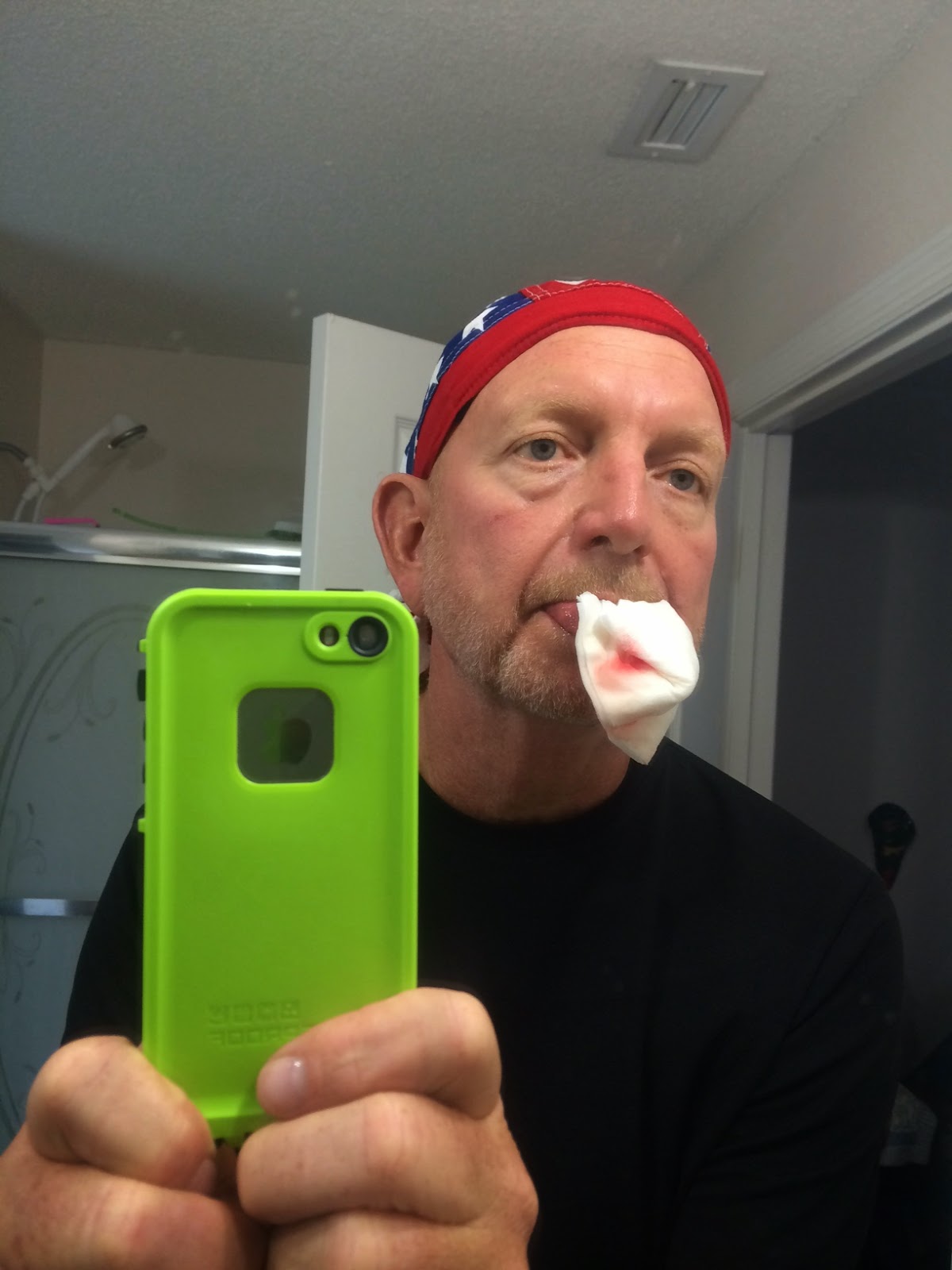
Today I learned that I need to keep sterile gauze pads in my 'tote with me wherever I go' Marfan first aid kit.  It is impossible to keep a bandaid on a tongue.
Life with warfarin, get used to bleeding. Marfan Syndrome normals.
Living a life framed by daily Warfarin doses is a challenge, we all know that.  But warfarin life is manageable when the bleeding occurs somewhere a bandaid will stick.  I really did try.  But a bandaid did not stick to my tongue.

I have been used to the persistent bruising and hard to stop bleeding cuts and scrapes.  But most of these bloody events occurred somewhere on the outside of my body where I could apply the reliable bandaid.  And I keep many in my go everywhere first aid kit.

This afternoon I was brushing my teeth after eating a dried fig.  Unfortunately one of the figs had a little stem left on it.  A sharp little stem.  A little stem so sharp that I said ouch when I bit into the fig.  But the fig tasted so good so I ignored the ouch part.  Until I went to brush my teeth.

Wetting my toothbrush I applied the Crest to the bristles and opened my mouth to clean the choppers.

Holy cow!  I looked like one of those vampires on the TV shows the teens watch, blood everywhere.  First question; Where was I bleeding?  Gums?  Tooth?  Once in a while I have a little blood from flossing but not the amount I was seeing flow down my tongue.
Mechanical aortic valves require anti-clotting drugs like warfarin (Coumadin)
Ugh.  The sharp stem.  I remembered.

Panic started swelling in my chest.  What am I going to do?  What if my tongue continues to gush blood?  I can never go swimming in the ocean again till I get this bleeding stopped!

OK.  I told myself that I had to calm down.  How do you stop a bleeding tongue from gushing blood?   I couldn't run ask Judy or the teens because if I opened my mouth they'd probably scream 'Vampire!'

The bandaid did not work, that was instantly obvious.  Then my problem solving expertise kicked in.  I thought 'sterile gauze bandaid'.  Grabbing a couple gauze packets from the closet I sat down on the floor and wedged the gauze between my tongue and the top of my mouth.  Gag! Blah! But that approach worked after about twenty minutes of gagging on a piece of gauze in my mouth.  Ugh.
Gauze is now a staple in my portable first aid kit.  Stopping a bleeding tongue is a challenge!
Thank god this happened here at the house.

Obviously it is time to go have my INR checked.

But I was going to make sure the vampire look did not return tonight - I made a broccoli smoothie.
Green vegetables high in vitamin K can quickly slow bleeding issues.  Just be careful you do not clot up your valve!
Quickly gulping the vitamin K rich liquid green I could feel my tongue bleed slowly throttle downwards in velocity.
Gulping the broccoli smoothie.  Post-dissection repair life is a challenge with daily warfarin doses.
Tonight, four hours later I can still taste blood.  I'll be sleeping with a packet of gauze nearby tonight in case the vamp symptoms return.
Finally, the bleeding slowed.  Yep, I need to scrape my tongue.  But not tonight!
Aortic dissection, mechanical valves and warfarin, the new normal.  No one to call, no where to turn to.  Figure this stuff out on the fly.  The new Marfan normal.

Sunday, June 1, 2014

A Florida Green Roof that Failed Over and Over Again - Missed Opportunity

Green roofs in Florida must be designed for a very unique set of rooftop variables.  Time and time again I see marvelous, well designed growing systems that work most everywhere else in the U.S. fail in Florida.
The first failure.  Check out the sprinkler erosion patterns in the green roof soil media.
Beware.  A successful Florida green roof is usually based not on the growing system.  Successful Florida Green Roofs are all about the rooftop plant design.  Other than hurricane resiliency and wind uplift issues, the green roof growing system could be a simple vertical coquina stone wall and with the right plants, be green and beautiful year around.

Remnants of the sedum plants that once covered the roof.  More irrigation erosions visible in the soil media.
I do not understand why this concept is so hard to understand by some.  But hopefully we can all learn from these 'hard' lessons.

Sedums work great north of Atlanta generally speaking.  The black death fungus commonly known as Southern Blight, Sclerotium rolfsii, that is pervasively present here in the Sunshine State, apparently wiped out the entire rooftop planting in a matter of weeks.

During hot, wet summer months, Southern Blight will turn many succulents to mush.  Want to learn more about this 'ScleROTium'?  Read more here.

Here in Florida there are a few 'constants' in green roofing design.  The underlying roofing assembly should keep the building water tight.  The entire roofing assembly and green roof system should be fire rated.  Additionally, the roof and green roof growing system should be wind uplift and tropical storm resilient.

A coquina rock wall can satisfy most of these requirements.  What I am trying to say is that here in Florida green roof plants can grow in any growing system installed on a roof.

What matters most is the type of plants chosen and how they interact with primary and secondary design variables.

The 10,000 square foot, green roof system shown here was a installed on the Aloft Hotel in Jacksonville, Florida by a well known national roofing company with a marvelous green roof line of products.

It has failed and failed and failed and was finally removed.

After the first attempt, perennial peanut, Arachis glabrata, was tried as a rooftop cover.  This design too was a failure. 
Such a waste of a beautiful green roof system.

Note the perimeter dead zone on the roof soon after the second round of plants were installed on the roof.  Within a short time the perennial peanut took off, but so did the Bidens app, Goldenrod, Dog-fennel, Ragweed, Pokeberry and extremely tall 'weeds'.

Hoses were draped over the edge of the roof to supply lots of water to plants destined to failure from day one.

Whirly bird sprinklers were set up on the roof but in the end did not save the plants, rather they contributed to washing out the soil media and atomizing-spraying what smelled like reclaimed irrigation water all over the swimming pool and garden patio area below.
Florida has the deadly seven H's.  Plants must be designed around each of them.

Hot summer, relentless photoactive radiation and no matter how much irrigation was applied the chosen plants dried up and turned brown.
This roof not only failed multiple times but also presented a serious liability and safety issue.  With rooftop temperatures approaching 150 degrees F, an afternoon breeze laden with a single cigar ash could have turned the entire structure into a great big torch.
Sometimes a green roof designer will mistake 50 inch annual rainfall amounts for being spread evenly over  four seasons.  Here in Florida it is not uncommon to see ten, twelve or sixteen week droughts without a single drop of rain.  
Again, the roof and growing system here are first class.  But in Florida, a successful green roof is designed around the plants.

I recommend talking to a nursery specializing in green roof plants.  Most nurseries know what drought tolerant plants to install on the ground, and the peanut might have worked well at the hotel site on the ground.

Yet, rooftop ecology needs are nowhere near the same as ground level landscape requirements.  Leaf surface temperature differences can be as high as 80-90 degree F greater on the roof than on the ground.  Find a green roof nursery specializing in green roof plants that has worked for years in your area.

Dead green roofs are fire hazards

Wind too can have so much more impact on the roof than on ground level.  Perennial peanut's success on the ground is due to a hyper-fast photosynthesis rate and biomass creation.  The plant grows fast and covers the ground quickly.  However because the plant does not possess significant spatial or time based separation and protection of the Calvin Cycle processes, roof level heat and wind can pull the water out of the plant faster than the vascular system can resupply.

Maybe as soon as rains started the plant may have 'greened' up (possibly), yet during the dry periods an unacceptable and serious fire hazard existed.

The landscaper had previous success with peanut on the ground.  But a Florida roof is unlike the ground.

Florida green roof design is all about the plants and not so much about the system.
Note too that because there is no handrail system, personal fall protection device attachments would have to be installed to protect maintenance workers.

Maintenance on a green roof should only be done by staff trained for working on a roof with personal fall protection equipment.  Never allow a landscaper on a roof unless they are properly trained and equipped with safety gear, including a hardhat, safety glasses, high visibility vest and personal fall protection gear for starters.

But even with the proper maintenance procedures and awesome green roof planting bed, someone never figured out that  it is 'all about the plants'.

Nice green roof system plus wrong plants equals dead green roof planting.

The fort in St. Augustine, Castillo de San Marcos, is built with solid coquina rock walls, continually buffeted by strong salt laden winds and exposed to intense sunlight.  But the walls support over fifty species of plants.  No soil media and no added irrigation.  Over time populations of native plants have made their self at home.

Castillo de San Marcos plant's teach us that here in Florida it is not so much about the rooftop growing system.  It is not so much about the soil media, although the wrong soil media will not support long term growth.  It is all about Right Plant Right Place on the green roof.

So if you want to design a Florida Green Roof you can learn via trial and failure over the years, or work with a plant person who understands rooftop ecology.

We are presenting a series of design articles covering the basics of rooftop plant design.

So follow our green roof modeling discussion on the Greenroofs.com website under their Tropical Green Roofs Section.  Part one of the discussion was published a couple months ago.  Part two of the design discussion is coming soon.

The green roof has been removed.  What an amazing opportunity missed.
And for a quick revisit of the seven H's check out some of the other posts about designing Florida Green Roofs.

Once more, Green roofs in Florida are harsh places – remember the 7 (or more) H’s:
  • High Humidity
  • Hot, hot heat
  • High desiccating winds (killer)
  • Hurricanes (not the football team)
  • Hard Freezes
  • Horrible temperature swings
  • Hurtful droughts
  • Harmful floods
The green roof planting system installed above was really amazing.  But forcing those plants though they may grow great elsewhere in the states, that are not suited for the 7H's, on a Florida green roof was not the right approach.

Then hiring a landscaper without a rooftop background to try and remedy the problem only magnified the issues leading to failure.

Thank goodness the landscapers did not fall off the roof.  Thank goodness a cigarette ash did not land on the dead vegetation.

It is not really about the system.  On a green roof, it is all about the plants.

A green roof is all about the plants.

Ditching Most Processed Foods From My Marfan and Post-Dissection Life

Recently I have embarked on a Paleo Diet adventure.

Yummy ice cold watermelon!  Ditching processed foods forever!
It is June 1st today.  I have fallen love in with the Paleo Diet, finding more satisfaction and fullness in this approach to eating than in ANY other food pattern I have encountered.  First, let me say my definition of Paleo may be different than others.  From what I understand, the Paleo Diet mimics what our nomadic ancestors would have eaten.  Though this sounds complicated it is not.  Just eat non-processed food.  Today I have eliminated any food that for the most part does not look like its original form.  I have seen my energy levels soar, my blood pressure drop and my weight peel off.

Of course I have my cheats, such as when company arrives and we go out to eat.  Even then though I stay away from highly processed substances, especially sugars, wheats, corn, beans and dairy.

I am eating more now; lots and lots of healthy foods.

Here is my typical Paleo food day.  I am not a purist Paleo, just trying to stay away from most processed foods.
  1. Breakfast - 2 cups coffee & green tea, 2 eggs (boiled, scrambled in butter or over medium), 4 slices of bacon, and a piece of fruit
  2. Lunch - one avocado, one tomato, handful or almonds or several small sardines
  3. Dinner - grilled salmon with garlic, kale, onions, rosemary, turmeric, and green peppers
  4. Water - 2 liters
  5. Snacks - couple handful of almonds, cashews or walnuts
Compare this to my old eating approach typically represented by a day such as;
  1. Breakfast - 2 dried dates, small bowl of black eye peas and small piece of baked chicken breast
  2. Lunch - 2 veggie burger patties & small bowl sauteed garden veggies in EVOO
  3. Dinner - 2 small bowls black eye peas
  4. Snack - couple handfuls of salty Lays potato chips (I know....) & 1/4 cup walnuts, couple of Nori wrapped garlic clove
Do you see the big difference?

I am staying away from high carb, processed corn and wheat products.  I am eating ocean fresh fish, grass fed beef and high quality fruits and vegetables.

Today I checked in at 175 lbs on the bathroom scale.  That is down 11 pounds in two months and 65 pound since my second open heart surgery.  And I am not hungry anymore.

Remember, always check with your doctor before changing your diet!

Tuesday, May 20, 2014

Native Plant Patterns and Historical Rainfall Trends, Predictors of Green Roof Plant Success

Climate and weather patterns are the most significant determining factors of what plants will go on your green roof project and so, rather than turn on the TV I like to look at historical weather maps.
National Weather Service's Historical Rainfall Maps
Green roof plant modeling process considers light and wind to be the two primary design variables for factors affecting green roof plants.  Sunlight relevance to green roof plants and for that matter even ground level landscape designs is usually referred to in terms of 'Photosynthetically Active (and Reactive) Radiation, or PAR.  Too much PAR and the plants can burn, desiccate and wither.  Too little PAR and the plants fail to grow.

Along with PAR is the photosynthetic pathway of the green roof plant and a host of other survival mechanisms such as photoperiodism, phototaxicity and phototropism.

Wind impact too is a design variable that must be accounted for during green roof plant layout.  Strong desiccating winds can harm green roof plants with as much severity as PAR overload.  Wind can pull so much water out of a leaf that the plant's vascular system will be overwhelmed and interestingly, no matter how much green roof irrigation is added to the planting bed, the plants still die.

Micro-irrigation usually alleviates the stresses of long droughts and so on those green roofs, available rainfall impacts may not be as much a controlling design variable (though still extremely important) as wind and light.

Still I find it very interesting to study rainfall patterns across the U.S. and across the world.  Nature has laid out and sorted the different types of vegetation across our continent in a manner relating to wind light and also according to rainfall amounts.

Yes, it is a simple and very broad generalization to say that following Mother Nature's lead supports project landscape or green roof plant potential success.  

When I look at the above map depicting historical rainfall amounts published by the National Weather Service, I see three main, broad patterns.  The Northwest and the East (red and orange areas) receive most of the rainfall across the U.S.  Broad leaf dicots and C3 monocots fill these regions.  Florida and the Central Plains (green areas) receive less than average precipitation and are vegetated with great stretches of grasslands.  Here in Florida the pine flat woods which make up much of the state are filled with C4 ground cover grasses such as the Andropogons and Sporobolis species (if you live in Pensacola though you may want to choose wetland plants for your green roof due to all the rain they have been receiving lately).  Finally, the areas depicted by the least rainfall amounts (less than 20 inches per year - light blue geographic regions) are inhabited by cacti and other succulents.

So if I were designing a green roof for an area outside of Florida I'd think of this map first.

I may or may not end up following Mother Nature's lead after examine a complicated host of other factors, including client intent and if I choose not to follow then my green roof planting design better be spot on in producing the ecology my selected green roof plants will require.

The roof is a seriously harsh place to grow plants.  Use of Mother Nature's millennia of trial and error as guidelines for selecting green roof plants is smart green roofing.  It is hard to beat local native plants on the roof or across the ground.

Saturday, May 17, 2014

Post-dissection Repair Everyday Challenges, Vertigo and Dizziness

I don't want to fall so I pace myself and have learned how to look for the signs of a vertigo or dizziness onset.
Post-dissection repair cycling has its own set of challenges, but is good PT and good for my mental state too!
I am also learning to recognize some of the post-dissection repair triggers.  This is good because I do not want to fall.  Falling and cutting myself or breaking a blood vessel while on Warfarin could be bad.  As it stands I still have a bruise and lump on my left arm after a small tumble almost two months ago.  Any type of trauma where bleeding is involved can have serious results while on anti-coagulants.

Most of the time I do not black all the way out and if I do it is only briefly so it seems.  But the sensation starts with a quiet ringing in my ears and head.  Very quickly my vision goes from ok to grey out.

When this happens I need to lower my center of gravity quickly.  Sit down Kevin, sit down now.  Falling over while sitting on the ground is much easier on my body than a tumble from way up there where I usually am in a standing position.

These sessions typically occur when I transition from laying or sitting to a standing position, though they can happen anytime during the day.

I suspect that they are a result of my very low pulse rate (less than 40) and lower blood pressure than what I have been used to for most of my life (now running 110/65).  Possibly though the dissected descending aorta and the huge false lumen hog most of the available blood leaving my heart, also contributing to the dizziness.

Either way, it is the new normal for me.  I am slowly learning to deal with it.

If I feel like I a going to pass out I sit or lay down.  I just need to reduce the risk of trauma from a tumble.

Honestly, a couple of times when I was out hiking last year I got so dizzy for so long I thought I was going to the great hiking trail in the sky, sat down, held the cross and hearts hanging around my neck and waited.  But the dizziness left, like it always has so far.

Yesterday on my bike I had a similar incident and had to sit down until the vertigo and fuzzy vision left.  Falling off a bike would be bad too.  So as soon as the ringing starts in my ears and the tingling begins in the top of my head I find a nice grassy area, dismount and plop myself down.

The doctor and the medicine containers all warn of dizziness.  Yes, the whole thing is an inconvenience  but it is the new normal.

So those of you out there with seriously dissected aortas on all types of meds who live with the lightheadedness, I can relate.  You are not alone.  It is a strange new normal.


Wednesday, May 14, 2014

Daily Medications and Travel, Don't Leave Home Without Spare Meds!

Travel is not something I frequently do.  My body is not really up to the stress and of course, not having a driver's license, transportation is difficult if not via a bicycle or hitched ride.
My recycled travel pill bottle
But when I do go somewhere I need to make sure I have access to my medications.

Like clockwork, my heart beat begins to accelerate once the morning dose of metoprolol starts to leave my system.  Likewise with a diminishing concentration of Losartan, my blood pressure rises.  If I do not take my afternoon beta-blocker and blood pressure meds then I invite a good chance of AFib or VTach to kick in.  VTach and AFib are bad influences on a shredded, torn aorta.

Even more important is the Warfarin.  A mechanical aortic valve requires clot-free surroundings and freely flowing blood to operate properly.  Clots like to form around foreign objects inside our bodies.  Warfarin helps protect me from valve issues by mitigating clotting action.

Leaving the house requires me to find my way back to the house in time to stay current with strict medication routines.  This applies to any travel away from the house, be the trip one mile or one hundred miles in distance.

At the end of the day I need to find my medicine.  My life depends upon it.

Even the area where Dr. Bates installed the Dacron graft over my ascending aorta, begins to hurt if I skip a dose of Metoprolol or Losartan.  I am not talking about a three or four pain level either, rather one much higher up on the pain scale.

In order to alleviate potential pain and panic I now carry a one weeks does of all my meds everywhere I go.  Sure I probably don't need that much with me at all times, but having  a 'safety net' of spare meds alleviates potential panic.  Panic generates adrenaline, something I don't need with a dissected descending aorta.

I've been carrying these spare meds around in an old prescription pill container.

There are probably nicer or better spare end cases but I like my old pill bottle.

Just knowing my magic pills are there, inside the plastic bottle is a comfort.  When I leave the house without them I always immediately find a way back home to retrieve them.  I honestly can not imagine not having them with me, even on a short trip across this side of town like a walk up to the corner library.

Just shaking the container and hearing my pills rattle around inside is often the only thing I need to do in order to slow my pulse down.

Sometimes something so seemingly insignificant and little can really make a difference in the quality of life for people with disabilities, like myself.