Saturday, March 5, 2016

Seepage Sand Mandala, Florida Native Plant and Wildflower Art

Seepage Sand Mandala. 
Seepage Sand Mandala by Kevin Shea
About a year's worth of illustrating. Seepage sands habitat are special. Our plant nursery was located in such an area and I grew to love and appreciate the native plants and wildflowers. Seepage Sand Mandala incorporates; gallberry, shiny blueberry, smilax, rayless sunflower, xyris, pitcher plants, Sabatias, Grass pinks, Sundew and more ( check out the level of amazing detail ). Limited edition ink on aluminum plate. Inquire kssonger@gmail.com


Level of detail

Sunday, February 28, 2016

Bidens Beggar Tick Mandala, Gíclee on Gloss Aluminum Plate, 16" Diameter

Bidens alba is one of those native wildflowers you see every day, or at least I do. In my opinion,
Bidens Mandala by Kevin Songer - Nature & Wildflower Mandalas

Bidens is one of the most important pollinator plants in Florida and across much of the nation. When most other wildflowers are dormant due to drought, floods, cold or heat, Bidens can usually be found blooming somewhere in the neighborhood.

 During most of the year Bidens can be found bluing at the seashore, along the edges of ponds and marshes, in creeks, across sandy vacant lots and even in the gutters of buildings!

The Bidens mandala contains three of my favorite Bidens species; Bidens alba (white), Bidens laevis (usually found growing in wet ditches), and Bidens mitis (little yellow blooms filling marshes and creeks).

The mandala is created on gloss plate aluminum and each is numbered and signed as a limited production print of 250 total.

Enjoy Florida wildflowers in your own home with one of Kevin's wildflower mandalas!

Wednesday, February 24, 2016

Aorta Dissection - Once Dissected Always Dissected

Yes, I know.  There are a few documented cases of spontaneous dissection healing.

Surviving Post-Dissection Life
But the maxim still holds true.  Once dissected always dissected.

This is hard for me to accept because I am a 'fixer'.  I always have been a fixer.  My family depends on me being a 'fixer'.

Even if I've never fixed something before I have always had the mindset that I could figure out how to fix it.

I can't fix my dissection.  Even if I could fix my dissection there is no going back to life the way I lived before the great rip.

Once dissected always dissected.  We've passed through a new door.  Our life's path has changed permanently and forever.  We have been irreversibly ripped asunder out of life's assumed normalcy. Post-dissection, we now walk in the unknown.

There is no turning back.

We have survived scares and hours of surgery, often unexpected emergency room intervention.

We've re-lived a thousand times over the fear of 'what is happening again" with each new pain or pulse of hurt ringing in our body.

We've laid quiet in the night, our loudly beating mechanical heart parts not beating loud enough to hide noises the grim reaper makes just outside our window.

We've struggled with loss of memory and with loss of happiness all the while our family wonders what has really happened to us.

And for some we've lost our abilities as providers and as 'fixers'.

But though some of us have passed on, many are still here.  As each tomorrow becomes another today we begin to see that the end may not be so near as we once perceived.

Steve Gee recommended the book 'Surviving Survival' by Laurence Gonzales to me the other day over coffee.  Steve too is a dissection survivor.

Gonzales in his book says of survival, " the true transformation in the journey comes when you see the amazing beauty of the place in which you are trapped.  This is the vision of the vision quest.  You embrace the pain, discard your concerns about death, and then the world opens up to you."

I would add, "there is no going back".

Another dissection survivor, Timo Söderlund often says, "today is a good day."

Most every day is a good day now for me.  But it wasn't always this way post-dissection.

Along my healing path there were many times where hopelessness just seemed to heavy a burden to bear.  And it still does even today sometimes.

Yet Timo Söderlund is right.  Today is a good day.

Somewhere along my healing path the immediate trauma of emergency dissection repair began to subside.  An instinct to 'survive survival' arose from deep within.

Laurence Gonzales further states in his book that survivors of deep trauma often will later say something to the effect of, "I'm really lucky.  I don't regret that this happened to me. What surprises me is something so horrific has been such a positive experience in my life."

This is surviving survival.

And I am now to that point along my healing path where I want to turn the trauma into transformation.

Today is a good day.  Even despite the very difficult challenges.

Gonzales offers twelve strategies to move us through survival, including;

1.  Want It, Need It, Have It. (Do something daily you are passionate about);
2.  Be Here Now;
3.  Be Patient;
4.  Be Tough. (Learn to suffer well (This is hard!));
5.  Get the Small Picture;
6. Put Things In Their Place;
7.  Work, Work, Work;
8.  See One, Do One, Teach One.  
9.  Touch Someone;
10. Be Grateful;
11. Walk the Walk;
12. Life is Deep, Shallow Up. (Learn to laugh at ourselves once in a while).

Dissection life has many maturation levels.  They are all hard.  They all are immediate and all consuming.  Each person has their own time table for the different stages of their post-dissection life journey.

I am mostly over the shock.  Now I am seeking out what the adventure has to offer - the opportunities and the possibilities.

Don't get me wrong.  I don't expect to do something 'great' or 'earth-saving' with my life.  I just want to survive.  As Judy says, "there is honor in being like the flowers.  They bloom and they die.  That is life."

Yet there can be adventure and opportunity in survival too.

I see the opportunity.  The 'See One, Do One, Teach One' calls out to me.

If you want to join some of us who have moved past the initial shock of dissection and are exploring what life can offer dissection survivors then search Facebook for the group "Adventures In Life After Aortic Dissection".  This is a closed, private group.

There are many other good dissection support groups, including one of my favorite, "Aortic Dissection Support Group".  Be sure to also follow Aortic Dissection Awareness Day and the John Ritter Foundation of Aortic Health.  Finally, The Marfan Foundation is another great resource to be plugged in to.

Life does offer many adventures and opportunities, even post-dissection.

They are about surviving survival.


Friday, February 12, 2016

Railroad Vine Mandala, Ipomoea pes-caprae Gíclee on Gloss Aluminum Plate

Mandala art form has always touched my heart.  I see the infinite cosmos and minute life forms flowing through the circular designs.
Railroad Vine Mandala Ipomoea pes-caprae, 16" dia Gíclee on Gloss Aluminum by Kevin Shea
Working on a collection of native plant mandala's I began to really become attracted to the luminescent railroad vine, Ipomoea pes-caprae.

Railroad vine grows in the salty sands of frontal dunes and attracts so very many beachfront pollinator insects as well as me, too.

I invite you to journey into railroad vine mandala.  You can actually hear the waves come ashore then flow back into the deep.  With wind in your hair, sand between your toes and salt on your lip, let railroad mandala minister peace to your urban soul!

Really, I just love the colors of this Florida native plant.

If you'd like a 16" diameter Gíclee on gloss aluminum with a hanger attached, then please order below. The 16" diameter railroad vine mandala is a limited edition production, 250 total and each piece is signed and numbered.

Thank you!

Feel free to email me if you have any questions.  My email is kssonger@gmail.com


Monday, February 8, 2016

Dune Endangered Species - Seagrapes on the Seashell Seashore Gíclee on Canvas 30" x 40"

Amazing mixed media design gloss Gíclee on Canvas on a very large 30" x 40" cafe mounted canvas 1.5" width wooden frame.

Seagrapes on the Seashell Seashore
Kevin's design of the living seashore includes native sea grapes, Coccoloba uvifera; the endangered important dune plant sea oats, Uniola paniculata; the beach fiddler crab, Uca spp.; endangered Sanibel rice rat mouse (can you find her?), Oryzomys palustris; the agile shorebird snowy egret, Egretta thula, colorful sea urchins, Arbacia punctulata; the proverbial and much beloved slender sea stars; Luidia clathrata, the cloudless sulfur butterfly, Phoebis sennae and more.

Beach shells include the giant cockle shell, Dinocardium rosbustum; the beautifully spotted junonia, Scaphella junonia; large and magnificent lightning whelks, Busycon contrarium; Lytechinus variegates;   color filled scallops, Argopecten irradians; luminescent pen shells, Atrina seminude; and so much more!

Bring the Sanibel and Gulf Coast seashore into your home or office year around.

The canvas is part of a 250 unit limited production run also available on floating aluminum.  Smaller sizes are available.  Please email Kevin, kssonger@gmail.com for the prices on aluminum and for prices of the smaller canvas works.

Each  30" x 40" gloss canvas Gíclee Seagrapes on the Seashell Seashore art piece is signed and numbered by Kevin and may be ordered for $600.00.

Thank you for your order!

Wednesday, February 3, 2016

Marfan Life, It's 1:41 AM and…We Need More Connective Tissue Awareness

My right leg hurts too bad to sleep.
My connective tissue tears easily and since I am on warfarin, many times I will develop internal bleeding
I can't lie still.  1:42 AM now and the blue iPhone light reflects across the room.

I worry that all the tossing and turning will wake my wife.  But I worry about that almost every night.  I am hoping Marfan Awareness month helps with others understanding crazy connective tissue life.

My leg hurts and I cannot find a good way to lie on the bed.  At least it does not hurt as bad as it did two weeks ago.

All I did step down off a curb a little differently.  I didn't fall.  I just stepped forward in a slightly unusual fashion.  All this pain because of one mis-step.

People wonder why I am hurting so bad.  Heres to hoping Marfan Awareness month helps with others understanding crazy connective tissue life.

Two weeks ago the nurses at the ER could tell something was up.  Perhaps my dark purple upper thigh looking like a beet was a clue.

"I tear", the words automatically roll off my tongue now when I go to the ER.  This is the second ER visit within a year for a major internal bleed.

The nurse's forehead wrinkled as he studied my leg.  I wish my wife, Judy wouldn't have that worried look on her face.

"I tear and I am bleeding out internally.  I've got blood all in my stool", I had said,  partially repeating myself and rubbing my swollen leg.

Yes, I hoped the hospital ER would be able to quickly determine the extent of my internal bleeding, tell me I was not going to die and patch me up and send us on our way.  My wife had a nature photography presentation the next day and I was so proud of her marvelous art.  I didn't want a stupid ER visit to ruin the show.

But that was two weeks ago and the walnut sized hematoma in my upper thigh muscles now felt hard as a rock and hurt like heck.  And the iPhone clock told me it was 2:10 AM.

I still can't find a comfortable position to lie in.  And the light blanket keeps pulling off my feet.

Why did I take my socks off earlier?   I know good and well the sheets will be off my feet sometime during the night.  Best to leave socks on when you are a long Marf.

How come sheets and blankets are most always made for short people?  Marfan life requires sheets with adequate long length.  And its tough too to find long enough pajamas.

My connective tissue obsessed mind swirls with unending strange thoughts and it is 2:20 AM.

"Are you already awake?" Judy asks.  I feel guilty for having woken her up with my tossing and turning and trying to arrange the sheet back over my feet.

Perhaps more Marfan Awareness could help those we sleep with understand just how much a hassle nighttime can be for those of us with connective tissue problems.

"I think I will type on the computer", I whispered and gently swung my pained leg out of bed.

Tramadol was supposed to help.  My primary care physician had taken one look at my purple thigh and said, "Ouch".  I can't take opioids because they constipate me in a really, really bad manner.

"No NSAIDs for you with all that bleeding", Doc had said.  "You have a torn muscle or ligament and we aren't going to go poking inside of you to see what it is.   Last thing you need is more prodding around inside of you.  I suppose it will take about twelve weeks to heal.  I'm giving you a script for Tramadol.  No need to come back unless it gets worse."

Oh God, I wish doctors really understood what a life with weak connective tissue is really all about.  Maybe Marfan Awareness month will help with doctors more accurately putting together pieces of the connective tissue life puzzle, I thought.

The Tramadol really helped with the hematoma pain.   Unfortunately my PT INR subsequently shot up to over seven.  Even more alarming was the fact that my stools had turned to bloody liquid.

But that was two weeks ago and now its 2:35 AM and I can hear my wife breathing as she sleeps once more.

Living with someone who has Marfan syndrome is difficult, I know this.  I wish she did not have this hard health care giver journey to endure.  Even so, I am really really glad she is my life partner.

Judy has unselfishly given the best of her life to help me through all kinds of crazy emergency aorta surgeries, heart infections and the emending day to day connective tissue problems I encounter.  And I do the same for her with her non-Marfan health issues.

But I hope this Marfan awareness month can help her and others like her understand even more so the craziness of connective tissue life.

Awareness is crucial.  It is now 2:45 AM and I hurt with that danged leg pain.  But I don't dare take another Tramadol or any other pain killer for that matter.  Where are the pain management experts who understand the relationships of artificial heart valves, anti-coagulants and pain killers?  I need to find one!

Yes, I know now the literature supports Tramadol as being compatible with PT INR management.  Looking back on my bleeding episode though, I probably should have been instructed to monitor my PT INR carefully with the addition of the pain medication.

Perhaps Marfan awareness month will help with more doctors understanding connective tissue life and pain management.

The day of my ER visit last week, Judy was supposed to have had a photography showing of some of her fabulous nature photography art.  She especially has a magnificent eye for wading bird and wildflowers.  We both love Florida nature so very much.  Our daily walks are therapeutic on both a spiritual and physical level.

"I'm going to postpone my presentation", she told me.

"No!" I replied.  Last thing I ever want as a tearing Marf is to be a burden for anyone.  "I'll be out of the ER in time for you to do your presentation!"

"I just can't", she said and shook her head.  "I can't speak to a group of people not knowing if you are going to live or die," Judy continued.

This was the last thing I wanted to hear.  Why can't people understand that Marfan Life is all about not knowing what is going to tear or break next?  Why do I have to be the one to get in the way of everyone else's lives?

I just wish they'd understand.

Then it hit me.

As I was writing this post.

At 3:04 AM, Wednesday morning EST.

This whole February Marfan Awareness month is not just to help others understand crazy connective life issues.

I am sure Marfan Awareness month will help those primary care doctors and pain management specialists and nurses and ER doctors with understanding their connective tissue challenged patients like myself.

Maybe even the sheet and blanket and pajama manufacturing companies might read this post and start offering a line of extra-long products (affordable ones please).

And there are so many others out there Marfan Awareness month could reach and ultimately improve the lives of us Marfs.

But what hit me just a few moments ago was the idea that Marfan Awareness month efforts should not just be directed at the 'others'.

Yes, others need to understand our connective tissue problems.

But I need Marfan Awareness as much as anyone else.  I need to know there are others whose legs and back and arms hurt at 1:41 AM.

I need to know that my feet are not the only feet protruding out from under too short sheets.

I am not the only one in the ER because I tear so easily and yes, my wife and family do worry about me  much more than a photography presentation.

Marfan awareness is not just about making others understand how they impact us.  Marfan Awareness is also about helping us understand how we fit into a non-Marfan world.

Like the short sheets and floody pajamas and PT INR or pain management, connective tissue life integration can be difficult to facilitate.

I need to stay involved with our local chapters and participate more in support group activities.

Marfan awareness is not just about 'the others', its about 'us Marfs" too.

I am so appreciative of all my supporting family and friends and physicians and the Marfan Foundation.  I hope we all can continue to be more aware of how we 'connect' in this crazy connective tissue life experience.

Here's to more connective tissue awareness for us all!


Sunday, January 10, 2016

Aortic Dissection and Raynauds Phenomena, Creative Problem Solving and Non-Fat Diets for AVR Induced Hemolytic Influenced Gallstones (lol)

First, let me apologize for the absurdly long title to this post.

Second, seems like so many of my aortic support group friends end up in the ER during the winter months.
Non-fat diet update, baked malanga and soy sauce.  Hard to describe.
Cold is not a friend to me so I can understand.  I've always dreaded January and February and the fast moving weather fronts that drastically change barometric pressure and urge my mechanical heart valve to go boom, boom, boom twenty four hours a day.

In fact, I ended up in the ER last year with a horrible case of bigeminy once ((bigeminy is not being married to two Gemini) rather bigeminy is where the heart starts beating out of rhythm - more specifically two beats for each normal one beat) and then another ER trip for a serious bleeding hematoma the second time.

I was exceedingly happy to move to southwest Florida this past summer with the grand anticipation of fewer winter cold weather challenges for my body.  I like warm.  I was raised in hot Miami.

But this afternoon I want to blog about a couple of issues, including Raynauds Syndrome, Creative Challenge Solving, this low fat diet I am on and something else which I have now forgotten what the topic concerned.  Thank you Pumphead Syndrome forgetfulness.

My cardiologist knew what Raynauds was when I told him several years ago about my suspicions and he prescribed Amlodipine (5 mg) daily to help with the symptoms.

If you develop cold hands, fingers or feet when the temperature drops ( below 60 F for me) a certain level then you may ask your M.D. about Raynauds.  In severe cases Raynauds manifests as white or blue extremities with painfully numb physical symptoms.

Like aortic dissections and aneurysms I had no idea what Raynauds was about until the aftermath of my two open heart surgeries.

Raynauds, in my opinion, is responsible for many winter and cold weather season cases of sky high blood pressure and erratic, speedy heart beats.

According to the Cleveland Clinic, Raynauds can be caused by beta-blocker use as well as from cold weather.

When I experience a Raynauds attack, my peripheral blood vessels constrict, causing my heart to pump harder and harder in a futile attempt to circulate blood through my hands and feet.  Raynauds induced periphery vessel constriction raises my blood pressure to scary levels and my valve booming booms even louder than normal booming.

All this invokes a stress response in my body compounding the already intense circulatory irregularities, feeding the Raynauds.

What causes Raynauds?  For me an attack is brought on with exposure to cold air.  I can't walk into a Costco open veggie freezer without fear of my fingers turning blue, heart racing and blood pressure skyrocketing.

Staying warm helps prevent Raynauds for me.  Amlodipine too is supposed to dilate my peripheral vessels and does help somewhat but with a cost.  Amlodipine tends to encourage arrhythmias and heart palpations in my chest as well as water retention.

And so I wonder how many of my aortic dissection survivor friends out there are experiencing Raynauds symptoms without knowing what to call the syndrome.

Practicing biofeedback techniques, avoiding stress, knowing when to pull on gloves, wearing warm socks and the silk long sleeve tee my Mom sent me, or seeking out the sun on cold days helps me avoid the ER.  I'd encourage others to ask their primary care physicians or cardiologists about Raynauds also, especially those whose fingers and feet get really cold during to early months of the new year.  It might assign a name to an issue and hopefully provide some insight into cold weather heart complications.

Enough said about Raynauds and winter month ER visits.  My next bit of rambling involves the low fat diet I am on.

OK, up front I know I am doing a good thing by cutting out all processed foods.  I will be so much healthier for doing so.

But eliminating processed foods from my diet is so depressing!

Yes I feel better physically and have quiet a bit more energy now.  Yes, I have lost over twenty pounds since before thanksgiving and my last really bad gallbladder episode.  Yes, I am avoiding gallbladder surgery for the immediate future.

But all the comfort foods I used to run to are now off limits.  No more salt and cracked pepper kettle cooked chips when I am feeling down in the dumps about health issues or any other issues.   No more deliciously distracting Publix sub sandwiches or crispy breaded chicken tenders to banish the blues.

Now I turn to sliced apples or peel a tangerine.

O.K. I know this is a good move.  But I am having a really hard time with giving up processed foods!  I want a non-nitrite organic hotdog.  I want a slab of brie cheese on a crunchy cracker!  I want something salty and oily and crunchy and satiating!  I don't want a raw carrot.

But I am eating mostly veggies and non-fat foods.

As I mentioned in my last blog, I now introduce myself with "Hi, I am Kevin and I am a vegan".

But today I almost had a breakdown in Publix and complained to Judy afterwards that I was so disappointed in life.  I think I may have hurt her feelings and should have been more specific about my otherwise global complaint.

Walking into Publix to buy a package of chicken thighs for her and Ruairi's Sunday dinner, I realized that in my present state of dysfunctional gallbladder health I could not eat ninety nine percent of the beautiful packaged processed food items lining the grocery store shelves.  Probably never again either.

This is a first world problem I told her.  I know I am so much better off sticking with non-processed foods and long term I will be happy with my hopefully soon to be six pack abs (there better be a pay off for the non-fat diet).  I know I should be happy and grateful with the abundance here of fresh veggies and more fresh veggies.

But those colorful bags and bottles and cans and packages of machine compiled food substances with all the long scientifically named additive and flavor compounds were all calling my name.  Actually they were screaming. "Kevin, why aren't you buying us anymore!"  The screaming peaked when I walked by the hummus cooler.

After much thought and a little discussion this afternoon I realize I am addicted to processed foods.  I've been treating those salty, oily, crispy, yummy processed foods as self medication to  mask the symptoms of PTSD from two open heart surgeries, depression, physical pain and chronic fatigue.  When I felt bad I'd head for a brie or hand full of macadamia nut pick me ups.

No I won't ever eat them again.  I may dream about a juicy Hebrew National dog but none shall pass my lips.  I know too well the pain gallbladders can cause.  And since my artificial valve chops up my red blood cells causing a chain reaction with my liver and more gallstones, I will always be stuck with the problem.

Until I have my gallbladder removed.

But therein lies the real problem.  My surgeon says I will be in the hospital for a week minimum because I am on warfarin and then there is the chance of a nicked liver and bleeding and ICU and you get the picture.

Perhaps sticking with a non-fat, non-gallbladder contracting causation diet is best.

This morning in church Rev. Allison spoke about creative problem solving, how we can create the patchwork quilt of our lives in any pattern we choose given the circumstances we are dealt with.

I do fully understand I can take the dissected aorta I am living with and the stoned gallbladder I am stuck with and either make the best of it all or just "roll" over.

Darn it, rolls, especially buttered rolls would be so good right now.  Better yet if I stuck a Hebrew National dog in one and made pigs in a blanket.

Dissection life is a trip!


Thursday, January 7, 2016

Cypress Dome Collection Giclée on Canvas by Kevin Songer

The Florida Primitive Cypress Dome collection represents approximately a year of work.  First let me say cypress domes are one of my favorite Florida habitats.

These domes are a collection of bald and/or pond cypress trees growing in a damp or wetland area, each competing for sunlight, reaching higher and higher above the next tree, creating an amazing dome shape.

Cypress domes provide habitat for a variety of migratory and wading birds, orchids, mammals, reptiles, amphibians and a host of vines, shrubs and trees.  Biologically speaking cypress domes are extremely diverse.

The three cypress domes included in the collection include; Dark Night Gator Pond (7.5" x 22"), Cypress Pond Fire (7.5" x 22") and Cypress Pond Splendor (7.5 x 25").  Each is Giclée on professional grade canvas.

The Florida Primitive Cypress Dome Splendor is a collection of Florida native wildflowers and plants.  Included in the art are; Roseate Spoonbills, several grass pinks (Calapogon app.), climbing aster, bacopa, wax myrtle, saw palmetto, muscadine, muhly grass, shiny blueberry, spotted bee balm, bracken fern, st. john wort, sabatia, joe pie weed, pulchea, Catesby lily, xyris, cattails, gallberry, scarlet hibiscus,  lizard's tail, sabal palm, sawgrass and much more.
---
The Florida Primitive Collection Cypress Dome Splendor brings memories of the magnificence of late spring-summer Florida wildlife and wilderness.

Florida Primitive Cypress Dome Splendor, Giclee on Canvas

---
The Florida Primitive Collection Dark Night Gator Pond focuses on American alligators and alligator snapping turtles swimming in the moonlight filled Florida cypress pond, full of calling tree frogs.

Florida Primitive Dark Night Gator Pond

---
The Florida Primitive Collection Cypress Pond Fire highlights late spring fire season where thunderstorms not only bring afternoon rains but lighting strikes and regenerative fire.
Florida Primitive Cypress Pond Fire
---
Each of these Florida nature art pieces are part of a limited production run and are individually numbered and signed by Kevin Songer.  Production is limited to fifty glicée on canvas per title, sized per the above specifications.  Custom sizing may be available on special request.

Florida Cypress Domes are an amazing part of the disappearing Florida wilderness landscape.  Bring this beautiful natural Florida habitat wonder into your home or office with these Florida Primitive Collection Cypress Dome giclée on canvas works of art.

Monday, January 4, 2016

I AM A VEGAN NOW!

I've been running and hiding from the dissection issue.  Fear has driven me away from this blog.

Marinated mushrooms are chewy and filling like meat, but contain zero fat and keep me satisfied for about two minutes.
Over the past two years I've reasoned if I don't talk about living with dissection then I won't be affected by it any more.  I have told myself that if I talk about aortic dissection and aneurysms then I am giving the issue more energy and problems may be more likely to manifest.

However I see more and more people who are joining Facebook support groups with many questions about dissection life.

So I am going to come back with pen in hand and journal my challenges.

Hopefully someone will be helped by the ramblings.

2016 is starting off just a little over 4 years beyond my second open heart surgery.  I am still alive.

My latest challenge seems to be gallbladder issues, caused directly or indirectly by a number of factors possibly including my aortic valve.

During extensive testing last month my GI doctor diagnosed me with red blood cell (RBC) hemolysis due to my St. Jude aortic valve.  The valve is chopping up RBCs.

I've known this since January 2012 and even had transfusions just after my second open heart event.

The damaged RBCs are filtered out by my liver, scavenged by haptoglobin.  In fact, most of my haptoglobin produced by my liver is constantly being used up scavenging RBCs.  That is why my haptoglobin levels are low.

My bilirubin is conversely high.  Seems there is a correlation between too many damaged RBCs and bile production - bilirubin levels.  This imbalance may also affect bile stone production in my gallbladder, hence the presence of my gallstones.

Gallstones hurt.  When I eat fatty foods my gallbladder constricts.  Ouch from the gallstones.  Big time ouch.

So for the past two months, since well before Thanksgiving 2015, I have become a vegan.

Yes, that's right, a vegan.  I swore I never would or could become a vegan.  I am a meat person and always have been a meat person.  But thanks to my aortic valve, I am a vegan now.
Typically it seems, when I meet a vegan the very first thing they say after telling me their name is 'I am a vegan'.  This seemed very silly to me in the past.

However after two months of being a 'non-fat' (including no EVOO or other oils) vegan I am finding the first thing I want to blurt out when talking to someone I haven't seen in a while is, "I AM A VEGAN!"

Believe me, the vegan thing is not intentional.

But I do feel very different after having just eaten non-processed mostly raw foods for the past two months.

I feel much lighter (as in twenty pounds) and full of much more energy.  Really the vegan trip is a little exciting, like discovering something new in life long after I thought I'd seen everything.  In that sense I feel a little like a life loving twenty something year old.

To prevent the excruciating gallbladder pain I am avoiding most all fats.  Natural fats, like avocado I seem to be able to handle OK though I haven't added nuts back into my diet as of yet.  If the label indicates any total fat content above '0' grams I avoid.

There really are so many good foods that are high in protein and good carbs without fat.  I didn't know this when I started the vegan diet but am learning fast.  Blackeye peas for instance do not have fat yet are full of protein and carbs.  Black rice is another food I've come to enjoy.  I can make some really good California rolls.  Dates and figs are like candy to me, an easy replacement for chocolate.

Watch those labels though as some foods you'd think would be free of fat actually have quite a bit of fat.  Nori seaweed for instance.  Some brands contain zero fat while others are full of hidden vegetable oils (like the ones I recently saw at Costco).

How long will the vegan diet last?  Probably until I have my gallbladder removed ( a week long hospital stay with higher risks since I am a Coumadin patient) or until I find the vegan diet heals all my ills.

Check back often for more updates.

And have a most blessed New Year and 2016!  I AM A VEGAN!  Kevin

Monday, December 28, 2015

Bog Rainstorm by Kevin Shea - Giclee on Canvas

Bog Rainstorm, 16" x16" Giclée canvas mounted on frame. Signed and numbered limited edition (of 50)

Bog Rainstorm by Kevin Shea
Species included are:
Bearded grasspink, Calopogon barbatus;
Manyflowered grasspink, Calopogon multiflorus;
Pale grasspink, Calopogon pallidus;
Tuberous grasspink, Calopogon tuberosus;
Xyris, Xyris spp.;
Candy root, Polygala nana;
Largeflower Rosegentian, Sabatia grandiflora;
Rose of Plymouth, Sabatia stellaris;
Bartram's Rosegentian, Sabatia decandra;

$250.00 plus shipping and tax


Community Sustainability through Art and Nature

After four years of recovering from a massive aortic dissection I am beginning a new life.

Red Mangrove Estuary by Kevin Songer
Exploring and discovering the beauty of our earth is my obsession now.  I want to share earth's magnificent colors, textures and life sustaining wonders with others.

My hope is we can all learn and appreciate nature even more through ecological art and that our communities reflect love and appreciation of mother nature.

Through education we will learn to cherish and protect our natural surroundings.  Through art this education can become reality.

From common wildflowers growing on a roof, wall or planted in a garden to rare and endangered species struggling to survive within critical habitat, nature calls to us all.

Come here often for more nature.  Share, learn, love and prosper.  This is what mother nature desires for us all.

Todays art piece is my illustration of a red mangrove estuary, one similar to those found here along Sanibel Island's shoreline just west of Fort Myers, Florida.

The nature features found inn the illustration include:

  • Red mangrove, Rhizophora mangle and propagules;
  • Railroad vine, Ipomoea pes-caprae;
  • Blue-eyed darner, Aeshna multicolor;
  • Fiddler crabs, Uca pugnax;
  • Barnacles, Crustacea; and
  • the constellation of Cancer (the crab) the second most biologically diverse ecosystem in the world - the mangrove estuary.
If you wish to purchase a signed and numbered copy of the Red Mangrove Estuary glicee print on canvas for $375 plus tax and shipping, click on the Paypal button below.  


Saturday, October 24, 2015

A Search for Meaning (Outdoors)

My dissection has given me pause to consider many questions.

What should I do to better my physical and mental health?  Why do we suffer pain and disease?  What is the meaning of life?

I still do not really know the answers.  Doctors have told and continue to tell me 'do this', while others say 'do that'.  Preachers and politicians alike say the same; a 'do this' or 'do that' depending on their perspective.

Books and articles and blogs like this one are full of words, too.  'Do this' or 'do that' the words say.

In addition to the 'do thises' and 'do thats', the books, articles, doctors and preachers and politicians also often say 'don't do this' and 'don't do that'.

Sound confusing?  Yes, few of the words really make any sense to me.  Each time I go down one path or I adopt one particular approach I can see there are other approaches offering what I am seeking also. Which one is right?  Even though there may be glimpses of a partial answer in one book or one preacher or one politician's words of wisdom, individually all the 'do this' - 'do that' advice falls short of answering my persistent questions.

Should I do a paleo, vegetarian, or vegan diet? Can I eat beans?  What about coffee?  Should I cover up with long sleeves or catch the rays and vitamin D?  Which 'holy book' is really true?  Should I be a democrat, republican or independent?  Why does one doctor say 'no way you can drive a car' while another says 'no reason you can't drive a car'?  What church, if any should I pick?  Will my aorta heal itself eventually or am I destined to, as I somedays fear, drop dead soon in the middle of some unlucky day?  Who should I vote for? Why do I have so many questions?

Its hard to make a connection between all the words of wisdom offered by politicians, preachers, doctors, books, and the blah, blah and blah internet.

I'm confused and don't really know the answers to anything anymore.

Of course, there is the heart-lung-machine-pumphead-excuse for me not getting 'it'.

But the questions continue to bug me.  The fact that I can walk around with a ripped aorta is amazing.  The world around me is amazing.  The people around me are amazing.  The fact I am a human is amazing.  I really want to know why life is happening and what I can do to maximize my human experience despite health challenges.

Lately I've been spending more time outdoors.  The Gulf of Mexico's gentle waves rolling in across jingle shells or ridged and colorful scallop shells relaxes me.  I've been faithfully using sunscreen and wearing long sleeve shirts in the sun.  Salt air, colorful sunsets, gentle breezes and turquoise blue waters bring peace to my anxious heart and pique my artist eyes.
Relaxing sunset at Bunche Beach.  Sanibel is in the background.

To the east of the beach, ancient slow-flowing, dark water swamps overgrown with bromeliads, orchids, giant cypress, strangler figs, wading birds and alligators create another positive respite for my body and mind.  Quiet jungle calls floating on the thick, warm humidity relax and reset my body too.

In between the sugar sands of gulf shorelines and cypress strands lie the mangrove swamps, a place so full of life the salty estuaries rival mighty rain forests for plant and animal biodiversity.   Within these backwater ebbs and flows our kayak expeditions do more good for my blood pressure, sanity and spirituality than all the books ever written, sermons ever preached or prescriptions ever scribbled out.

These close encounters with wildlife and wildflowers inspire me to draw.  I like colored pencils, paper and vector art on the iMac.

For the last year I've been drawing; first, Florida wildflowers and native plants, then important urban ethnobotanical plants and finally most of the plants mentioned in the Bible.

My last drawing was a cypress dome.  I've been working on it for about a week now.  The vector art begins with me drawing each cypress needle-like leaves, then adding the leaves to small branches and small branches to larger branches then to the grooved lichen covered trunk.  These domes are an amazing community of cypress trees, each one contributing to the overall dome-shape and wildlife rich ecosystem.
A Cypress Dome in the Everglades (the group of cypress in the back of the photo that resembles a dome)

My iMac is equipped with a maximum amount of RAM memory and high speed processor.  The computer can handle making large videos and complicated presentations, an amazing creation of high technology.  Unfortunately, after about twenty cypress trees (each one containing a couple thousand needle-like leaves), the iMac begins slowing down.  The cypress dome vector art drawing quickly became unbearably slow, trying my patience.  I never had this problem before when drawing single wildflowers, even the complex species.

There is so much information in the illustration of fifteen accurately drawn and detailed cypress trees that my iMac bogs down.  'That's crazy', I told myself, 'its just a drawing of a cypress dome' and I put the iMac to sleep.  Today was Saturday, my son's eighteenth birthday and Judy, Sesha, Ruairi and I were heading out to Sanibel for a birthday kayaking adventure.

Sanibel offered both the beach and mangrove estuary therapy I discussed above.  The slight frustration of information overload in a cypress dome drawing did disappear into the dark backwaters of the red mangrove stands.  There was hope!  Maybe as we walked in the sunset surf more answers would avail themselves to my poor confused mind.
The Gulf of Mexico washes up new shells each day on Southwest Florida's beaches.

That Saturday most of my age old questions were answered.  And the answers were simple.

A small shrimp.  A palmetto leaf.  A scallop shell.

Somewhere along the kayak trail the cypress drawing question was answered.  Surrounded by mangroves, our small paddling trail meandered through estuarial blackwater muck below and a dense mangrove canopy above.
Red mangrove stands in Sanibel estuaries are full of life

'Pop pop, pop', the tiny mangrove snapping shrimp fishes for its prey by creating a bubble of air by moving their larger claw so quickly that the resulting bubble burst is so loud prey are then stunned, caught and devoured.  In fact, the tiny mangrove snapping shrimp's bubble explosion is thought to be one of the loudest noises in all our seas and oceans.

Only dolphins and some whales create louder marine noises.  Moreover, the surface temperature of the small cavation bubble is calculated to be around 10,000 degrees F.  That's not a misprint.

How a tiny shrimp can do things we find hard to describe with words much less understand is amazing.  What mechanism facilitates these wonders?  There must be so much data store in just a shrimp-sized amount of DNA.

Then I thought about my cypress dome drawing.  The iMac's memory in itself is amazing.  The computer could store most every word ever written, sang, spoke, preached or prescribed.  If I was looking for answers in the words of humanity I could surely find a clue to those answers on my computer.  Or in a book.  Or written on a blog or in a movie. Or in a sermon or on a bottle of medicine.  All those words of wisdom neatly fit in my computer's memory.

Problem is, there are never any comprehensive answers to my questions in all those words of people.

Yet in a cypress tree or small mangrove snapping shrimp there is more information than what my computer could ever handle.  Nature is a grand collection of an infinite amount of information and answers.  All that data is compressed into forms invisible to the naked eye, chains of amino-acids.  The amount of information in the snapping shrimp's DNA could fill countless thumb flash drives, probably many more than I could ever order off Amazon.

I've been looking for answers in a relatively small library before, the library of human words, human thoughts and human philosophy.

The snappy shrimp showed me there were so many more answers and information around me outdoors, waiting to be touched, smelled, heard or tasted.

Two more encounters ended the day with gifts of new awareness and more answers for me.  I limped back to the car with my cane, exhausted from the kayak expedition.  The vehicle was parked in front of a group of palmettos on a bed of compacted shell.  A scallop shell lay beside my foot and I reached down to pick up the mollusk.
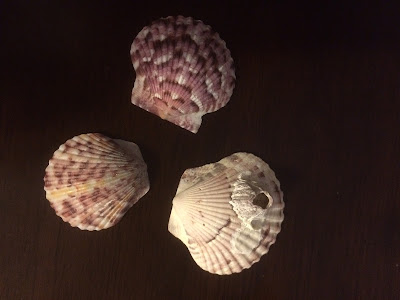
Scallop shells.  Note the many different grooves and ridges all connect at one central point.  Such is life.

The tiny scallop shell's design radiated from the center bottom out to the upper edges like rays of a rising sun.  I placed the shell on the frond of an adjacent outstretched palmetto leaf.
Saw palmetto fronds exhibit the same pattern of radiating differences with connectiveness, just as with the scallop.

Both shell and frond appeared similar in so many ways.  Strikingly, the scallop had many grooves and ridges, each individual and each coming together at one point.  The frond too possessed many individual, radiating leaf parts all joining in the center.  'Learn this', the shell and frond spoke to me in a figurative manner.  There are many paths in many different directions.  But they all lead to one common ground.  Separate differences coming together make the whole.  Alone they are isolated.  Coming together they make a whole.

And so the answer to my questions of why, what and how was answered then by objects appearing to be so simple but in reality so complex.  Like the cypress trees or snapping shrimp the shell and frond at first glance looked common and insignificant. Yet they spoke volumes to me, for in each separate, outwardly radiating shell groove or plant frond was a story of how there are many paths, many answers, many traditions and they all lead to one point.

The meaning of life for me is not about adhering to the 'do this' or 'do that' or 'don't do this or that'.  I never could find life's answers in a prescription or a book or some person's ramblings.  The words of one doctor or preacher or politician or philosopher do not hold answers for me.

Rather all the different - sometimes small, very small - things and people and paths and traditions and experiences in life coming together make the complete whole.  Just like the many grooves and ridges in the scallop shell.  Just like the fronds pointing in different directions but originating from one central source in the palmetto leaf.  Just like the seemingly insignificantly tiny snapping shrimp that creates temperatures that almost surpass the surface heat of the sun on a bubble pop so loud that marine vessel sonar is stymied.

All the small and large life forms around us are so full of information and answers.  And they all coexist and inter-relate to form the perfect whole.

Life's answers don't lie in a well worn script in a book or on a computer or delivered from a pulpit.  The answers lie in the complex web of varying and different flows and forms of life and cosmos around us.  Each differing but coming together in a group sustaining whole.

Some information can never be gleaned from words or books.  Some times you need to spend time in nature taking in the infinite amount of answers bundled up in the simplest wildflower or shrimp or fossilized shell.

Looking for answers?  Spend time in the great outdoors!
Hammock therapy is better for me than couch therapy.


Friday, October 16, 2015

Back to Blogging about Aortic Dissection Life

I've been quiet for a long time now.  Mostly because I get into writers funk brought on by depression from take your pick:

  • myriad of medications
  • fatigue
  • life gets in the way
  • blah blah blah
Aorta Dissection Life - Bandaids and Compression Socks

But in the interim I've had a lot of post ideas develop in my mind.

Try as hard as I do to forget them- which is actually quite easy to do - they keep surfacing in the back of my mind during 2 A.M. insomnia episodes.

So I thought I'd start trying to bring this blog site back up to date.

And just writing this little bit is a way to jump start the whole blogging process once more.

Look for some of my thoughts later this weekend.

But for now, today has been the typical Dissection Life morning.  I wake up and my thumb is still bleeding a little from the small knife nick I gave it in the kitchen day before yesterday.

Stumble to the bathroom to find bandaids.  Cant get the bandaid cover paper off the bandaid.  Finally get the paper cover off now the entire bandaid is bloody.  Rinse off the bandaid now the bandaid won't stick.

Repeat the above paragraph until I get a clean, non-bloody bandaid on.

In the kitchen fix a cup of Starbucks Via Instant Columbian.  So good to smell the aroma.

Carry compression socks to living room to put on.  Sit on floor because I've made a commitment to sit on the floor each time I put on socks or shoes so I can always stay in enough shape to get up off the floor.  If I sit on the floor and then stand back up ten times a day then this is equivalent to 3,650 squats a year.  Ten a day is much easier.

Bummer!  Compression socks are inside out!  It is hard enough to put them on right side out.  Oh feck!

Reach my thumb into the inside out part of the compression socks, which is really the right side out part and try to pull them back out to the appropriate side out but them won't budge.  Double feck!!

Yank on the inside out sock tip and the bandaid rips off.

Back to the band aids in the bathroom.

Lol!  Just another Dissection Life day!

More tomorrow!

Tuesday, June 23, 2015

Urban Agriculture DIY Low Cost Raised Vegetable Bed for Urban Core Sustainability

Our yard soil is well drained sand.  Gardening in Florida sand is difficult to say the least.  It does little good to water with a hose because the moisture disappears almost immediately.

Even our native horsemint, Monada pnctata wilts on a daily basis here in the dry, hot sandy soil.
Here in Palm Coast the Atlantic winds are constantly blowing hot, dry air across our yard.  Even the native plants such as spotted horsemint, Monarda punctata and black eye Susan, Rudbeckia hirta, are all wilting by the time four o'clock in the afternoon arrives.

I wanted to do some serious gardening this year without spending hundreds of dollars each month trying to keep the impossible to irrigate sandy garden patch, irrigated.

The idea of a raised bed filled with organic matter to hold the moisture stayed in my thoughts as I considered different gardening bed design options.

But raised beds can be expensive.  After totaling my first materials list for a 8' long by 4' wide by 3' deep bed, I was shocked at the price tag. No way will I build this.  I'd be better off financially by buying organic veggies from Publix, I told myself.

The affordability component of sustainability and urban agriculture is crucial for long term success.  So rather than spend the four hundred dollars it would cost to buy nice straight cedar boards and stainless hardware, I spent the morning looking at what few scrap materials were stacked neatly (lol) in the backyard.

I soon found out constructing a raised growing bed for pennies can be easily accomplished.

After gathering about thirty metal stakes and laying them out in the shape of a rectangle, I retrieved the big hammer from the garage and enlisted my tall teenager into tapping them into the sandy ground about one meter apart.

Soon the rough outline of the garden bed appeared above the sand.

Recycled stakes and old chicken wire form the perimeter of the urban agriculture raised planting bed
Once the stakes were in place, reused chicken wire was stretched and attached to the stakes with ties fashioned out of copper strands from an old, worn out extension cord.

With the 'frame' in place the next step was to line the interior of the bed with saw palmetto.  Our back backyard is filled with saw palmetto.
Urban agriculture raised bed lined with saw palmetto fronds

Saw palmetto, Serenoa repens, grows broad and fibrous fan shaped leaves approximately two to three feet in diameter.  Saw palmetto, besides being a Florida native plant, provides a variety of ethnobotanical benefits from fiber from the leaves, nectar from the flowers and medicine from the berries.
Urban agriculture planting bed uses saw palmetto fronds as an organic bed liner.

We placed three layers of fresh cut, green saw palmetto fronds inside the chicken wire and over the bare soil.   The fronds served two main purposes of; A. keeping the dirt from spilling out of the chicken wire, and B. slowing down any vertical drainage of water from the bed into the thirsty sand below.
Urban agriculture planting bed layered with leaves and sandy soil

Urban agriculture planting bed layered with leaves and sandy soil
 Once the saw palmetto fronds were in place, sandy soil from our old garden beds was added over the fronds.

With four inches of soil over several inches of fronds in the raised bed, we then added a foot of decomposing oak leaves, another four inch layer of sand-dirt and them more leaves, then more dirt.

Soon our bed was a full three feet full of sand and decomposed leaf compost.  We watered in the bed and allowed the organic planting mass of leaves and dirt to settle for a week.

Urban agriculture planting bed, scatter seeds and water.
Judy always keeps a chest full of seeds in the house, so when it came time to plant I had fun selecting a variety of summer vegetables.  Seed packets are usually so pretty and jump-start a gardener's imagination.

I simply scattered the seeds across the top of the raised bed and watered them in.

The enormous amount of organic matter in the bed holds moisture, keeping the planting area from drying out like the sand in our backyard.
Urban agriculture raised bed, seeds soon sprout and vegetables grow
Earth worms have already made their way to the raised bed and in turn the robins and mockingbirds frequent the area daily in search of any raised bed bugs.

One of the most important keys to a successful urban core agriculture project are pollinators.  The native Rudbeckia hirta, best known as 'black-eyed Susans' grow around the perimeter of the bed, loudly calling the pollinators, attracting them en masse and in turn facilitating the development of many yummy veggies.
Urban agriculture raised bed with pollinator plants, Rudbeckia hirta
The bed is the perfect compost pile.  The raised growing area also keeps the plump, furry saw palmetto rabbits from grazing on our veggies.

Growing plants in the rich, deep leaf humus is so much easier than in our well-drained sand.  Water tends to stay inside the frond lined bed instead of draining away quickly down into the surgical aquifer.
Urban agriculture raised bed easily grows organic vegetables

Urban agriculture raised planting bed with three week old squash plants and lots of baby squash

Urban agriculture raised bed plant roots and saw palmetto fronds hold soil in place, eliminating need for side boards.
Though I first considered lining the outside of the planting bed with boards, I can see now that an outside covering is not necessary.  The root architecture of the plants weaves into the chicken wire forming an impenetrable vertical wall.  In fact, flowers and veggies are growing out of the side, forming an edible and blooming living wall of sorts.

Urban agriculture can be effective without becoming expensive.

Recycling, reuse and use of locally available materials are key.  As is a little imagination.  Just hold a packet of veggie or wildflower seeds in your hand and look out back and think - 'in just three weeks'....