
Wednesday, April 6, 2022
Florida Hemp IPM, Beautyberry Organic Pest Control
Callicarpa americana cuttings after one month. Beautyberry is an extremely important integrated pest management #ipm #nativeplants team member here. Mosquitoes & pests flee BB. #floridahemp #hemp #850hemp #arendellhillnursery #freshfromflorida https://t.co/WN08aq6tCB
Sunday, March 20, 2022
Spring Equinox is Here!
Soil temp in the organic sunny hemp bed is 68F/20C. Needs to warm up a bit. #hemp #floridahemp #freshfromflorida #organic #cannabis

Thursday, March 10, 2022
Earwigs (Dermaptera) and Florida Organic Hemp Cultivation
Are earwigs friend or foe in the hemp cultivation area?
Earwigs are omnivores, and they are usually hungry. From my observations across Arendell Hill Nursery, earwigs prefer aphids and other small insects.
 |
| Florida Organic Hemp Pest Management, Earwigs belong to the insect order Dermaptera |
The answer may be both! Earwigs can be a friend but also a foe to the organic hemp farmer and crop.
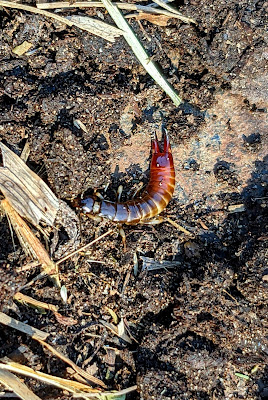 |
| Florida Organic Hemp Pest Management, Earwigs have 'pinchers' also called 'cerci' attached to the rear of their abdomen |
However earwigs will also eat young, tender plant shoots, buds and leaves if there are not enough aphids, mites, insect eggs or small prey to satisfy their voracious appetites.
There are a number of earwig species and importantly, many are primarily carnivores. The earwig preference for pest insects can be beneficial to the hemp farmer and as long as there are adequate numbers of small insects for forage.
The key to integrating Dermaptera successfully into an organic hemp integrated pest management program lies in developing an understanding of earwig life cycle requirements. The hemp farmer should know what environmental conditions favor earwig population growth.
Once the hemp farmer recognizes favorable earwig growth conditions, the grower can adjust many of those factors to maintain earwig population stability, effectively avoiding population explosions while ensuring an adequate number of earwigs exist to help manage aphid issues.
Interestingly, the insect's common name 'earwig' is rumored to have been derived from a fear this bug could crawl into a sleeping person's ear at night resulting in all sorts of painful pinching. This rumor is unfounded though and earwigs generally do not bite or pinch humans.
So are earwigs desirable as an integrated pest control partner for hemp cultivation? I'd have to say a definitive yes.
As with all partnerships, successful relationships require active management of interactions and the same holds true with earwigs. An overpopulation of earwigs with not enough aphids for food will result in hemp plant bud and new growth damage as the earwigs seek out alternative food sources.
Earwig population numbers can be managed with straight forward mechanical and environmental pest control measures such as moisture control, good housekeeping and sanitary practices and regular surveillance.
The key is to have just enough earwig pest control partners.
Smart hemp cultivation site pest management can employ earwigs to hunt down and eat pesky aphids and mites.
Employing native insects and native plants as partners in organic farming can be the safest, most effective and sustainable growing approach for Florida hemp and most all organically farmed crops.
Tuesday, March 1, 2022
Organic Hemp Cultivation Pest Plant Alert, Lamium amplexicaule aka Henbit
Henbit, Lamium amplexicaule, is a purple flowered non-native groundcover with an aggressive growing habit renown for taking away native plants growing space.
 |
| Lamium amplexicaule, Henbit and Organic Hemp Cultivation |
Once established, henbit is difficult to eradicate.
There are two main species of Lamium in Florida, henbit and purple deadnettle, L. purpureum. Purple deadnettle differs from henbit visually with purple hued leaved near the plant top, or apex. Henbit also can be usually recognized by the way it's leaves directly clasp the stem.
Although diminutive, lacy in appearance and a rather pretty groundcover, henbit might be thought of as harmless yet the opposite is true. It is estimated by many ecological experts that almost half of all native plant species are in population decline due to loss of habitat as a result of competition from non-native species.
Lamium competes with native groundcovers for water, growing space, nutrients and importantly can be a host for hemp or other crop damaging pest insects, including a number of nematode species such as Ditylenchus spp., Heterodera spp., and Meloidogyne spp. along with a number of viruses (including Arabis mosaic virus) and fungal pathogens.
Controlling Lamium spp. in rowcrop cultivation settings can be difficult. This weedy plant is often thought of as an annual species however it may often behave as a biennial in Florida climates.
I prefer to help establish lyre-leaf sage, Salvia lyrata or turkey tangled frog fruit, Phyla nodiflora along with a host of much better suited native groundcovers that support beneficial predatory insects, beneficial pollinators and positive biological pest management.
Personally, if I see henbit growing in the hemp cultivation areas the plant quickly becomes a candidate for pulling and mechanical eradication/composting. Better safe than sorry when growing hemp.
Sunday, February 27, 2022
Florida Organic Hemp Cultivation and Fungi Based Integrated Pest Management
Blue oyster mushrooms, Pleurotus sp., are an important part of our Integrated Pest Management program here across Arendell Hill nursery.
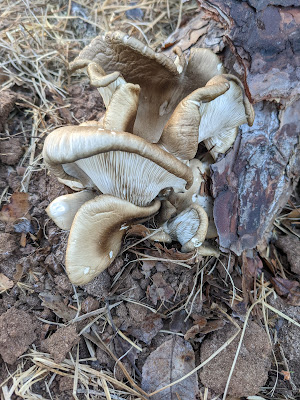 |
| Oyster mushrooms are an integral part of Organic Hemp IPM program here at Arendell Hill |
Oyster mushrooms help clean stormwater and detoxify any contaminants that find their way via wind, rain or drift into the garden.
Interestingly, many fungi are capable of absorbing complex carbon chains found in the environment and converting them into carbohydrates for their own growth.
Mycoremediation, as the mushroom's decon process is commonly referred to, has been shown to be an effective way to support hemp cultivation area cleanliness while helping to ensure pure surface water.
Additionally, mycobooms, which are a mixture of hay and fungal spores can be used to contain and cleanup most types of contamination spills and can be an effective pollution control management tool.
Because our cultivation areas are organically managed and free of pesticides and herbicides, the oysters in our garden are usually free of contamination and may also end up in our kitchen for dinnertime sauteing.
For decades, fungi have been successfully used in many organic-focused integrated pest management programs. Additionally, mushrooms are fun to grow. Cultivating oyster mushrooms as a companion species to hemp is just one, but an important part, of Arendell Hill's organic hemp integrated pest management program.
Thursday, February 24, 2022
Millipedes, A Beneficial Integrated Pest Management Partner for Florida Hemp Cultivation
Millipedes are an important #IPM partner for our #hemp cultivation plot.
They do a marvelous cleanup job here at Arendell Hill, mulching up leaf litter and then fertilizing the soils with plenty of organic droppings.
Millipedes help control fungal and algal explosions by keeping damp leaf debris accumulation to a minimum amount. These small arthropods are constantly foraging here. I see them occasionally during the day but at night they are visible (with a UV light) almost everywhere across the ground.
Millipedes have 2 legs per segment side while centipedes have one.
Consider your cultivation area lucky if you are fortunate enough to have a substantial population of these beneficial arthropods.
Wednesday, February 23, 2022
Sow Thistle & Hemp Cultivation
Pest plant (weed) alert!
 |
| Sow Thistle, Sonchus sp., an invasive weed in the hemp cultivation area |
Sow thistle, Sonchus sp., is native to Eurasia and Africa but can be found across Florida in yards, farms and in the woods.
Each plant can produce up to 10,000 seeds and each seed can last many years, laying dormant until the right conditions come along. The young leaves can also be cooked as potherb greens.
The problem with sow thistle is that the plant is so prolific and hardy with it's fat tap root that sow thistle takes away habitat from native flora (botanical adverse possession) and can crowd out hemp plants in the cultivation area.
I just mow or weed eat sow thistle down before flowers form, preventing the plants from reproducing, keeping them out of the garden.
Often mistaken for dandelion, sow thistle is in the aster family. Both have basal rosettes yet the leaves are considerably different. Aphids are often attracted to sow thistle.
Sunday, February 20, 2022
Surinam Cockroach and Organic Hemp Cultivation
These photos are of the Surinam burrowing cockroach, Pycnoscelus surinamensis, also known as the greenhouse cockroach, an exotic pest insect originally found in south to southeast Asia.
 |
| Surinam Cockroach, a potential key pest for hemp plants |
Though preferring tropical or subtropical climates, the Surinam cockroach is now recognized to thrive in temperate zones also.
Surinam cockroach is often considered an economic risk pest especially in greenhouse settings. This roach is susceptible to solar desiccation and usually ventures out at night, where in the greenhouse it has been documented to eat tender buds and plant tips.
Surinam cockroach is one of the few insects that can commonly reproduce through female cloning without male sperm. This process is referred to as parthenogenesis. Studies have shown that multiple generations of the Surinam cockroach exist in the same location without the presence of even one male.
 |
| Surinam Cockroach in the hemp garden |
Because the Surinam cockroach can damage tender buds and plant tips, any roach favorable habitat such as piles of wood, trash or stacks of nursery pots should be cleaned and either disposed of or organized appropriately.
I try and encourage bird presence in areas where I've identified this pest insect as birds will prey on this insect.
Understanding the preferred habitat and taking steps to integrate predatory management approaches in the hemp cultivation plan can lead to a successful Surinam cockroach control program.
Saturday, February 19, 2022
Organic Florida Hemp Cultivation, Identifying Crop Pests with UV Light
Evolution has equipped many insects with a sublime ability to camouflage themselves.
Insects may stay hidden under daylight wavelengths too.
 |
| Pest Insects may remain hidden under most light wavelengths as shown here on a greenhouse lemon balm plant. |
Insects may stay hidden under daylight wavelengths too.
 |
| Evolution has equipped many insects with effective camouflage appearances |
Interestingly and importantly for the grower, ultraviolet lights used at night that produce illumination in the wave range between 300nm and 400 nm can often illuminate otherwise camouflaged pest insects.
 |
| UVb light can assist in identifying the presence of crop pests |
Pest reconnaissance of crops in cultivation areas including those in row plantings and in the greenhouses can be conducted at night often with successful results for insect identification efforts.
Insects, plant damage, and even chlorophyll containing algae and cyanobacteria can be identified at night by examining plant stems, leaves and flowers using UVa and UVb lights. Many insects react to UV light through florescence of phosphors in their exoskeletons. Chlorophyll on the other hand under UVb absorbs all light waves except for 'red' wavelengths which are reflected back. Algae growing across cultivation areas can easily be identified using UVb light.
Not all insects that glow under UV light are considered pests. Potentially beneficial organisms such as stick insects, millipedes and even anoles can be easily spotted using UVa and UVb flashlights.
My personal favorite light for night insect surveillance are lithium rechargable, well built LED units with UVb filters.
Though the grower may not spot all pest insects on their greenhouse or row crop plants, chances are any key pest infestation can be quickly identified.
Friday, February 18, 2022
Warrior Beetles and Organic Hemp Cultivation
Warrior beetle. Good insect for hemp cultivation.
Warrior beetles are excellent predatory pests to have in the Florida organic hemp cultivation area.

Pasimachus sp., plays an important role in our organic integrated pest management program.
Pasimachus has a never ending appetite for pest insects in the garden! What a great predatory beetle.
#IPM #organic #hemp #Florida #Floridahemp
Florida Hemp Cultivation Bed Preparation
Hay arrived yesterday for spring gardens.
Hemp cultivation is made easier with a quality mulch such as organic hay.

Excellent quality organic hay is useful as a mulch in the hemp garden, usually a bit more pest free than our mulched leaves.
We do mulch and reuse our leaves too however we find hay to be a favorite for maintaining soil moisture, keeping soils less compacted and not as hot, for buffering pH and contributing to overall organic matter content.
Hay is easily to spread, lightweight and readily & sustainably available on a local basis.
Sunday, February 13, 2022
Planting Bed Prep for Spring Organic Hemp Crop
We began breaking soil and adding mulched organic matter from the Arendell Hill site in preparation for spring hemp planting.

In addition to the mulched organic leaf litter bird feeder platforms are now added to the cultivation area. Arendell Hill is a favorite foraging location for all types of birds, from large raptors to small songbirds.
We enlist the birds to protect our hemp plants. Songbirds work efficiently in eating certain pest insects such as caterpillars, beetles and bugs.
Planted around the base of the bird feeders are native plants and wildflowers such as spotted bee balm, Monarda punctate. M. punctate attracts predatory wasps and other beneficial insects such as the assassin bug. Predatory wasps and assassin bugs control many cannabis crop pests through a variety of methods.
Arendell Hill Nursery employs a complex and highly integrated matrix of natural and organic pest control approaches. An understanding how the cultivation site's ecosystematics function allows the grower to take advantage of each and every biological, meteorological and geological variable for growing amazing quality CBD and CBG rich flowers.
Friday, February 4, 2022
Asian Lady Beetles and Organic Hemp (Cannabis) Cultivation
I've been seeing Asian lady beetles, Harmonia axyridis, almost everywhere lately (early February 2022).
 |
| Asian Lady Beeetle, Harmonia axyridis, exotic insect and Organic Hemp Cultivation |
Though they do little direct harm to cultivation (they do eat aphids) these exotics can cause serious nuisance issues around plants and especially in buildings. They certainly are not my preference for natural IPM across the hemp farm as they compete with native lady beetles.
 |
| Asian Lady Beetles on pepper plants at a local Tallahassee Nursery |
Mostly, I tend to ignore them because they do not rise to the nuisance level of a 'key pest'. Beware though the Asian lady beetles can bite humans and they do leave a yellowish staining, foul smelling excretion when congregating in and around building windows.
 |
| Asian Lady Beetles should be monitored however across the hemp farm for potential damage |
All in all, I'd rank them as a low species of concern, one worth notation (I certainly would not want too many of these insects foraging in plant flowers and buds) but not worth immediate worry over, across the hemp farm.
Monday, January 31, 2022
January Fungi, Florida Hemp Cultivation Integrated Pest Management
Fungi play an important part in our integrated pest management program. Tracking fungi appearance and location is an important part of the organic matrix at Arendell Hill. January fungi under live oaks, coral fungi, Ramaria sp. considering R. formosa. Leon County
Tracking fungi across Hemp Cultivation area helps us understand the role fungi play in pest control

Friday, January 21, 2022
Organic Hemp Cultivation, Pests in the Leaf Litter
Caterpillars, when their population numbers grow unchecked, can devastate a hemp or cannabis crop in a matter of hours.
 |
| Organic Hemp Cultivation Pest Control, Managing Eastern Tent Caterpillar Web Masses |
Last year there was a significant population bloom of the Eastern Tent Caterpillars, Malacosoma americanum in east Leon County. The thick, web masses began to appear during spring and continued to grow in size through summer into autumn, finally falling to the ground with winter winds and rainstorms.
Here across Arendell Hill we counted thousands of the Eastern Tent Caterpillars over the course of the growing season. They would crawl down from the safety of their web nests, across the ground and find any number of plants, including trees, to feed on, devouring blossoms, buds and leaves alike.
Our Myers lemons were hit especially hard from hungry caterpillar appetites.
Arendell Hill Nursery was not the only place infested with an over-population of the M. americanum, I encountered significant numbers of these caterpillars all across the city. Park benches placed around our local library green space were often covered in masses of M. americanum.
As autumn leaves fall, so often do Eastern Tent Caterpillar eggs. Their eggs are usually laid en masse around twigs, at the base of leaves. Winter storms often blow these egg masses to the ground where they become mixed with leaf litter and await warmer weather before hatching.
An important part of any organic based integrated pest management program is prevention. One way to control on-site Eastern Tent Caterpillar populations is through daily ground surveillance. Make it a habit to be on the lookout for fallen egg or web masses. When you come across the eggs or webs on the ground, pick them up, place in a trash bag, tie securely then drop the bag into the garbage can for landfill destination pick up.
Chances are the web masses may not actually contain eggs but chances are also they may.
Eastern Tent Caterpillar egg and web masses blend in well with fallen leaf litter. With a little practice one can soon find these well camouflaged potential future pest masses and begin disposing of in a convenient refuse container.
Much of the time the most successful organic pest control practices spring forth from common sense practices and an understanding of pest insect and bug life cycles.
Controlling Eastern Tent Caterpillars before they hatch is much easier than battling hoards of hungry pests.
Monday, January 3, 2022
Leaf Footed Bugs, Friend or Foe to Organic Hemp Cultivation?
Leaf footed bugs, Leptoglossus spp., are larger size, primarily vegetarian insects, that feed on seeds, vegetables, plant matter and fruit with their cutting and sucking proboscis-like mouth.
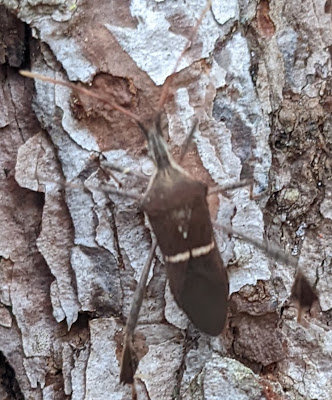 |
| Adult leaf footed bug, Leptoglossus spp. on a pine |
Named for their leaf-like feet appendages, Leaf footed bugs are polyphagous and will feed on hemp plants, tomatoes, fruit, squashes and other garden crops when available. During months when crops are not readily available they will feed on plants and seeds, seeking out 'weedy' areas across the hemp cultivation site. These insects may be often seen on hemp and cannabis plant stems, buds and leaves.
Adult leaf footed bugs can fly long distances. I usually see them hiding, over-wintering, in wood piles during cooler months. They lay their eggs during spring and summer and may produce several generations in a year.
 |
| Leaf footed bugs can damage hemp and vegetable crops |
Birds, spiders and predatory wasps, possibly the sand wasp, are all natural enemies of leaf footed bugs and help keep their population numbers managed.
Though not the worst pest insect to the organic hemp or vegetable grower, they can inflict damage to both plant and flower. In a well balanced horticultural ecosystem they can provide forage to other insects and wildlife and as such provide a certain level of food chain importance.
Certain species of thistles seem to attract leaf footed bugs as well as citrus. Thistles are also quite beneficial in their supporting relationship to useful pollinators, birds and other natural pest predators. Native plant species such as milkweeds and mints are an important tool as they attract leaf footed bug enemies, such as predatory wasps.
A organic based integrated pest management approach to managing leaf footed bugs on the hemp farm should include;
- native plants that attract predatory wasps
- plenty of bird feeding opportunities
- removal of unnecessary wood and debris piles
- spider habitat
- sighting notations in daily grow journal.
As long as the leaf footed bug population numbers are not out of control, their occasional presence should not be a priority concern to the hemp grower. They can be however, a dynamic variable in the hemp garden's ecosystematic matrix and as such their presence should be recognized by the grower in the daily journal.
Saturday, January 1, 2022
Assassin Bugs, An Organic Hemp Cultivator's Helper
Assassin bugs are a great pest control partner to have when growing hemp organically.
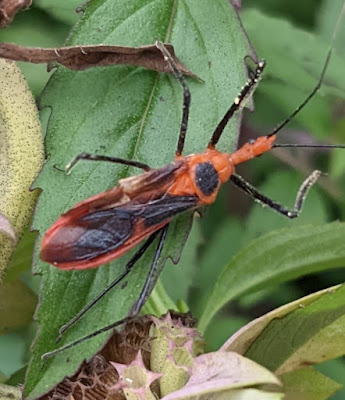 |
| Milkweed assassin bug, Zelus longipes, is an important part of an organic hemp pest management program |
Members of the Reduviidae insect family, assassin bugs are the perfect hemp (or for that matter any organically grown garden plant) pest predator. They inject a digestive secretion into their prey and then suck out their prey's body fluids through a straw-like snout. Assassin bugs favorite hunt includes; aphids, beetles, caterpillars, leafhoppers and even bees and flies.
Included with the Assassin bugs in the Reduviidae family are the closely related ambush bugs (subfamily Phymatinae), wheel bugs (Harpactorinae) and kissing bugs (Triatoma spp.). Some Reduviidae can and will bite humans. As with any insect bite, a bite from these insects may be painful and proper first aid should be administered.
Foraging across the garden, the assassin bug's appetite is voracious and non-discriminatory, devouring both bad and beneficial insects. But on the whole, the assassin bug is welcomed as an eat all pesty pest bug control partner.
 |
| Milkweed assassin bug, Zelus longipes, foraging on Monarda punctata |
The key to managing the assassin bug in the hemp growing area includes the use of nectar producing native plants the bug is naturally attracted to. Strategic plantings of spotted bee balm, milkweed, goldenrod, mountain mint and other wildflowers can direct assassin bug's attention into those areas needing urgent pest control attention.
There are about one hundred fifty species of assassin bugs. One of the most common assassin bugs seen in the garden is the Milkweed assassin bug, Zelus longipes.
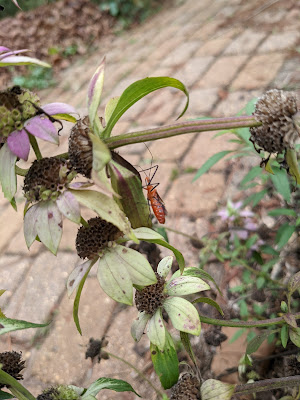 |
| Milkweed assassin bug, Zelus longipes, have a never ending appetite for hemp cultivation pests |
Though assassin bugs may look wicked, they can help the organic hemp grower keep pest insects to a minimum.
The native plants mentioned are known to attract assassin bugs looking for high-energy packed nectar. Organic hemp integrated pest management will always use assassin bug attracting native plants around growing areas, either as permanent plantings or in movable growing containers for spot pest control.
The organic hemp nursery is a dynamic site, rich in complex ecosystematic matrices. The relationships between native wildflowers, the Reduviidae family of insects and the hemp farm are important for the grower to understand.
Welcoming these colorful but alien looking bugs is another key component in a successful organic hemp growing program.
Thursday, December 30, 2021

Raptor Perches for Organic Integrated Pest Management
Arendell Hill has two new raptor perches now and we hope the birds of prey make themselves at home on the fourteen feet tall bird stands. These raptor perches are inexpensive and easy to build, and can be moved as necessary to different locations in the future.
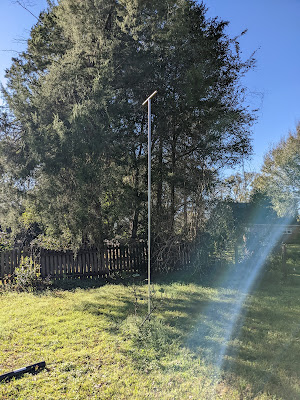 |
| Organic Hemp Cultivation incorporates birds as pest control partners. Here is one of two raptor perches at Arendell Hill. |
The horizontal perch section is a 1 1/4" diameter wooden dowel and is fastened to the vertical support pole.
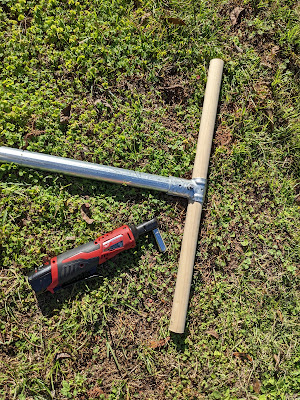 |
| Raptor perch, horizontal wooden dowel attached to vertical metal support pole |
The materials list is for two perches:
- Three 10' galvanized chain link fence top rail posts for vertical support
- One 4' in length 1 1/4" diameter wooden dowel for horizontal perch
- two galvanized chain link fence 1 3/8" T connectors
 |
| Raptor Perch materials, IPM for Organic Hemp Cultivation |
The tools I used to construct the raptor perches included; a fence post hammer (so much easier than a sledge hammer), level, portable ratchet, metal screws and portable screwdriver.
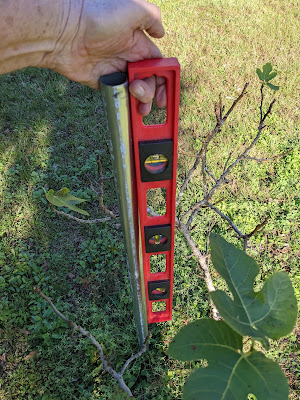 |
| Raptor perch support pole should be plumb vertical |
I cut one of the three ten foot top rail posts in half and drove the smaller diameter end into the ground using the pipe hammer approximately three feet or depending on the soil composition deep enough to keep the five foot pipe section sturdy.
Using the level I made sure the support pipe I was driving into the ground was vertically plumb, straight up and not skewed or leaning to the side.
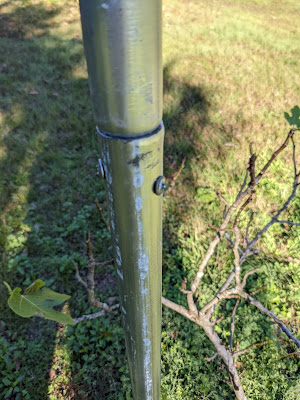 |
| Raptor perch support poles are fastened together and secured with metal screws |
Once the support pipe is hammered into the ground then the small diameter end of the uncut ten foot six inch top rail pipe with the wooden dowel attached are placed into the support pipe. The two vertical pipes are fastened together with two metal screws. A pilot hole can be drilled for the two metal screws.
Because the raptor perch support post is not permanently anchored in concrete, it can be moved depending upon hawk or other raptor flight patterns. Disassembly is easy; unscrew the two metal screws, remove the longer top rail with perch attached then pull up the support pipe hammered into the ground.
Birds of prey such as both the red-shoulder and red-tail hawks, swallow tail kites, sharp-shinned hawks, Cooper's hawks, broad-winged hawk, Swainson's hawk, Screech owls, Barred owls, Great horned owls, Barn owls, Peregrine falcons, Kestrels and even vultures scour hemp cultivation areas for rodents and other vermin.
Rats, mice and other vermin will eat hemp and cannabis plants and flower buds for food and also for the phytochemical action upon their bodies. Once a vermin devours enough cannabis flower they make an easy target for a nearby bird of prey.
Raptor perches afford the birds of prey a reason to stop and check out the hemp farm. For the grower, hawks and owls are an important part of the beneficial organic pest control team.
Monday, December 27, 2021
Rooting Bee Balm Cuttings Organically, Hemp Cultivation and Pest Control With Wasps
Monarda punctata, spotted bee balm, is a native wildflower here in Florida and an important pest control plant at Arendell Hill. Spotted bee balm attracts beneficial pollinators and wasps and beetles, such as native ladybugs. Spotted bee balm also serves as a decoy, diverting pest bugs away from hemp crops. Seeking out Monarda's nectar, potential pest insects soon find themselves consumed by lady beetles, dragonflies and other insects foraging in the bee balm.
 |
| Organic Hemp IPM Incorporates Spotted Bee Balm, Arendell Hill Nursery |
December, with its cooler and shorter days here in Florida is the perfect time to root cuttings. I cut six to eight inch healthy stem tips from a thriving bee balm plant and place the cuttings in a 72 count seed tray filled with a mixture of perlite, vermiculite and rockwool. Cuttings are placed in a shade house and misted every twenty minutes for ten seconds.
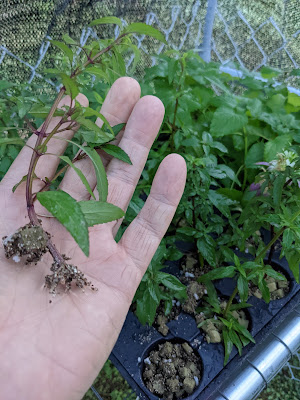 |
| Organic Pest Control Plants; Monarda cuttings root easily without hormones |
That is it. In two to three weeks the cuttings are rooted and ready to be potted up into four inch pots filled with an organic potting mixture.
Moreover, a very important benefit of incorporating Monarda punctata into a native plant based organic pest control management plan for the hemp garden is the plant's ability to attract the predatory sand wasps! Sand wasps are highly effective at controlling hemp damaging marmorated stink bugs.
A stink bug infestation can quickly devour much of a hemp crop in short time.
Fortunately sand wasps love to feed their larvae stink bugs. Sand wasps are a group of predatory wasps that include the Astata and the brightly colored Bicyrtes species. Sand wasps seek out the nectar of Monarda, mountain mint (Pycnanthemum spp.) and milkweeds (Asclepias spp). Adult sand wasps especially love to hone in on the odor of marmorated stink bugs.
Mamorated stink bugs, Halyomorpha halys, are an exotic pest native to the far east but now widespread in North America. These pests can inflict significant damage on hemp crops as well as cannabis and other agricultural plants. Yet sand wasps will kill these stink bugs and carry their bodies into tunnels in the ground to feed wasp larvae where they live during maturation.
A single sand wasp may kill dozens of stink bugs across the hemp cultivation area, greatly reducing potential pest damage risk.
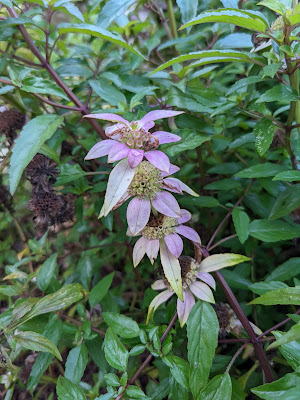 |
| Organic Hemp Pest Control involves many native plants, like Spotted Bee Balm which attracts beneficial insects |
Spotted bee balm is also one of the most carefree and easiest native plants and wildflowers to grow, requiring little if any attention while being resilient to salt, wind and drought.
Native plants are often ignored when integrated pest management programs are developed for organic hemp cultivation, yet native plants offer so many benefits to the hemp and cannabis grower. Just as Monarda punctata attracts the stink bug killing sand wasp, other native species too play host to insects, amphibians, reptiles and birds that work together as an efficient team, keeping ecosystem balanced and effectively reducing pest pressures on crops.
Subscribe to:
Posts (Atom)